
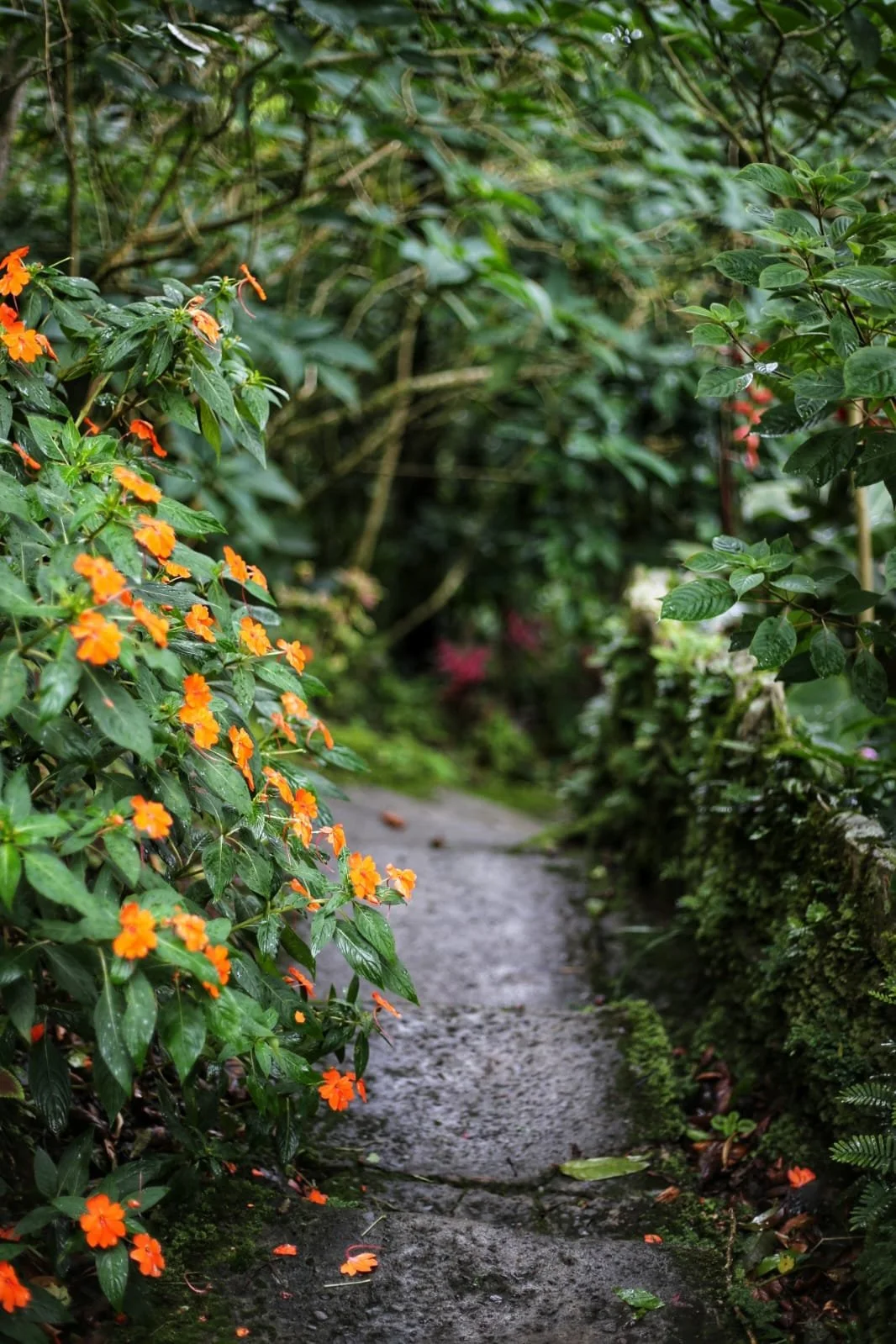
You step off the last bit of daylight and onto a narrow trail where the forest immediately feels closer than it did an hour ago. The air is cool, damp, and alive with quiet motion, like the entire landscape is exhaling around you.
At Lost and Found Hostel, night does not fall all at once. It seeps in slowly, blending shadows and mist until your headlamp becomes a small personal sunrise cutting through drifting cloud.
The hike begins gently, your footsteps softened by layers of leaves that have absorbed years of moisture. The ground feels springy, almost cushioned, and each movement carries the faint scent of earth and moss.
Your light catches the first signs of life quickly. Tiny insects appear suspended in air, wings reflecting light in flashes that vanish the moment you try to focus on them.
Then comes the realization that the forest is not quiet at all. It hums. Chirps overlap with faint rustles, and somewhere above, a branch shifts with deliberate weight.
You pause, and the forest does not. Something moves across a leaf at eye level, perfectly still until the beam reveals it. A frog sits there, glistening like it was sculpted from rain.
Further along, a lizard clings vertically to bark, blending so seamlessly with the trunk that it seems to materialize only when you lean closer.
The trail bends, and your light sweeps across the ground where shapes begin to emerge from shadow. A tarantula might be there, motionless, existing with the calm confidence of something perfectly adapted to darkness.
Every now and then, someone whispers and points, and the group gathers around a small discovery that would be invisible in daylight. A scorpion glows faintly under specialized light, revealing a secret color hidden from ordinary vision.
The forest canopy above is never fully visible, but movement there feels constant. A branch sways without wind, suggesting life that prefers not to be introduced.
Sometimes eyeshine reflects briefly from above, then disappears before certainty arrives. It might be a kinkajou, or perhaps an olingo navigating branches with quiet precision.
You continue walking, and the rhythm settles in. Step, pause, listen. The pace is unhurried because the experience rewards patience more than distance.
Fireflies appear like drifting sparks, floating between trunks in soft pulses. They do not illuminate the forest so much as decorate the darkness.
Along damp surfaces, glow worms shimmer faintly, subtle enough that you wonder if you imagined them until you see another.
The trail occasionally opens to a view where clouds pass across the moon. Light filters through moving mist, creating shifting shadows that make the forest feel almost theatrical.
An owl calls from somewhere unseen, its voice carrying clearly through humid air. For a moment, the sound becomes the center of the world.
Lower down, a quiet rustle reveals something moving through leaf litter. An opossum crosses without ceremony, focused on its own nightly business.
The realization slowly settles in that sightings are never guaranteed. The forest does not perform; it reveals itself selectively.
Yet even without dramatic encounters, the experience remains rich. Standing still, you notice the texture of air, the weight of humidity, the way sound travels differently here.
When clouds part briefly, moonlight filters through branches, turning mist into silver ribbons drifting between trees.
The walk continues for an hour, sometimes an hour and a half, but time feels stretched by attention. Distance matters less than awareness.
For ten dollars per person, the experience offers something increasingly rare: unfiltered presence inside an ecosystem that continues exactly as it always has.
Some nights offer glimpses of mammals high in the canopy, perhaps a cacomistle moving like a shadow that decided to travel.
Other nights are defined by sound alone, layered calls and movements that form an invisible map of life around you.
In Panama’s high cloud forests, darkness is not absence but atmosphere, a condition that reveals how much life prefers subtlety over spectacle.
Eventually, the trail returns you toward shelter, but the sensation lingers. Your eyes adjust slowly back to ordinary light, and the world feels sharper for it.
Every night walk is different. Some deliver sightings, others deliver stillness, and both feel equally complete once you realize the forest was never meant to be predictable.