
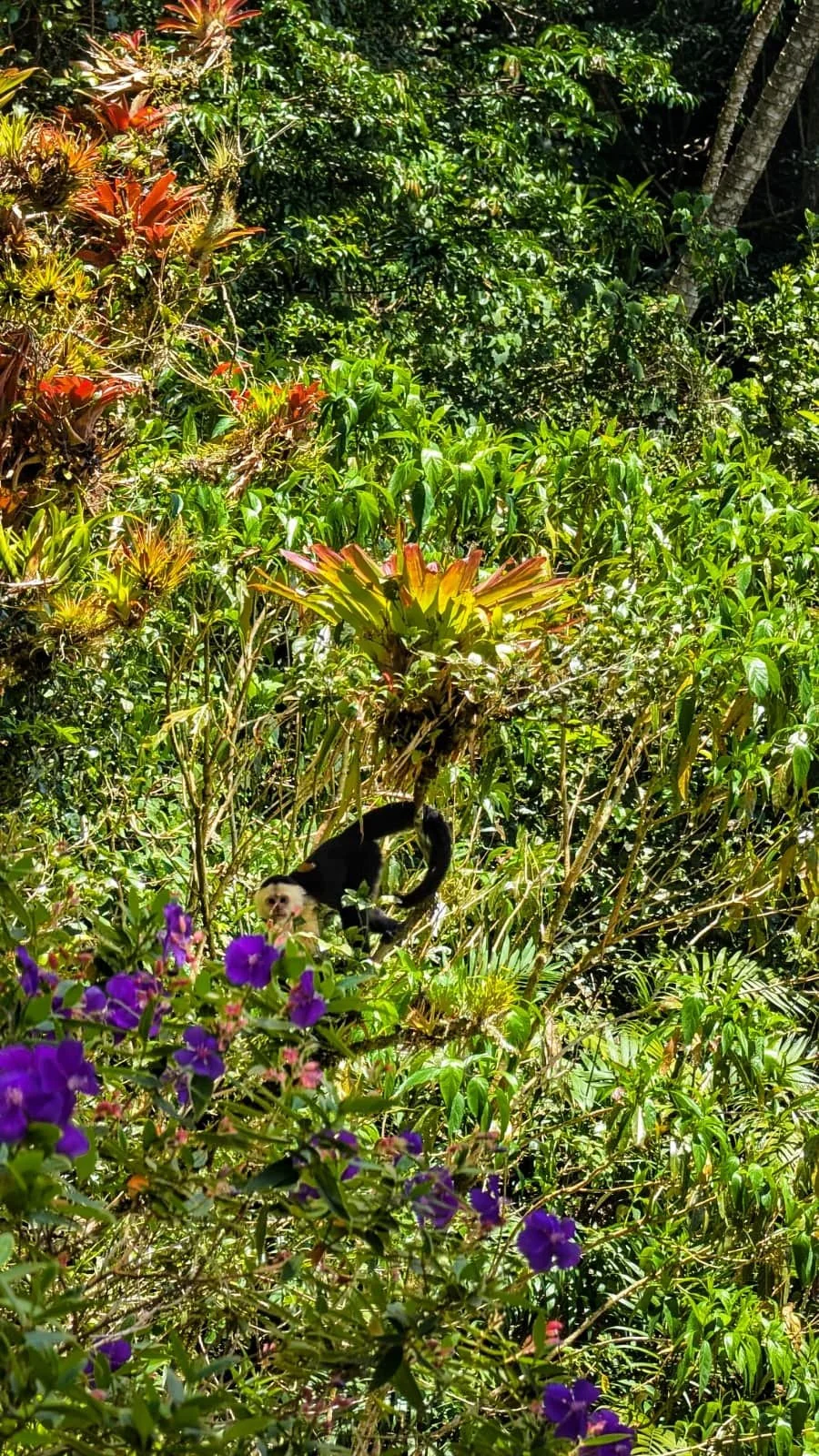
Most people exploring the rainforests of Panama spend far too much time looking at the ground. They watch for snakes crossing trails, colorful frogs clinging to leaves, or army ants marching across the forest floor. Meanwhile, an entirely different world exists high above their heads. Hidden in the canopy is a civilization of thieves, acrobats, screamers, strategists, and tiny jungle geniuses. Panama’s monkeys are not just background wildlife. They are among the most intelligent, social, and fascinating animals in the country.
For many travelers, their first monkey encounter in Panama is unforgettable. Perhaps it begins with an eerie roar exploding through the jungle before sunrise. Maybe branches begin shaking violently overhead while unseen animals crash through the trees. Sometimes a white faced monkey suddenly appears near a trail, staring directly at humans with disturbingly intelligent eyes, clearly evaluating whether they might have food worth stealing.
Panama is one of the best places in Central America to see monkeys because the country still contains large stretches of tropical forest connecting North and South American ecosystems. The nation acts as a biological bridge, allowing species from both continents to thrive. Dense rainforests, mangroves, cloud forests, islands, lowland jungle, and mountain habitats all support different primate populations.
The fascinating thing about Panama’s monkeys is how dramatically different they are from one another. Some are loud enough to sound like monsters from a dinosaur movie. Others are so silent and hidden that even experienced wildlife guides rarely see them. Some spend most of their lives eating leaves and sleeping. Others behave like hyper intelligent gangs constantly plotting theft and chaos.
Scientists often describe monkeys as ecosystem engineers because they shape the rainforest itself. Every fruit eaten, every seed dropped, and every movement through the canopy influences how the forest grows. In many ways, Panama’s forests exist partly because monkeys help maintain them.
The Mantled Howler Monkey, The Jungle’s Living Alarm System
Mantled Howler Monkey are the undisputed kings of jungle noise. Their roar is one of the most extraordinary sounds in nature and often becomes one of the defining memories travelers take home from Panama.
The first time people hear howler monkeys in the wild, they rarely guess correctly what they are hearing. Visitors imagine giant predators, wild pigs, or even machinery echoing through the forest. The sound is deep, guttural, and shockingly loud. In still jungle air, the calls can carry several kilometers.
What makes this even more astonishing is that howler monkeys are not particularly aggressive or energetic animals. They are actually among the laziest monkeys in Panama.
Their leaf heavy diet explains much of this behavior. Leaves contain relatively little energy compared to fruit, forcing howlers to conserve calories. Instead of constant movement, they spend enormous amounts of time resting, digesting, and lounging in trees. A troop may remain in roughly the same area for hours while occasionally feeding and calling.
To compensate for their low energy lifestyle, evolution gave them specialized vocal anatomy. Enlarged throat bones act like natural amplifiers, creating the booming roar that makes them famous. Their calls help establish territory and avoid direct fights with neighboring groups. Instead of wasting energy battling, rival troops essentially yell at one another from long distances.
Interestingly, howler monkeys are among the few New World monkeys with fully prehensile tails. Their tails are so strong they can support the monkey’s entire body weight. Watching one hang effortlessly from a branch by its tail while lazily eating leaves looks almost unreal.
Despite their size and loudness, howlers are surprisingly peaceful. They often tolerate close observation and may simply stare calmly at humans from the canopy. Their facial expressions sometimes appear oddly thoughtful, almost philosophical.
Many Panamanians living near forests grow so accustomed to howler calls that they use them almost like natural clocks. In some rural regions, the jungle literally wakes people up before sunrise.
Howler monkeys are excellent swimmers compared to many primates. On islands and river systems, they occasionally cross water surprisingly well. Scientists believe some island populations may have originally arrived by swimming or rafting naturally across flooded areas.
Another fascinating fact is that howler monkeys possess color vision similar to humans in some populations. This helps them distinguish young nutritious leaves from older tougher ones.
The best places to see howlers in Panama include Soberanía National Park, Bocas del Toro, and many Pacific coastal forests where their calls echo through the trees every morning.
The White Faced Capuchin, The Criminal Mastermind of the Rainforest
White Faced Capuchin are arguably the smartest monkeys in Panama and possibly the most entertaining wildlife travelers encounter.
Everything about capuchins feels intense. They move constantly, investigate everything, and display endless curiosity. Unlike slow moving howlers, capuchins rarely seem relaxed. Their entire existence appears powered by caffeine and criminal ambition.
These are the monkeys most likely to rob tourists.
Throughout Central America, capuchins have developed legendary reputations for stealing food, opening bags, snatching sunglasses, and causing general chaos around humans. In some tourist areas they have become astonishingly bold. Experienced guides often warn visitors to guard their belongings carefully because capuchins quickly learn which humans are careless.
Part of this behavior comes from their incredible intelligence. Scientists studying capuchins have discovered advanced problem solving skills, tool use, social learning, and even evidence of cultural traditions passed between generations. Some populations use rocks to crack nuts or manipulate objects in surprisingly sophisticated ways.
Capuchins possess large brains relative to body size, and their social systems are extremely complex. Troops contain intricate hierarchies, alliances, and rivalries. Individual monkeys remember relationships and social status within the group.
Watching a troop move through the canopy feels almost military. Scouts search ahead while others forage, groom, or play. Young monkeys wrestle constantly while adults remain alert for predators and opportunities.
Capuchins are omnivorous opportunists. Fruit forms much of their diet, but they also consume insects, frogs, crabs, bird eggs, lizards, and small mammals. Some even wash food in water before eating it, a behavior once thought unique to humans and a few other species.
One of the strangest facts about capuchins is their fascination with strong smelling substances. Researchers have observed them rubbing crushed insects, citrus, and plants into their fur, possibly as insect repellent or social bonding behavior.
Capuchins are also notorious pranksters within their own troops. Young individuals steal food from each other constantly and test social boundaries through play fighting and teasing.
In Panama, they thrive in a wide variety of habitats from coastal forests to islands and mainland jungle. Around places like Coiba National Park, capuchins are often among the easiest monkeys to observe.
Yet despite their adaptability, capuchins can become dangerously aggressive when tourists feed them. Human food alters their behavior and increases conflict. A monkey that begins as cute and curious can quickly become territorial and unpredictable.
Geoffroy’s Spider Monkey, The Olympic Athlete of the Jungle
Geoffroy's Spider Monkey are perhaps the most visually impressive monkeys in Panama. Watching spider monkeys move through trees can feel almost impossible from a physics perspective.
They are built for speed, balance, and aerial movement. Long limbs stretch dramatically between branches while powerful tails function almost like extra arms. Unlike most monkeys, spider monkeys have reduced thumbs, allowing hook like hands perfectly adapted for swinging through the canopy.
Their tails are extraordinary. The underside near the tip is hairless and packed with nerve endings, creating an incredibly sensitive gripping surface. Spider monkeys can hang entirely by their tails while reaching for fruit with both hands.
Among Panama’s monkeys, spider monkeys are probably the most graceful. They glide through the forest canopy with fluid elegance while other species crash, leap, or stumble comparatively clumsily.
Spider monkeys also possess some of the most advanced social systems among New World monkeys. Troops frequently split into smaller temporary groups depending on food availability. This flexible structure helps reduce competition while foraging.
Unlike noisy howlers, spider monkeys often communicate with surprisingly subtle vocalizations including whinnies, barks, and squeals. However, when alarmed they can become extremely loud and chaotic.
One fascinating detail is that spider monkeys are obsessive fruit specialists. They rely heavily on ripe fruit and travel enormous distances searching for it. Because of this, they play a critical role in rainforest seed dispersal. Some tropical tree species depend almost entirely on large animals like spider monkeys to spread seeds effectively.
Spider monkeys are also among the most emotionally expressive primates in Panama. Their facial expressions and body language often appear startlingly human. Mothers form particularly strong bonds with offspring, and juveniles remain dependent for long periods.
Unfortunately, spider monkeys are also among the most vulnerable monkeys in Panama. Because they require large areas of healthy forest and reproduce relatively slowly, habitat destruction impacts them severely. Hunting pressure in some regions has also reduced populations.
Remote forests like Darién National Park remain some of the best places to encounter them.
Geoffroy’s Tamarin, The Tiny Hyperactive Survival Expert
Geoffroy's Tamarin are among the smallest monkeys in Panama, but what they lack in size they compensate for with speed, intelligence, and pure nervous energy.
Tamarians seem permanently caffeinated. They dart through vegetation with frantic movements, constantly searching bark, vines, and leaves for insects and food. Unlike larger monkeys dominating the upper canopy, tamarins often occupy lower forest levels and edge habitats.
Their small size creates enormous challenges. Virtually everything in the rainforest wants to eat them. Snakes, hawks, cats, and larger mammals all view tamarins as potential prey.
As a result, tamarins evolved extraordinary vigilance. Troops maintain constant communication through chirps, whistles, and squeaks. A single sign of danger can send the entire group exploding into dense vegetation instantly.
One fascinating fact is that tamarins frequently give birth to twins, unusual among primates. Carrying and caring for twins requires significant cooperation within the troop. Fathers and siblings often help transport infants, creating strong family dynamics.
Their agility allows them to access branches too thin for heavier monkeys, opening feeding opportunities unavailable to larger species. They consume insects, fruit, nectar, tree sap, and small vertebrates.
Tamarians are also surprisingly adaptable to human altered landscapes. Some populations survive near towns and disturbed forests better than larger primates.
Despite their tiny size, tamarins are fearless mobbers of predators. Groups sometimes harass snakes or birds of prey collectively to drive them away.
The Mysterious Night Monkey, Panama’s Hidden Nocturnal Primate
Night Monkey may be the least known monkey in Panama and certainly among the hardest to see.
Unlike most monkeys, night monkeys are primarily nocturnal. They emerge after sunset with enormous eyes adapted for low light conditions. Their soft gray fur and quiet movements allow them to disappear almost completely into darkness.
Night monkeys live secretive lives hidden from both predators and humans. Many people spend years exploring Panama’s forests without ever encountering one.
Their calls are soft and haunting compared to the explosive sounds of howlers. During nighttime forest walks, guides sometimes identify them first by subtle movement or reflected eyeshine high in the canopy.
One especially unusual feature of night monkeys is their strong family bonds. Males participate heavily in infant care, carrying babies for much of the time while mothers mainly nurse.
Because they remain so poorly studied compared to other monkeys, much about their behavior remains mysterious.
Monkey Intelligence, How Smart Are Panama’s Primates?
Many travelers underestimate how intelligent monkeys truly are. Capuchins especially demonstrate problem solving abilities comparable to some great apes in certain tasks.
Studies suggest monkeys understand social relationships, recognize individuals, remember past interactions, and adapt strategies depending on circumstances.
Some species even display personality differences. Certain monkeys are bold, others shy. Some are highly social while others remain solitary or aggressive.
There is growing evidence that monkey societies contain traditions passed culturally between generations rather than purely through instinct.
The Dangerous Relationship Between Monkeys and Humans
Although monkeys appear playful and approachable, human interaction often harms them.
Feeding monkeys creates dependency, aggression, and disease transmission risks. Capuchins that associate humans with food may become increasingly bold and dangerous.
Habitat destruction remains the greatest threat overall. Roads, agriculture, logging, and development fragment forests, isolating monkey populations and reducing genetic diversity.
Yet ecotourism also provides hope. Protected areas and wildlife tourism generate incentives for conservation across Panama.
The Best Places in Panama for Monkey Watching
Panama offers extraordinary monkey viewing opportunities.
Soberanía National Park is one of the easiest accessible wildlife areas near Panama City, famous for monkeys and birdlife.
Bocas del Toro offers island forests filled with howlers and capuchins.
The misty cloud forests around Lost and Found Hostel occasionally produce unforgettable monkey encounters echoing through the foggy canopy.
And deep within Darién National Park, some of the wildest monkey populations in Central America still survive in ancient rainforest largely unchanged for centuries.
The Jungle Would Feel Empty Without Them
Monkeys give Panama’s forests personality. They provide noise, movement, unpredictability, and intelligence to the canopy. Without them, the rainforest would still be beautiful, but strangely silent and lifeless.
Every crashing branch overhead, every distant roar before dawn, and every sudden glimpse of eyes peering through leaves reminds travelers that the forest is not just scenery. It is an active society unfolding constantly above the trails.
And somewhere high in the canopy, hidden by vines and mist, Panama’s monkeys continue their endless dramas of survival, theft, family, conflict, and curiosity, mostly unseen by the humans passing quietly below.