
The Bird That Sounds Like Someone Hitting a Giant Metal Bell in the Jungle
There are many strange sounds in the forests of Panama.
Howler monkeys roar like prehistoric monsters somewhere beyond the trees. Cicadas create electrical waves of noise so loud the jungle itself seems to vibrate. Frogs chirp through the night beside rivers and puddles. Parrots scream overhead with dramatic tropical confidence.
Then there is the three wattled bellbird.
And absolutely nothing prepares people for hearing it the first time.
Because the sound does not seem natural.
Travelers hiking through cloud forests in western Panama sometimes suddenly stop mid sentence when a loud metallic BONK echoes through the mountains.
Not chirping. Not singing. Not warbling.
BONK.
Like someone deep in the forest just struck a giant steel pipe with a hammer.
Then it happens again.
BONK.
The sound carries astonishing distances through misty mountain forests. It echoes across valleys, bounces through trees, and cuts through all other jungle noise with almost ridiculous clarity.
People genuinely look around trying to locate machinery, construction workers, or some mysterious mountain device hidden in the jungle.
But the noise comes from a bird.
A weird bird.
A very weird bird.
The three wattled bellbird is one of the most fascinating and bizarre birds found in Panama’s highland cloud forests, especially in western regions near Boquete and forests surrounding Volcán Barú.
And honestly, everything about this bird feels slightly surreal.
The males look unlike almost anything else in the tropical forest. They are mostly chestnut brown with white heads and, most famously, three long dangling black wattles hanging from their beaks.
These wattles resemble strange flexible cords or tiny black worms hanging from the bird’s face. Scientists believe they play roles in display and attraction during mating season, although honestly they still look wonderfully ridiculous.
The first time most people see a male bellbird, their reaction is usually some combination of: confusion amazement and uncontrollable laughter.
Because nature occasionally seems to invent animals while experimenting creatively.
The females look much less dramatic with greenish camouflage plumage that helps them blend into dense forest vegetation. This difference between males and females is common among tropical birds, but with bellbirds the contrast feels especially extreme.
The males appear designed specifically to attract maximum attention.
And the sound absolutely accomplishes that goal.
The bellbird’s call ranks among the loudest bird calls in the world. Scientists studying the species discovered that males can produce astonishing sound levels capable of carrying enormous distances across mountainous rainforest terrain.
The noise functions mainly for attracting females and competing with rival males.
And in the dense cloud forests of Panama, sound matters enormously.
Visibility in these forests constantly changes. Mist drifts through trees, clouds roll across mountainsides, and dense vegetation blocks sightlines everywhere. A loud call allows birds to communicate across huge distances even when completely hidden.
The result is one of the most unforgettable sounds in Central American forests.
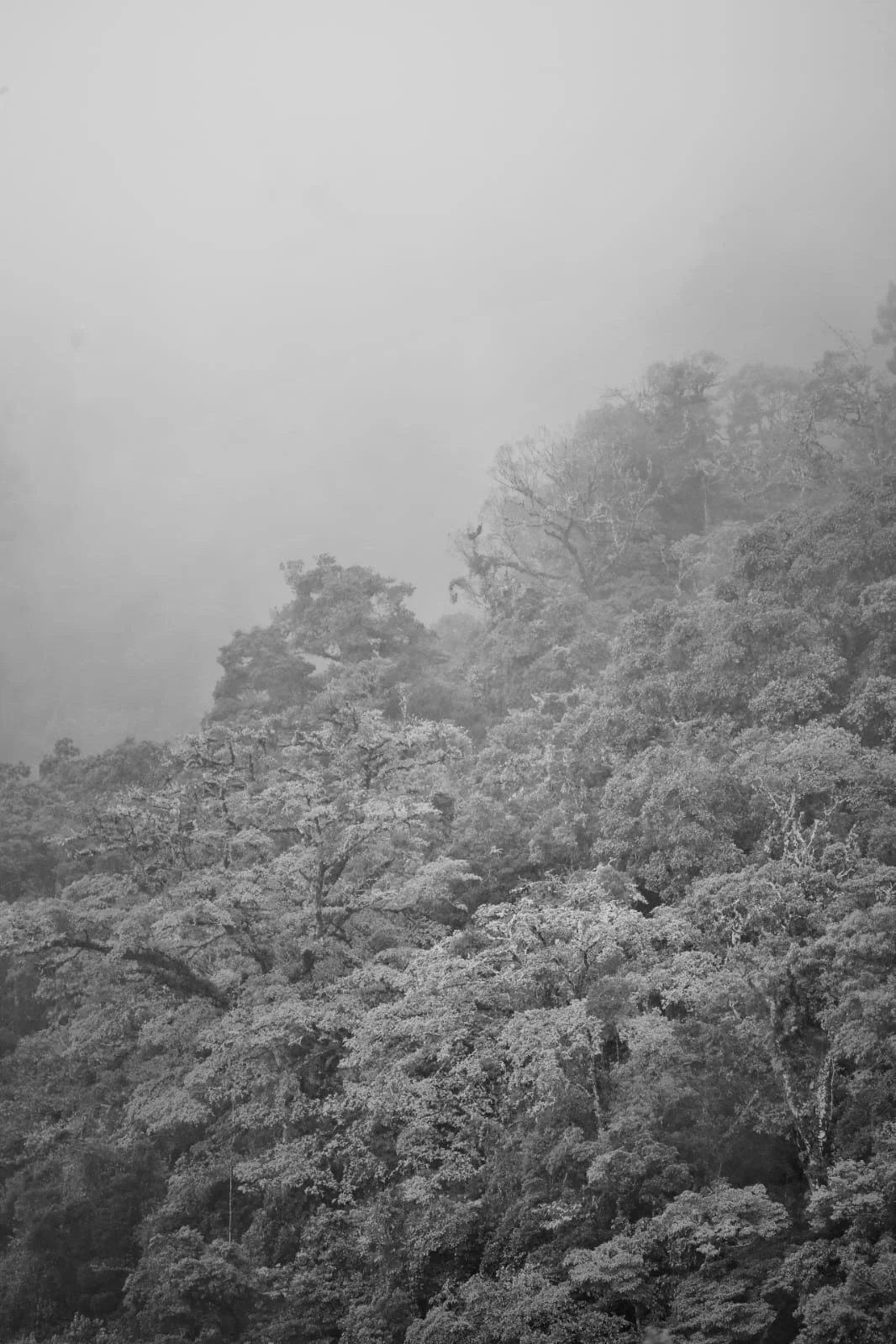
Imagine hiking through cool mountain fog surrounded by dripping moss covered trees while distant bellbird calls echo through the valleys like metallic jungle alarms from another planet.
The experience feels ancient somehow.
Cloud forests themselves already feel magical. Compared to Panama’s hot tropical lowlands, the highlands near Boquete and Volcán Barú feel cooler, mistier, quieter, and deeply atmospheric. Moss covers branches. Ferns spill across trails. Orchids cling to trees while clouds drift slowly through the forest canopy.
Then suddenly: BONK.
The sound cuts through everything.
One of the fascinating things about three wattled bellbirds is that they migrate seasonally within Central American mountain systems. They move between elevations following fruit availability and breeding conditions.
This means birdwatchers often track seasonal patterns carefully hoping to encounter them during the right times of year.
And birdwatchers absolutely obsess over bellbirds.
Panama already ranks among the greatest birdwatching destinations on Earth thanks to incredible biodiversity and accessible habitats. But the bellbird occupies special legendary status because of both its bizarre appearance and unforgettable call.
People travel internationally specifically hoping to hear and see one.
Sometimes they spend hours hiking quietly through wet mountain trails guided mainly by sound. The bird itself may remain hidden high in the canopy while its metallic calls echo dramatically across valleys.
And even when unseen, the sound alone leaves enormous impressions.
There is something psychologically strange about hearing a bird call so powerful and metallic it genuinely sounds artificial.
The forests around Cerro Punta and highland cloud forest reserves provide some of the best opportunities to encounter them. These cooler mountain ecosystems support extraordinary biodiversity overall, including quetzals, trogons, hummingbirds, orchids, and countless other remarkable species.
The bellbird somehow perfectly matches the atmosphere of these forests.
Mysterious. Strange. Beautiful. Slightly haunting.
And because cloud forests often remain partially hidden in mist, encounters with wildlife there feel especially dramatic. A bird suddenly appearing through drifting fog while producing metallic jungle calls becomes unforgettable very quickly.
One especially interesting aspect of the three wattled bellbird is how important fruit is to its survival. Bellbirds feed heavily on fruits from cloud forest trees and therefore help disperse seeds through the ecosystem.
Like many tropical birds, they play major ecological roles maintaining forest health.
In other words, these bizarre screaming birds help build the rainforest itself.
Unfortunately, cloud forest ecosystems face serious conservation challenges. Habitat loss, climate change, deforestation, and fragmentation threaten many mountain species across Central America.
Cloud forests are delicate systems.
Small temperature changes can dramatically shift moisture patterns, vegetation zones, and food availability. Because species like the bellbird depend heavily on these unique environments, protecting highland forests in Panama became extremely important.
Places near Volcán Barú and protected reserves in western Panama therefore matter enormously not only for tourism and scenery but also for biodiversity preservation itself.
And honestly, hearing a bellbird in wild forest makes conservation suddenly feel personal.
You realize sounds like this could disappear someday.
The forests would become quieter. Stranger in a different way. Missing one of their most iconic voices.
One funny thing about bellbirds is how perfectly they ruin people’s expectations of what birds are “supposed” to sound like.
People imagine birds singing sweet melodies.
Bellbirds chose violence instead.
Their call sounds industrial. Mechanical. Aggressive. Almost comedic in its intensity.
And somehow that makes the bird even more beloved among travelers and birdwatchers.
Nature becomes more fascinating when it feels unpredictable.
The three wattled bellbird reminds people that evolution sometimes creates creatures so bizarre they almost seem fictional.
A chestnut colored mountain bird with dangling facial cords screaming metallic explosions through cloud forests?
That sounds invented.
Yet somewhere in the misty mountains of western Panama right now, hidden high above mossy rainforest slopes, a male bellbird is probably perched silently in the canopy preparing to unleash another impossibly loud metallic BONK across the valleys below while confused hikers stop walking and wonder what on Earth they just heard.