
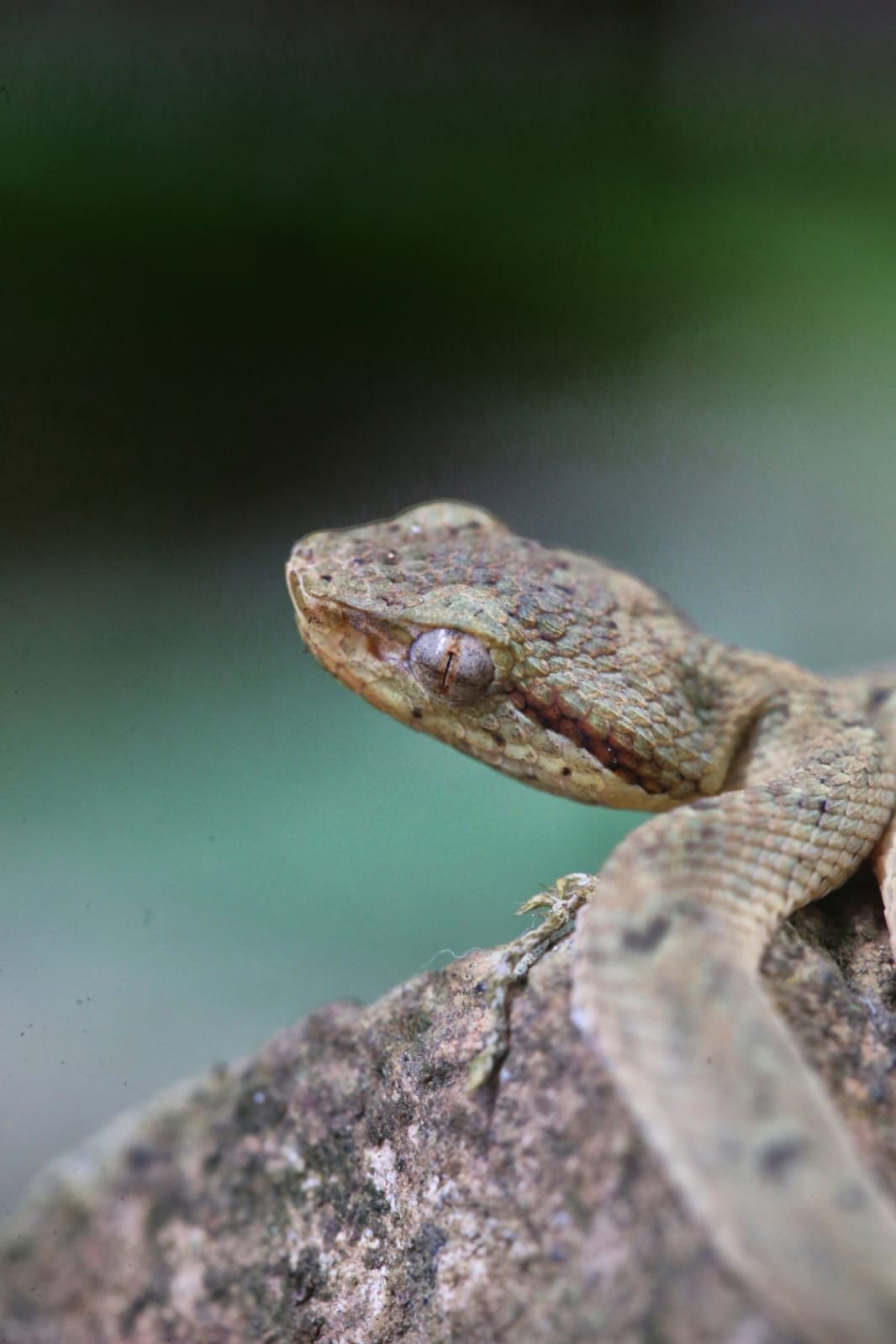
Deep in the humid forests of Panama, where daylight fades quickly under thick canopy and the night seems to arrive like a physical presence rather than a time of day, one of the most elegant and misunderstood reptiles begins its work. The cat-eyed snake, a slender, nocturnal hunter with striking vertical pupils that resemble those of a feline, moves through leaf litter, low branches, and tangled understory vegetation with a calm precision that contrasts sharply with the chaos of the tropical ecosystem around it. In a landscape filled with loud monkeys, flashing hummingbirds, and buzzing insects, this snake represents something entirely different: silence, patience, and a kind of controlled invisibility that makes it one of the most fascinating reptiles in Central America.
The species most commonly referred to as the cat-eyed snake in Panama belongs to the genus Leptodeira, a group of mildly venomous rear-fanged snakes distributed widely across Central and South America. In Panama, one of the frequently encountered forms is the species complex often identified as Leptodeira annulata, though several closely related species occur depending on region and habitat. Despite the intimidating name, this snake poses no real danger to humans. Its venom is specialized for subduing small prey and is delivered through enlarged rear teeth, making it effective against frogs and small lizards but not medically significant to people. What it lacks in danger, however, it makes up for in ecological importance and behavioral elegance.
One of the most defining features of the cat-eyed snake is, of course, its eyes. The vertical slit pupils give it an almost supernatural appearance under flashlight or moonlight, especially in the rainforest where most encounters happen at night. These eyes are not just decorative; they are highly adapted tools for nocturnal hunting, allowing the snake to detect subtle movement in low light conditions. In Panama’s dense tropical forests, where nights are often dark even under a full moon due to canopy cover, this adaptation becomes crucial. The snake does not rely on speed or brute force. Instead, it relies on stillness, observation, and perfectly timed strikes.
Behaviorally, the cat-eyed snake is a master of patience. It is most active at night, slowly moving through forest edges, wetlands, streams, and areas near temporary pools of water where amphibians gather. Frogs form a major part of its diet, especially tree frogs that breed explosively during Panama’s rainy season. When heavy rains transform the forest into a chorus of amphibian calls, the cat-eyed snake becomes far more active, taking advantage of the sudden abundance of prey. It often hunts by positioning itself near breeding sites, waiting motionless for frogs to approach within striking distance. This sit and wait strategy is highly efficient in tropical environments where energy conservation can be as important as hunting success.
The ecological role of this snake is deeply tied to the amphibian populations it helps regulate. In Panama’s rainforests, frogs can appear in massive numbers during wet periods, and without natural predators like the cat-eyed snake, their populations would fluctuate in ways that could disrupt insect control and broader food web dynamics. By feeding primarily on frogs and small reptiles, the snake acts as a stabilizing force in the ecosystem, helping maintain balance in environments that are constantly shifting with rainfall, temperature, and seasonal cycles.
In terms of habitat, the cat-eyed snake is remarkably adaptable. It can be found in lowland tropical rainforest, secondary growth forests, wetlands, agricultural edges, and even areas near human settlements where vegetation and water sources attract amphibians. This adaptability is one of the reasons it is relatively commonly encountered compared to many other snakes in Panama. However, despite this range, it remains extremely well camouflaged. Its coloration typically consists of blotched or banded patterns in shades of brown, gray, and cream, allowing it to blend seamlessly into leaf litter, branches, and shadowed forest floors. Most people only notice it when it is already moving, or when a flashlight briefly catches its reflective eyes in the dark.
Unlike larger, more aggressive snakes, the cat-eyed snake is generally calm and non-confrontational. When disturbed, it may freeze, slowly retreat, or attempt to blend into its surroundings rather than display defensive aggression. This behavior makes sense for a mid-sized nocturnal predator that relies on stealth rather than intimidation. It does not seek encounters with humans, and most sightings occur purely by chance during night walks or accidental encounters along forest paths. Even then, it often disappears quietly into vegetation without incident, reinforcing its reputation as a ghost-like presence of the night forest.
Reproduction in cat-eyed snakes follows seasonal rainfall patterns, which are particularly pronounced in Panama. During wetter months, when food is abundant and amphibian activity peaks, breeding increases. Females lay eggs in hidden, humid locations such as rotting logs, leaf litter, or protected soil cavities. These environments provide the moisture and temperature stability needed for successful development. Once hatched, juvenile snakes are fully independent and begin immediately hunting small prey, continuing the cycle of nocturnal predation that defines the species.
One of the most interesting aspects of encountering a cat-eyed snake in Panama is how it changes perception of the forest at night. Many people imagine tropical nights as quiet or empty, but in reality they are filled with layered activity. Insects fill the air with constant sound, frogs call from every direction, and predators like the cat-eyed snake move silently through this soundscape, following chemical and visual cues that humans rarely perceive. Seeing one in the wild often creates a shift in awareness, where the forest is no longer just a backdrop but a fully functioning night ecosystem with its own rhythm of hunting and survival.
Even in areas frequented by travelers, such as forest corridors and eco lodges, the cat-eyed snake can occasionally be encountered. Places like Lost and Found Hostel, which sit within rich transitional forest zones between Panama’s highland and lowland ecosystems, are surrounded by habitats where amphibians thrive after rainfall. This in turn attracts predators like Leptodeira, meaning that on rare nights, careful observers walking with a flashlight may glimpse the reflective eyes of this snake moving along the edge of vegetation or near damp ground where frogs are active. These encounters are usually brief, but they leave a strong impression because they reveal an entirely different layer of forest life that exists just beyond human awareness.
Ultimately, the cat-eyed snake of Panama represents a quieter form of wilderness intelligence. It is not large, loud, or dramatic, yet it plays a critical role in maintaining ecological balance in some of the most biodiverse environments on Earth. Its beauty lies not in spectacle but in subtlety: the way it moves without sound, the way it waits without urgency, and the way it exists as part of a nocturnal system most people never fully see. In a country defined by vibrant and visible wildlife, this snake reminds us that some of the most important lives in the forest are the ones that unfold in silence, under cover of darkness, where observation is rare but survival is constant.