
Among the countless animals that capture the imagination of visitors to Panama, few are as instantly recognizable or as surprisingly impressive as the iguana. At first glance, an iguana resting motionless on a tree branch may appear almost prehistoric, as though it belongs to a distant age when giant reptiles ruled the Earth. With their spiny crests, powerful claws, muscular tails, and watchful eyes, iguanas possess a distinctly dinosaur-like appearance that fascinates travelers, photographers, and wildlife enthusiasts alike. Yet despite their exotic appearance, iguanas are a familiar part of life throughout much of Panama. They can be found basking in the sun beside rivers, climbing through coastal forests, lounging in mangrove trees, wandering rural roads, and occasionally even appearing in suburban neighborhoods. To understand iguanas in Panama is to appreciate one of the country's most successful and adaptable reptiles, a creature that has survived countless environmental changes and continues to thrive in one of the most biodiverse nations on Earth.
Panama provides an ideal environment for iguanas because it contains the warm temperatures, abundant vegetation, freshwater sources, and extensive forest habitats that these reptiles require. Stretching between North and South America, the country serves as a biological bridge that supports an extraordinary range of wildlife. From the mangrove-lined Pacific coast to the islands of the Caribbean, from lowland rainforests to river valleys and tropical dry forests, iguanas occupy a remarkable variety of habitats. The most commonly encountered species is the green iguana, a reptile that can grow to impressive sizes. Many people are surprised to learn that large adults can exceed one and a half meters in total length when their tails are included. Although they are often called green iguanas, individuals may display a surprising range of colors depending on age, sex, season, and location. Some appear bright green, while others develop shades of orange, brown, gray, or even bluish tones.
One of the most fascinating aspects of iguanas is their connection to the trees. Unlike many reptiles that spend much of their time on the ground, iguanas are exceptional climbers. Their long fingers end in sharp claws perfectly adapted for gripping bark and branches. It is not unusual to walk through a Panamanian forest and completely miss an enormous iguana perched overhead because its coloration blends so effectively with the surrounding vegetation. These reptiles often spend hours basking in sunlight filtering through the canopy. Since they are cold-blooded animals, sunlight plays a crucial role in regulating their body temperature. Early in the morning, an iguana may remain relatively sluggish as it absorbs warmth from the sun. As its body temperature rises, it becomes increasingly active and capable of moving with surprising speed.
Visitors are often astonished by how agile a large iguana can be. Despite their bulky appearance, they are capable of sprinting across the ground, climbing almost vertically, and launching themselves from considerable heights into water. Many iguanas living near rivers have developed a remarkable escape strategy. When threatened, they simply leap from overhanging branches into the water below and swim away. Their powerful tails act as effective rudders, allowing them to navigate through rivers and streams with ease. An unsuspecting traveler walking quietly along a riverbank may suddenly hear a loud splash as an iguana dives from a tree into the water, often causing a brief moment of alarm before realizing the source of the disturbance.
The diet of Panama's iguanas is another aspect that surprises many people. Given their dragon-like appearance, some assume they are fierce predators. In reality, green iguanas are primarily herbivorous. They feed on leaves, flowers, fruits, and tender shoots from a variety of plants. This diet plays an important ecological role because iguanas help disperse seeds throughout the forest. After consuming fruit, they may travel considerable distances before depositing seeds in new locations. In this way, they contribute to forest regeneration and plant diversity. Their role in the ecosystem extends far beyond simply being another reptile wandering through the jungle.
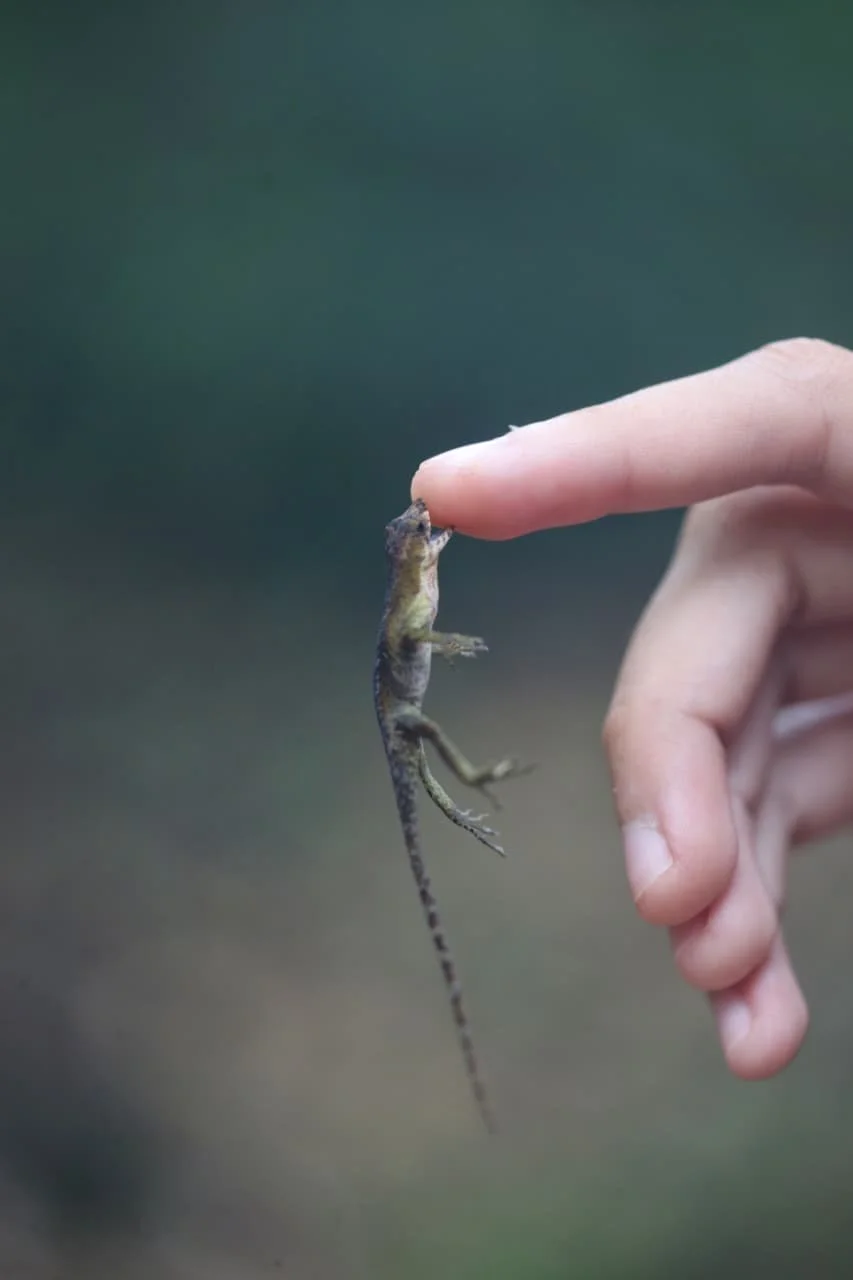
The reproductive cycle of iguanas reveals another fascinating chapter in their lives. Female iguanas undertake impressive nesting journeys during the breeding season. After mating, they search for suitable locations where they can dig deep burrows to deposit their eggs. A single female may lay dozens of eggs in one nesting event. Once the eggs are buried, however, parental care essentially ends. The young hatchlings must fend for themselves from the moment they emerge. These tiny iguanas face enormous challenges. Birds, snakes, mammals, and other predators all view them as potential prey. Only a small percentage survive to adulthood, making the success of mature iguanas all the more remarkable.
Panama's forests contain numerous predators capable of hunting iguanas. Large birds of prey, including hawks and eagles, may target younger individuals. Snakes can prey upon hatchlings and juveniles. Mammalian predators occasionally capture them as well. Yet iguanas have evolved an impressive range of defenses. Their camouflage allows them to blend into vegetation. Their climbing ability enables rapid escape into treetops. Their tails can deliver powerful defensive strikes when necessary. Perhaps most remarkably, young iguanas possess the ability to shed portions of their tails if grabbed by a predator. The detached tail continues to twitch and wriggle, distracting the attacker while the iguana escapes. Although the tail eventually regrows, it rarely matches the original perfectly.
Throughout Panama, iguanas have long held cultural significance. Indigenous communities and rural populations have interacted with these reptiles for centuries. In some regions, iguanas were historically hunted for food, and their eggs were considered a valuable resource. While conservation awareness has increased and regulations exist to protect wildlife, the historical relationship between humans and iguanas remains an important part of local culture. Older generations often possess extensive knowledge about iguana behavior, nesting habits, and seasonal movements acquired through years of observation.
One of the most enjoyable aspects of encountering iguanas in Panama is that they are often accessible to ordinary travelers. Unlike elusive jaguars or secretive tapirs, iguanas can frequently be observed without venturing deep into remote wilderness. Visitors exploring beaches, rivers, parks, islands, and forest trails have a good chance of spotting them. In some areas, particularly near water, large individuals become so accustomed to human presence that they allow surprisingly close observation. Photographers often delight in capturing images of these ancient-looking reptiles silhouetted against tropical landscapes.
The diverse environments of Panama contribute to the success of iguanas in fascinating ways. Along the Pacific coast, they inhabit mangroves and coastal forests where they can exploit abundant vegetation and nearby water. On the Caribbean side, lush tropical conditions provide year-round resources. Inland river valleys support healthy populations, while lowland rainforests offer extensive habitat. Even areas near human settlements can support iguanas if suitable vegetation remains available. This adaptability has helped them survive environmental changes that might challenge more specialized species.
What makes iguanas particularly remarkable is their deep evolutionary history. The ancestors of modern iguanas belong to a lineage that stretches back millions of years. Long before humans arrived in the Americas, iguana-like reptiles were already thriving in tropical ecosystems. Every time a traveler observes an iguana basking on a branch in Panama, they are witnessing a survivor from an ancient evolutionary story. Its basic body design has proven remarkably successful across vast spans of geological time. The spiny crest running along its back, the muscular tail, the powerful limbs, and the keen senses all represent adaptations refined through countless generations.
For travelers exploring Panama's extraordinary natural landscapes, iguanas often become one of the country's most memorable wildlife encounters. There is something captivating about spotting what appears to be a miniature dragon resting above a jungle river or watching a massive reptile climb effortlessly through tropical foliage. They embody many of the qualities that make Panama such a remarkable destination for nature lovers: biodiversity, adaptability, beauty, and a tangible connection to the ancient natural history of the tropics.
In a nation famous for colorful birds, dazzling butterflies, playful monkeys, and extraordinary marine life, iguanas sometimes receive less attention than they deserve. Yet these magnificent reptiles are among the true icons of Panama's wildlife. They are living reminders of a world far older than our own, creatures that have watched forests grow and rivers change for millions of years. Whether encountered on a remote island, beside a jungle stream, near a coastal mangrove, or simply sunning themselves on a branch above a forest trail, Panama's iguanas remain some of the most fascinating and charismatic reptiles in the Americas, ancient dragons continuing their timeless existence in one of the most beautiful corners of the tropical world.