
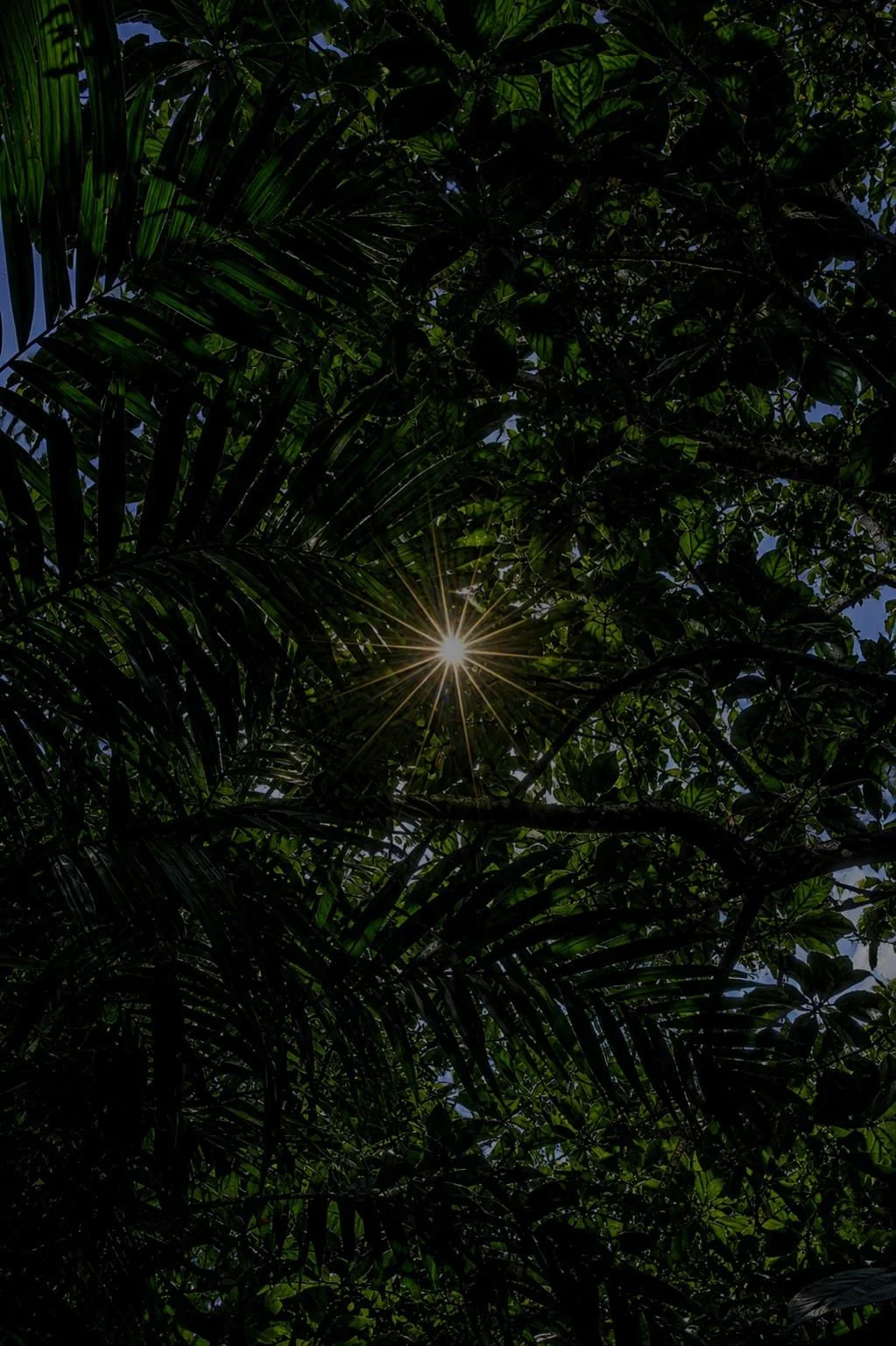
There is something almost magical about entering the cloud forest after the sun has disappeared. During the day, the forest surrounding Lost and Found Hostel is already an extraordinary place, filled with birds, butterflies, hummingbirds, monkeys, enormous trees, tangled vegetation and distant mountain views. But after dark, the entire ecosystem seems to change character. The familiar trails become mysterious, the temperature drops, moisture begins settling across the vegetation, and sounds suddenly seem to come from every direction. The Lost and Found Hostel night walk offers travelers the chance to experience this completely different side of the Fortuna cloud forest, following the trails after sunset and searching for the creatures that only emerge when darkness takes over.
The first few minutes of the walk can feel surprisingly different from hiking the same trails during daylight. The mountains around Lost and Found have a cool, humid microclimate, and after sunset the air can become noticeably cooler. Moisture hangs in the vegetation, leaves glisten under flashlight beams and mist can drift through the forest. During the day, your eyes naturally scan the entire landscape, but at night your attention becomes concentrated on a small circle of light. A leaf, branch or patch of moss that you would normally walk straight past can suddenly become fascinating when it is illuminated against complete darkness.
Then the forest starts revealing its nighttime residents.
One of the most exciting possibilities is seeing bats flying through the forest. Panama has an extraordinary diversity of bats, and the darkness provides perfect conditions for them to become active. You may see them darting rapidly between trees, crossing the trail or flying overhead as they search for insects or fruit. Their movements can be almost impossible to follow with your eyes, making a brief glimpse particularly exciting. Bats are one of the most important groups of mammals in tropical ecosystems, contributing to insect control, pollination and seed dispersal. Seeing one emerge from the darkness is a reminder that an enormous amount of activity is taking place above your head even when the forest floor appears completely still.
And then there are the owls. Hearing an owl somewhere in the darkness can be one of the most atmospheric moments of the entire walk. Owls are perfectly adapted to the nighttime environment, and their calls can seem to travel enormous distances through the forest. Actually spotting one is considerably more difficult, which makes an encounter especially memorable. A guide may stop the group and listen carefully, trying to determine where a call is coming from before everyone slowly scans the surrounding branches. Sometimes the forest gives you only a sound. Other times, if you are exceptionally fortunate, an owl may appear perched quietly in the darkness.
The canopy is another world entirely at night. While many travelers naturally concentrate on the trail beneath their feet, nocturnal arboreal mammals can be moving through the trees above them. Kinkajous, olingos, opossums and other nocturnal mammals can sometimes be active after dark, moving between branches in search of fruit, insects or other food. Spotting these animals is never guaranteed, but that uncertainty is part of the excitement. A sudden movement in the canopy can turn an ordinary section of trail into a few minutes of intense wildlife watching.
The flashlight may reveal a pair of reflective eyes high above the ground, followed by the outline of an animal moving carefully between branches. Sometimes the creature disappears almost immediately. Other times it may remain visible long enough for everyone to watch it moving through the canopy. These encounters demonstrate how different the forest becomes when the daytime animals retreat and nocturnal species take over.
Down on the forest floor, the possibilities become even more varied. Armadillos are among the animals that can occasionally be encountered during a nighttime exploration. These unusual mammals spend much of their time close to the ground, searching through leaf litter and soil for food. Seeing one wandering along the forest floor would be an incredible encounter, but like most wildlife sightings on the night walk, it depends entirely on luck, timing and the animal's movements.
The same is true of porcupines. Panama's forests are home to porcupines that spend much of their time in trees, where their excellent climbing abilities allow them to move through the canopy in search of food. A porcupine is not an animal most travelers expect to see in a tropical forest, which makes an unexpected encounter particularly memorable. Spotting one quietly moving through the branches is the kind of experience that can become one of the stories travelers remember long after leaving Panama.
And then there are the creatures that are much smaller but sometimes even more spectacular.
The night is when the insect world really takes over. Katydids, crickets, beetles, moths, stick insects and countless other arthropods become active. Some are incredibly well camouflaged, blending almost perfectly into leaves and branches. Others are brightly patterned or have bizarre shapes that make them look as though they belong in a science-fiction movie. A good night walk encourages everyone to slow down and examine the vegetation carefully because some of the most fascinating discoveries may be only a few centimeters from the trail.
Spiders become particularly interesting after dark. Their webs can suddenly appear in the beam of a flashlight, sometimes stretching between branches and covered in tiny droplets of moisture. Other spiders sit motionless on leaves or tree trunks, waiting for prey. There is an enormous diversity of spiders in tropical forests, and their shapes, behaviors and camouflage strategies can be astonishing. For travelers who normally rush past insects and spiders, the night walk can completely change their perspective on these animals.
One of the strangest creatures you might encounter is a whip scorpion, sometimes called a tailless whip scorpion. Despite its intimidating appearance, it is not a true scorpion. Its unusual body and extremely long sensory appendages make it look almost prehistoric. Finding one sitting on vegetation beside the trail is the sort of discovery that immediately attracts everyone's attention. It is one of those animals that many travelers have never even heard of before visiting the tropics.
Frogs are another major part of the nighttime soundtrack. As the sun goes down, different species begin calling from streams, vegetation and the forest floor. Their calls can range from quiet chirps to surprisingly loud and distinctive sounds. Sometimes the frog itself is almost impossible to see, hiding beneath leaves or among moss, while its call seems to come from somewhere completely different. Searching for the source becomes a small detective exercise.
The cloud forest itself becomes part of the experience. Moss, lichens, bromeliads, ferns and other epiphytes cover branches and trunks, creating layers of vegetation throughout the forest. At night, a flashlight picks out individual details that would be lost in the complexity of the daytime landscape. Tiny droplets of water sparkle on spider webs. Moss glows green under the beam. Giant leaves appear almost sculptural. Tree trunks seem enormous as they disappear into darkness overhead.
There is also something psychologically different about walking through a rainforest at night. During daylight, you can see the trail stretching ahead of you and understand the landscape around you. At night, your flashlight only reveals a small portion of the world. Everything beyond that circle of light becomes unknown. A rustle in the vegetation makes everyone stop. A branch moving high overhead attracts immediate attention. Something flying across the trail disappears before anyone can identify it. The forest feels much larger, wilder and more mysterious.
This is where the experience becomes more than simply a wildlife walk. It becomes an adventure.
You never know what the forest is going to reveal. One night might produce an incredible insect encounter. Another might bring a frog, a spider or a whip scorpion. If luck is on your side, you might see a bat, an owl, an armadillo, a porcupine or a nocturnal mammal moving through the trees. There are no guarantees, and that is precisely what makes the experience exciting. The forest is not a zoo where animals appear on schedule. It is a functioning ecosystem, and you are simply entering it at a time when many of its inhabitants are becoming active.
The possibility of encountering larger animals is also what keeps everyone looking. The trails around Lost and Found pass through a remarkably rich mountain environment, and nocturnal species can move quietly through the vegetation without announcing themselves. A glimpse of eyes reflecting from the darkness can be enough to stop the entire group. Sometimes it turns out to be a small animal. Sometimes the creature disappears before anyone gets a good look. Occasionally, however, the encounter lasts long enough for everyone to appreciate exactly what they have found.
The sounds are just as important as the sightings. During the day, the forest is dominated by birds and other daytime wildlife. At night, the soundtrack changes to crickets, katydids, frogs, rustling leaves, distant calls and the occasional wingbeat overhead. An owl may call from somewhere beyond the trail. A bat may suddenly pass overhead. Something may move through the leaf litter several meters away. Sometimes the best moments happen when everyone stops talking and simply listens.
For backpackers staying at Lost and Found, the night walk also offers something that is difficult to experience on a normal tourist excursion. You are not simply visiting a rainforest for an hour before returning to a city or resort. You are staying directly in the mountain environment, surrounded by forest. The night walk allows you to experience the same landscape when its nocturnal ecosystem is fully active.
That connection between the hostel and the surrounding forest is what makes the experience particularly special. The trails are right there, the cloud forest surrounds the property, and the transition from the social atmosphere of the hostel to the quiet darkness of the jungle happens remarkably quickly. One moment you are talking with other travelers, and minutes later you can be standing beneath enormous trees listening to frogs and insects in complete darkness.
For many travelers, the biggest surprise is realizing how much they normally miss. A daytime hike might reveal colorful birds, monkeys, butterflies and spectacular vegetation, but the nighttime forest exposes an entirely different layer of biodiversity. Animals that hide during the day become active. Insects appear everywhere. Spiders construct webs. Frogs begin calling. Bats cross the canopy. Nocturnal mammals move through the trees. Armadillos may wander along the forest floor. Porcupines can potentially be somewhere above you. Owls watch from the darkness.
The cloud forest doesn't shut down when the sun goes down.
It changes shifts.
And walking through it after dark gives you a chance to witness that transition firsthand. The Lost and Found Hostel night walk is ultimately about slowing down, turning off the distractions of the outside world and paying attention to the incredible amount of life surrounding you. You might see something rare, something bizarre, something tiny or something you never knew existed. You might hear an owl without ever finding it, watch a bat disappear into the canopy or discover a strange insect sitting perfectly still on a leaf.
Or, if you're particularly lucky, you might walk around a bend and find yourself looking at an armadillo on the trail, a porcupine moving through the trees or a nocturnal mammal watching you from the darkness.
Those are the moments that turn a simple night hike into one of the great Lost and Found experiences: unpredictable, adventurous, slightly mysterious and completely connected to the wild cloud forest surrounding the hostel.