
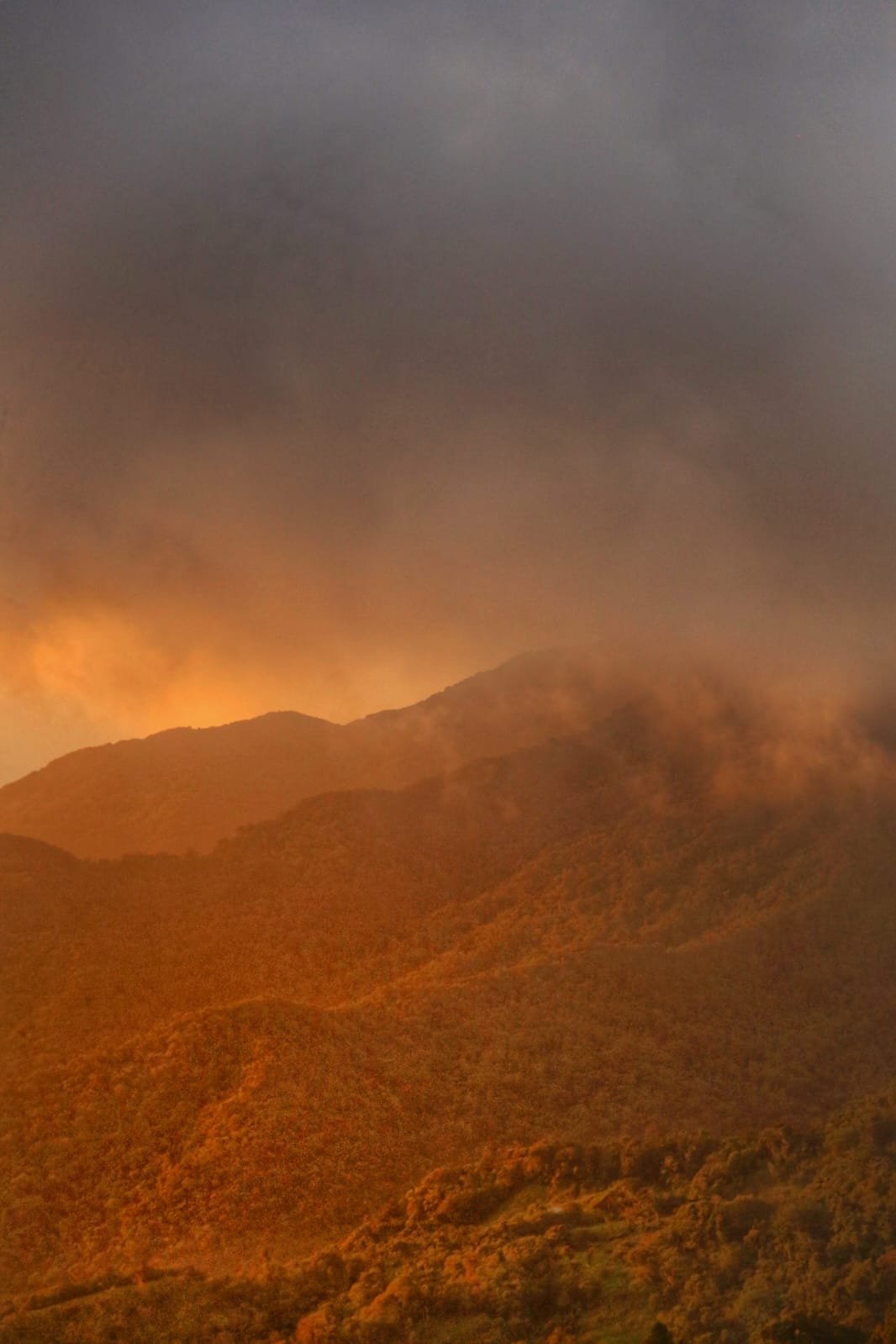
When people imagine Panama, they usually picture endless green. Towering rainforest, misty mountains, enormous jungle trees, banana plantations, coconut palms and dense vegetation stretching toward the horizon. It can seem almost impossible to imagine the Panamanian landscape covered in flames.
But Panama does get wildfires.
And there is another, much more common type of fire that is an important part of rural life in the country: farmers deliberately burning vegetation to clear land and prepare fields. These agricultural fires can be a normal part of traditional farming practices, but under the wrong conditions they can also escape control and become dangerous.
The relationship between Panama and fire is therefore complicated. Fire can be a tool, a threat, an ecological force and, occasionally, a disaster.
Panama Is Green, But Green Does Not Mean Fireproof
Panama's tropical climate gives it an enormous amount of vegetation. During the rainy season, the landscape can become unbelievably lush. Rivers swell, waterfalls explode into life and vegetation grows at a remarkable rate.
But Panama also has a pronounced dry season.
In many parts of the country, particularly along the Pacific side, months can pass with very little rainfall. The vegetation that was brilliantly green during the wet season can gradually dry out, grasses turn brown, leaves fall and enormous quantities of plant material accumulate on the ground.
This creates fuel.
When temperatures rise, humidity falls and vegetation dries sufficiently, a small fire can spread surprisingly quickly.
A landscape that looked almost impossible to burn a few months earlier can suddenly become highly flammable.
Where Are Wildfires Most Likely?
Wildfires can occur in different parts of Panama, but the risk varies significantly depending on the climate, vegetation and season.
The Pacific side of Panama tends to experience a stronger dry season than many areas on the Caribbean side. Provinces such as Los Santos, Herrera, Coclé, Panamá Oeste and parts of Chiriquí can experience significant dry conditions.
The Azuero Peninsula is particularly interesting because it has experienced extensive deforestation and agricultural development over generations. During the dry season, grasslands and agricultural areas can become extremely dry, creating conditions where fires can spread rapidly.
The forests of eastern and western Panama can also experience fires, particularly when unusually dry conditions combine with human activity.
The Caribbean side generally receives more rainfall, although that does not make it completely immune.
The Farmers' Fire
To understand fire in Panama, you have to understand rural agriculture.
For generations, farmers throughout Panama and across Central America have used fire as a way to clear vegetation and prepare land for cultivation.
The basic idea is simple.
Vegetation is cut down, allowed to dry and then burned. The resulting ash returns nutrients to the soil, while the fire removes vegetation that would otherwise require considerable physical labor to clear.
This practice is often referred to as slash and burn agriculture, although the reality varies considerably from one farmer and region to another.
For a small farmer working with limited machinery, fire can be an extremely effective tool.
Instead of spending days or weeks removing vegetation manually, a controlled burn can clear a field relatively quickly.
And when conditions are right, the ash can provide nutrients that temporarily benefit the soil.
This is not some strange modern invention. Humans have been using fire to manage landscapes for thousands of years.
But Controlled Does Not Always Mean Contained
This is where things become complicated.
A farmer may intend to burn a small patch of land.
The fire may be carefully planned.
The weather may initially appear calm.
But Panama's dry season can produce conditions where fire behaves very differently from what people expect.
A gust of wind can carry burning embers into nearby grass.
A flame can cross a dry ditch.
A fire can move through vegetation faster than someone can react.
Suddenly, the small agricultural burn has become a much larger fire.
This is one of the reasons agricultural burning can contribute to wildfires.
It is not necessarily because someone deliberately wanted to start a wildfire. A fire that begins as a land management practice can escape its intended boundaries.
The Dry Season Changes Everything
Panama's dry season is one of the most important factors in understanding wildfires.
During the rainy season, a fire can struggle to move through wet vegetation.
During the dry season, the situation can be completely different.
Grass becomes brittle.
Leaves become dry.
Branches lose moisture.
The ground dries.
Humidity can drop.
And winds can push flames across open landscapes.
The combination creates what firefighters call favorable fire conditions.
This is why a traveler driving through rural Panama during the dry season might suddenly see smoke rising from the countryside.
Sometimes that smoke comes from a farmer burning vegetation.
Sometimes it comes from a larger uncontrolled fire.
And occasionally, it can be difficult to tell the difference from the road.
Why Does Panama Sometimes Look Smoky?
Visitors arriving during the dry season sometimes notice something unexpected.
The horizon can look hazy.
Mountains can appear faint.
The sun can take on a strange orange appearance.
There may be a smell of smoke in the air.
It can be tempting to assume that pollution is responsible.
But in some parts of Panama, seasonal agricultural burning and vegetation fires can contribute significantly to the haze.
This can be particularly noticeable in rural areas.
For someone arriving from a country where agricultural burning is uncommon, seeing smoke rising from multiple locations across the countryside can be quite surprising.
For many Panamanians living in agricultural regions, however, it is a familiar part of the dry season.
Fire and Panama's Wildlife
Wildfires can be particularly damaging to wildlife when they enter natural forests.
Panama is one of the most biologically diverse countries on Earth, and its forests provide habitat for an extraordinary variety of animals.
Monkeys, sloths, deer, peccaries, armadillos, anteaters, birds, reptiles, amphibians and countless insects all depend on vegetation.
A fire can destroy food sources and shelter while forcing animals to flee.
Some animals can escape.
Others may move deeper into surrounding forest.
Some species are more vulnerable because they move slowly or depend on specific vegetation.
The effects can therefore extend far beyond the area that actually burns.
A forest fire does not just remove trees.
It can temporarily transform an entire ecosystem.
But Fire Is Not Always the Enemy
There is an interesting ecological twist here.
Fire is not universally bad for nature.
Some ecosystems have evolved with periodic fires, and controlled burning can sometimes influence vegetation structure and reduce accumulated fuel.
The problem is that tropical forests are generally not adapted to frequent, intense fires in the same way that some fire adapted ecosystems elsewhere in the world are.
A rainforest that burns repeatedly can suffer major ecological changes.
Fire can kill young trees, damage mature trees and open the forest canopy. Once the canopy is opened, grasses and other vegetation can grow more easily, potentially creating even more fuel for future fires.
This can create a dangerous cycle.
Forest burns.
Canopy opens.
Grass grows.
Grass dries.
Another fire becomes easier.
Over time, repeated burning can push an ecosystem away from its original forest condition.
Deforestation Makes the Fire Problem More Complicated
There is another major factor.
Land that has been cleared for cattle ranching, agriculture or development can become much more flammable than intact rainforest.
Dense forest contains enormous amounts of moisture, particularly during the rainy season.
Open pasture and dry grass can behave very differently.
This is one reason areas with extensive agricultural development can experience more visible fire activity during the dry season.
The landscape has been transformed, and so has the way fire moves through it.
What About Panama's National Parks?
Panama's protected areas are incredibly important because they preserve some of the country's remaining forests and wildlife habitats.
But protected status does not create a magical force field against fire.
If surrounding areas are burning, smoke can enter protected forests.
Under sufficiently dry conditions, fires can also threaten natural areas directly.
This is particularly concerning in regions where forests border agricultural land.
The boundary between farmland and wilderness can become the front line.
A farmer may be burning a field on one side while a national park or forest begins only a short distance away.
When conditions are dry and windy, that distance can become very small indeed.
The Mountains Have Their Own Fire Story
Mountainous Panama may seem like an unlikely place for wildfire.
After all, places such as Boquete, Volcán and the cloud forests of western Panama can receive substantial rainfall.
But even mountainous regions experience dry periods.
The difference is that elevation, vegetation and local weather can dramatically change fire behavior.
A dry hillside can carry fire upward.
Wind can move along ridges.
Smoke can become trapped in valleys.
And reaching a remote fire can be much more difficult for firefighters.
This is one reason rural fires in mountainous areas can become particularly challenging.
What Travelers Should Know
If you are backpacking through Panama during the dry season, do not be surprised if you occasionally see smoke rising from the countryside.
It does not automatically mean that you are in danger.
However, if you are hiking in an area where there is an active fire, heavy smoke or rapidly changing conditions, it is sensible to follow local advice and avoid entering affected areas.
Smoke can travel considerable distances, and fires can change direction quickly when wind conditions change.
This is especially important in remote areas where emergency access may be limited.
The Human Side of Agricultural Burning
It is easy for an outsider to look at a farmer burning a field and immediately think, "Why would anyone do that?"
But understanding the practice requires understanding rural economics.
A small farmer may not have access to tractors, industrial clearing equipment or large amounts of labor.
Fire is inexpensive.
It is fast.
It has been used for generations.
For many agricultural communities, burning vegetation is part of an established system of land management.
The challenge is finding ways to reduce the risk of escaped fires while still recognizing the realities faced by rural communities.
That is where education, timing, weather awareness, firebreaks, agricultural regulations and better land management become important.
Panama's Fire Season
The dry season is when the situation becomes most interesting.
The exact timing and intensity varies from year to year and from one part of Panama to another, but the Pacific side generally becomes much drier than during the rainy season.
As the months without significant rainfall continue, vegetation becomes progressively more flammable.
By the later part of the dry season, the difference between the lush Panama of the rainy months and the dry Panama of the Pacific lowlands can be astonishing.
The jungle may remain green in some regions, while nearby grasslands are almost completely brown.
And that is when fire becomes something to watch.
A Country of Water That Still Burns
There is something almost paradoxical about Panama's relationship with fire.
This is a country famous for water.
Two oceans.
Thousands of rivers and streams.
Massive tropical rainfall.
Cloud forests.
Waterfalls.
Wetlands.
And one of the world's most important canals.
Yet every year, during the dry season, parts of the country become dry enough for fire to become a serious concern.
It is a reminder that tropical does not automatically mean wet all year.
Panama has seasons.
And those seasons can dramatically change the behavior of the landscape.
The Smoke Is Part of a Bigger Story
When you see smoke rising above a Panamanian field, there may be a much bigger story behind it.
It might be a farmer preparing land.
It might be vegetation being cleared.
It might be a carefully managed burn.
It might be an escaped agricultural fire.
Or it might be a genuine wildfire spreading through dry vegetation.
The smoke is a visible reminder that Panama is a country where humans and nature constantly interact.
Agriculture, forests, climate, wildlife and communities are all connected.
And fire sits right in the middle of that relationship.
Panama may be famous for its impossibly green rainforests, but fire is also part of the country's story.
The rainforest survives because of water. The farms depend on the seasons. The dry season turns vegetation into fuel. And every year, across parts of Panama, farmers light fires that can either remain carefully within their intended boundaries or, under the wrong conditions, become something much larger.
That contrast is one of the most fascinating things about traveling through Panama.
One month you can be walking through a dripping cloud forest surrounded by moss, waterfalls and mist.
A few weeks later, you can drive through the countryside beneath a brilliant blue sky with dry grass stretching toward the horizon and columns of smoke rising in the distance.
Panama is a country of extremes, and even fire has a season.