
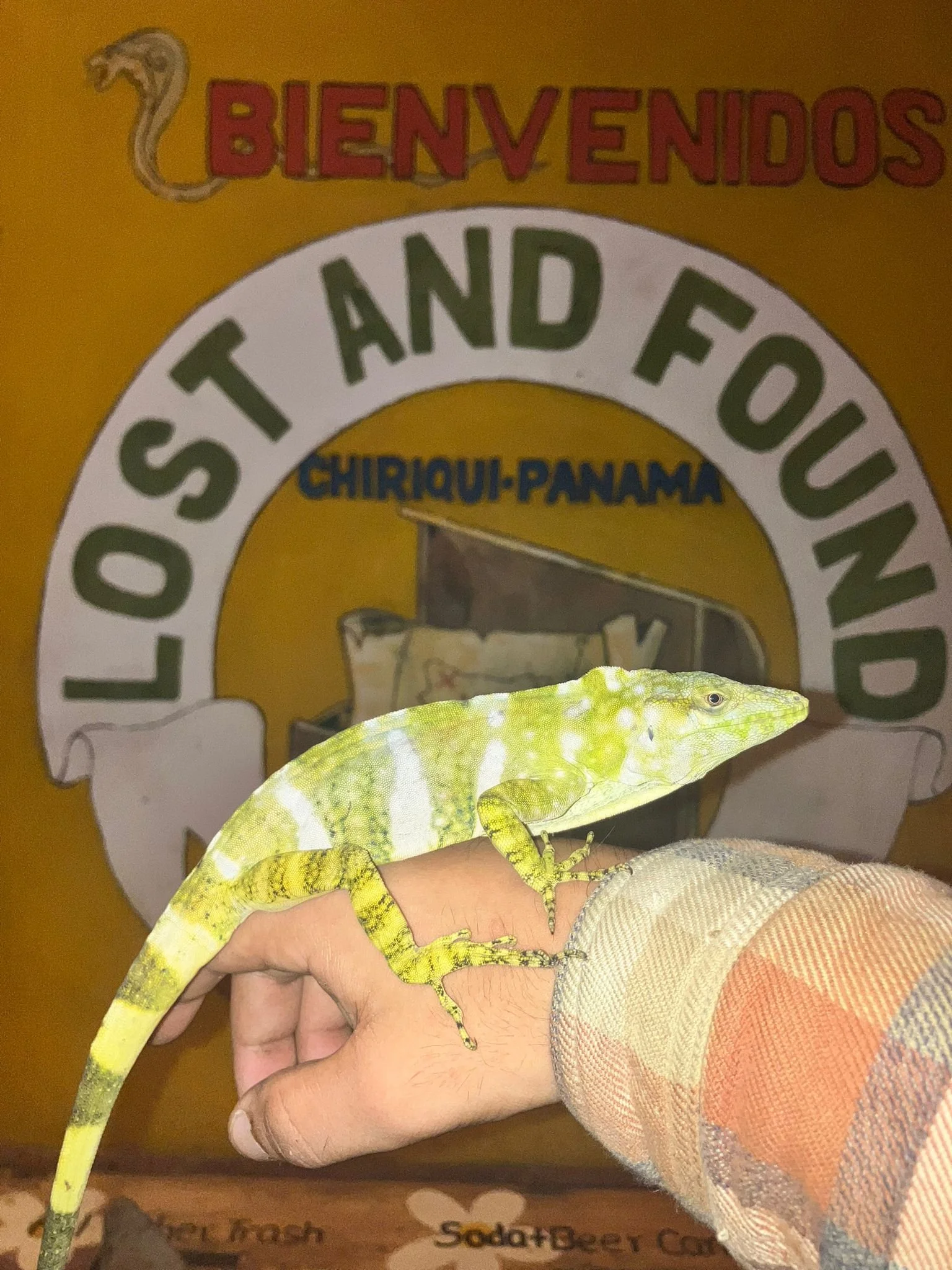
High in Panama's mountains, where clouds drift through the trees and the forest floor stays damp with mist, there is a creature that can make an ordinary walk through the jungle suddenly feel like an expedition into another world.
It is an anole.
But not the tiny lizard you might expect.
In Panama's cloud forests, some anoles can be surprisingly large, beautifully patterned and impressively prehistoric looking. They sit motionless on tree trunks, branches and vegetation, waiting for insects to wander within range. Then, in a flash, they disappear into the forest.
For backpackers hiking through the mountains around places such as Chiriquí, these lizards can be one of those encounters that you remember long after you have forgotten what trail you were walking on.
A Lizard With a Big Personality
Anoles belong to a large group of lizards found throughout the tropical Americas. Panama is home to numerous species, and their appearances can vary dramatically.
Some are tiny.
Some are brightly colored.
Some spend most of their lives close to the ground.
Others are highly adapted to living in trees.
And then there are the larger species that give the impression that someone accidentally left a miniature dinosaur wandering around the cloud forest.
Their long bodies, powerful legs, long tails and alert eyes make them look considerably more imposing than the small garden lizards many travelers are accustomed to seeing.
The first time you encounter a large anole sitting perfectly still on a tree trunk, it can take a second to realize exactly what you are looking at.
Then it moves.
And suddenly the illusion of a miniature dinosaur becomes even stronger.
The Cloud Forest Is an Incredible Place to Find Them
Panama's cloud forests create a very different environment from the hot lowland rainforest.
At elevation, temperatures are cooler, clouds can hang directly among the trees and humidity remains extremely high. Moss covers branches, epiphytes grow everywhere and the forest can feel almost permanently damp.
These conditions support an extraordinary diversity of life.
Ferns grow beneath enormous trees.
Orchids cling to branches.
Bromeliads collect water high above the ground.
Hummingbirds flash between flowers.
Frogs hide among leaves.
And somewhere on a moss covered trunk, an anole may be sitting perfectly still.
The incredible thing about these lizards is how easily they disappear into this complicated environment.
Their bodies can blend into bark, leaves and shadows remarkably well.
They Are Masters of the Tree Trunk
Anoles are famous for their ability to climb.
Their feet are specially adapted for gripping surfaces, allowing many species to move confidently across tree trunks and branches.
Instead of simply walking around the forest floor, an arboreal anole can navigate an entirely different world above your head.
This gives it access to insects and other small prey that ground dwelling animals might never encounter.
It also gives the lizard a different perspective on danger.
A bird can attack from above.
A snake can approach through branches.
A mammal can climb toward it.
The forest canopy is not necessarily safer.
It is simply a different battlefield.
Then Comes the Famous Dewlap
One of the most spectacular things about anoles is something that many visitors do not notice until they see it happen.
The male suddenly extends a colorful flap of skin beneath his throat.
This is called a dewlap.
Depending on the species, it can be yellow, orange, red, blue, white or another striking combination.
One moment the lizard appears completely ordinary.
The next moment it looks like it has opened a tiny tropical flag beneath its chin.
The dewlap is primarily used for communication.
Anoles can use visual displays to communicate with other members of their species, particularly during territorial and reproductive interactions.
The display can be remarkably dramatic.
The lizard extends its dewlap.
It moves its head.
It may perform push up movements.
Its body posture changes.
Another anole may respond.
Suddenly two seemingly motionless lizards are having an elaborate conversation without making a sound that a human would normally notice.
The Cloud Forest Is Full of Invisible Conversations
Once you start noticing anoles, you begin realizing how much communication is happening around you.
A lizard changes position.
A bird calls from somewhere in the canopy.
A frog answers from the vegetation.
An insect buzzes through the mist.
Leaves move.
Something rustles in the undergrowth.
The forest is constantly communicating.
Humans simply aren't very good at understanding most of it.
Anoles are particularly fascinating because their communication is heavily visual.
Their world is full of signals.
Movement.
Color.
Posture.
Head bobbing.
Dewlap displays.
To a person walking past, it may look like the lizard is simply stretching.
To another anole, it could be an extremely important message.
They Are Ambush Hunters
Large anoles are predators, although they are nowhere near the top of the food chain.
Their diet can include insects and other small animals.
Rather than chasing everything they see, many anoles rely heavily on the element of surprise.
They can remain motionless for long periods.
Then they suddenly move.
A beetle passes.
The lizard's head turns.
It waits.
The prey gets closer.
Then the anole launches forward.
The movement can be so quick that someone watching may barely understand what happened.
This sit and wait strategy is particularly effective in a complex forest where insects are constantly moving through vegetation.
They Are Part of the Cloud Forest Food Web
Anoles may be predators, but they are also prey.
Birds can hunt them.
Snakes can hunt them.
Larger reptiles can potentially prey on them.
Mammals may also pose a threat.
This makes the anole an important part of the food web.
Remove a predator and prey relationships change.
Remove prey and predators have less food.
Every seemingly insignificant lizard is part of a much larger ecological system.
That is one of the great lessons of Panama's cloud forests.
The animals that attract the most attention are not necessarily the most important.
A tiny lizard can be just as connected to the ecosystem as a monkey or a sloth.
Why Do They Look So Ancient?
There is something about a large anole sitting on a tree that triggers the imagination.
Perhaps it is the long tail.
Perhaps it is the angular head.
Perhaps it is the way the animal freezes before suddenly sprinting away.
Or perhaps it is simply the fact that reptiles seem to belong to a much older chapter of Earth's history.
When the clouds are drifting between enormous trees and an anole is perched on a moss covered branch, the modern world can feel very far away.
You are surrounded by organisms that have adapted to tropical forests over immense periods of evolutionary time.
The anole is not actually a dinosaur, of course.
But it certainly looks like it belongs in the scenery of a prehistoric adventure movie.
Panama's Mountain Forests Are Full of Surprises
One of the best things about exploring Panama's mountain regions is that the biggest wildlife encounters are not always the most memorable.
You might spend hours hoping to see a sloth.
You might hear monkeys but never see them.
You might search the canopy for a colorful bird.
And then, while walking along the trail, you suddenly notice a huge lizard staring directly at you from a tree.
That is the magic of cloud forest wildlife.
You never really know what is going to appear.
A trail that looks completely ordinary can suddenly become fascinating because of one small movement in the vegetation.
Look Closely
If you are hiking through Panama's cloud forests, slow down.
That is one of the best pieces of wildlife watching advice anyone can give.
Do not simply look straight ahead.
Look at the tree trunks.
Look along branches.
Look underneath leaves.
Look at fallen logs.
Look for movement.
And especially look for animals that are trying not to move.
Anoles can be remarkably difficult to spot because remaining motionless is part of their survival strategy.
Once you learn what you are looking for, however, the forest begins to reveal more of itself.
A branch that seemed empty suddenly has eyes.
A patch of bark suddenly moves.
A flash of color appears beneath a throat.
And you realize you have been walking past these animals the entire time.
The Perfect Little Cloud Forest Predator
There is something wonderfully appropriate about the anole.
It is not enormous.
It is not dangerous to humans.
It does not have the celebrity status of a jaguar, harpy eagle or sloth.
Yet it is perfectly adapted to its world.
It climbs.
It hunts.
It communicates.
It disappears.
It waits.
It watches.
And it survives in one of the most complex ecosystems on Earth.
That is what makes the giant anoles of Panama's cloud forests so fascinating.
They are reminders that you do not need to find a massive animal to experience something extraordinary.
Sometimes the best wildlife encounter is a reptile sitting quietly on a moss covered tree while clouds drift through the forest around you.
And then, just when you lean closer to get a better look, it suddenly launches itself into the vegetation and vanishes.
The forest goes quiet again.
You keep walking.
And somewhere above the trail, another giant anole is watching you.