
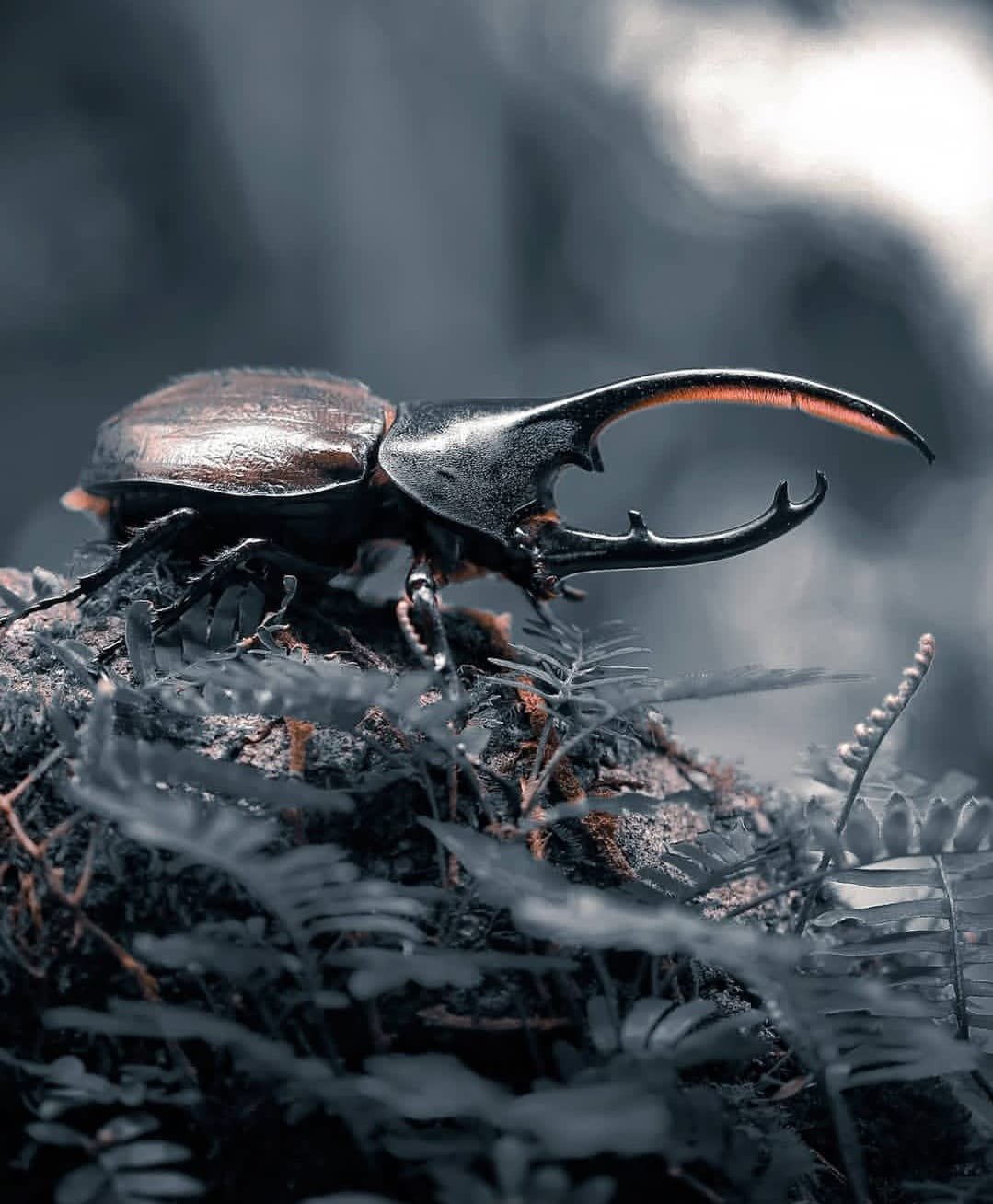
Deep in the forests of Panama, particularly in the cooler, wetter forests of the mountains, lives an insect that seems almost too spectacular to be real. It is enormous, heavily armored, equipped with dramatic horns, and capable of making a surprisingly intimidating noise.
This is the Hercules beetle, Dynastes hercules.
For anyone exploring Panama's forests, discovering one of these giants can be an unforgettable wildlife encounter. And unlike a jaguar, monkey or sloth, you don't necessarily need to hike for hours looking for it. On the right night, a Hercules beetle can sometimes appear around lights, resting on vegetation, tree trunks or the walls of buildings near forest.
Panama is part of the natural range of the species, with the Central American form occurring from southern Mexico through Central America. Records and studies of the species place it in Panama's forest environments, particularly broadleaf and montane forests.
The beetle that looks like a weapon
The first thing you'll notice about a male Hercules beetle is the horns.
And they aren't subtle.
A large male has two enormous horn structures, one extending from the head and another from the thorax. Together they create the unmistakable appearance that gave the beetle its mythological name.
Females look completely different. They don't have the spectacular horns and are generally much less dramatic in appearance. The horns are primarily associated with males and are used in competition between males.
When two males encounter each other, they can use those horns to wrestle. The objective isn't necessarily to kill the opponent. Instead, males can attempt to grab, lift and throw one another, effectively competing for access to females or a favorable position.
It's basically a tiny jungle wrestling match involving one of the world's most heavily armed insects.
They can be surprisingly large
The Hercules beetle is one of the largest beetles on Earth and is famous for its extraordinary length.
Some specimens can reach around 15 centimeters, although enormous individuals are considerably less common than the internet photographs might make you believe. Central American literature reports adults in the range of approximately 7–15 cm.
Part of that impressive length comes from the male's horns.
This creates one of the most interesting things about Hercules beetles: two males of the same species can look dramatically different depending on their size and horn development.
A smaller male may have relatively modest horns, while a large male can look like an entirely different creature.
Panama is perfect Hercules beetle country
The Hercules beetle is associated with tropical forest, and Panama provides an extraordinary variety of suitable environments.
The species has been documented in Panama, and Central American populations occur in forest habitats ranging from lower elevations into mountain forests. One source describes Dynastes hercules septentrionalis from southern Mexico through Panama, including broadleaf rainforest and montane broadleaf forest between approximately 500 and 2,000 meters.
That makes Panama's mountain forests particularly interesting places for anyone fascinated by giant insects.
Think about the kind of environment where you'd expect to encounter one: enormous trees, high humidity, fallen logs slowly decomposing on the forest floor, thick vegetation and darkness after sunset.
That isn't just scenery.
It's the Hercules beetle's world.
The real giant isn't the adult
Here's the part that surprises most people.
The spectacular horned adult you see crawling through the forest represents only a small portion of the animal's life.
For much of its existence, a Hercules beetle is a grub living inside decaying wood.
The larvae are saproxylophagous, meaning they feed on dead and decaying wood. They develop in rotten logs and decomposing tree trunks.
So while visitors are fascinated by the enormous adult beetle, the forest's fallen trees are quietly supporting an entirely different stage of its life.
A rotting tree isn't necessarily a dead piece of scenery.
It can be an entire ecosystem.
Inside it, beetle larvae can spend months developing while microorganisms, fungi and other decomposers break down the wood around them.
It takes a long time to become a Hercules beetle
Hercules beetles don't rush.
Their transformation from egg to adult can take roughly 19–21 months under laboratory conditions, with the larval period accounting for the vast majority of that time.
The process begins with an egg.
Then comes the larval stage, when the animal looks nothing like the famous adult. It becomes a large grub and spends a long period developing inside decaying wood.
Eventually it forms a pupa.
Inside the pupal chamber, the transformation takes place.
The grub that spent much of its life eating rotten wood eventually emerges as the extraordinary armored beetle that people recognize as a Hercules beetle.
It is one of nature's more spectacular examples of complete metamorphosis.
Why are the beetles sometimes different colors?
Another fascinating feature of Dynastes hercules is its coloration.
The wing covers, known as the elytra, can appear greenish or yellowish, but their color can change dramatically with humidity.
Researchers have documented how fluctuations in relative humidity can cause the beetle's elytra to rapidly change from green toward black.
That means the same beetle can look surprisingly different depending on the conditions.
In the humid Panamanian rainforest, where moisture can change dramatically between different environments and times of day, this becomes particularly interesting.
The beetle isn't simply wearing a fixed color.
Its body is responding to the environment.
Don't be afraid of the horns
If you're visiting Panama and encounter a Hercules beetle, there's no reason to panic.
Those enormous horns look dangerous, but they aren't designed to attack humans.
The male uses them primarily in competition with other males.
In fact, one of the strangest things about seeing a Hercules beetle up close is realizing that an animal that looks so intimidating is generally far less threatening than its appearance suggests.
It is not a predator hunting people.
It's a beetle living its life in the forest.
And if you leave it alone, it has little reason to bother you.
Listen carefully at night
Hercules beetles are particularly fascinating after dark.
Like many rhinoceros beetles, members of the dynastine scarab group are associated with nighttime activity and are often attracted to lights.
This is one reason night walks in Panama can reveal creatures that visitors would never see during the day.
A daytime hike might produce monkeys, birds, butterflies and lizards.
A nighttime walk changes the entire cast.
Suddenly there are katydids calling from the trees, moths circling lights, frogs hiding beside streams, spiders waiting on vegetation and enormous beetles appearing from the darkness.
And occasionally, one of those beetles can be a Hercules.
And then it makes a noise...
Here's another surprise.
Hercules beetles can stridulate, producing a sound by rubbing parts of their body together.
The sound can be used as a defensive behavior, and it is one of those bizarre characteristics that makes the beetle even more interesting once you know about it.
Imagine walking through a dark Panamanian forest.
You hear insects everywhere.
Then something large moves against a piece of bark.
You shine your flashlight toward it.
And sitting there is a giant horned beetle.
You pick it up carefully or observe it from the ground.
Then it starts making a strange rasping or buzzing sound.
For a first-time visitor, it can feel like you've discovered a creature from another planet.
The forest needs Hercules beetles
The Hercules beetle is also a reminder of how important dead trees are to tropical forests.
It's easy to look at a fallen tree and think of it as something the forest has finished with.
In reality, the opposite can be true.
Dead wood becomes habitat.
Fungi colonize it.
Microorganisms break it down.
Invertebrates move into it.
Larvae feed within it.
Predators search it.
Eventually, nutrients return to the soil.
The Hercules beetle is one small participant in this enormous recycling system.
The giant adult gets all the attention because it looks incredible, but the humble decomposing log is arguably just as important to the species.
Why seeing one in Panama is special
Panama is famous for spectacular animals.
Visitors come looking for sloths, monkeys, toucans, frogs and crocodiles.
But some of the country's most extraordinary wildlife is hiding at a completely different scale.
The Hercules beetle is a perfect example.
It isn't necessarily going to leap dramatically out of the forest.
It may simply be sitting quietly on a tree.
And because insects are so often overlooked, a traveler can walk straight past an extraordinary creature without realizing what is there.
That's why slowing down matters.
Look at the tree trunks.
Check the leaves.
Watch around lights at night.
Pay attention to fallen wood.
And don't assume that something crawling along the forest floor is just "another beetle."
Panama has 157 documented species of dynastine scarab beetles across Panama and Costa Rica, according to Brett Ratcliffe's comprehensive treatment of the group. The Hercules beetle is just one member of an astonishingly diverse community of rhinoceros beetles.
A jungle legend hiding in plain sight
Perhaps the best thing about the Hercules beetle is that it changes the way you see the Panamanian forest.
A giant fallen tree is no longer just a fallen tree.
A strange noise at night might not be a bird.
A shadow crawling across a trail might turn out to be one of the largest beetles you've ever seen.
And a seemingly ordinary patch of rainforest can contain animals that have spent nearly two years developing in complete darkness before emerging for their brief adult existence.
The Hercules beetle is enormous, bizarre, powerful-looking and almost prehistoric.
But it isn't a monster.
It is a tiny piece of Panama's enormous ecological machine.
And if you're lucky enough to encounter one during a night walk, stop, look closely and appreciate it.
Because in a country overflowing with spectacular wildlife, the Hercules beetle is one of the creatures that proves you don't always have to look up into the trees to find something extraordinary.
Sometimes the jungle's biggest secrets are crawling beneath your feet.