
Panama is almost unfairly well designed for backpacking.
It is small enough that you can cross the country without spending your entire vacation on buses, yet geographically diverse enough to feel like you've travelled through several different countries. In a matter of days, you can go from skyscrapers and colonial streets to Caribbean islands, volcanic mountains, Pacific surf, cloud forest, Indigenous communities and remote jungle.
And that is what makes backpacking Panama so addictive.
You aren't simply moving from one attraction to another. You're watching the landscape, climate, culture and atmosphere completely transform as you move across the isthmus.
A popular backpacker route runs from Panama City to the San Blas Islands, El Valle de Antón, Santa Catalina, Boquete, Lost and Found Hostel and finally Bocas del Toro, although there are countless ways to rearrange it.
The beauty of Panama is that you don't need to see everything. You just need to understand the highlights and build a route that gives you enough time to actually experience them.
Start in Panama City
For most backpackers, Panama City is the natural starting point.
And what a beginning it is.
You arrive expecting tropical Central America and instead find yourself staring at one of the most dramatic skylines in the region. Huge glass towers rise beside the Pacific, while just a short distance away are the crumbling ruins and colorful colonial buildings of Casco Viejo.
Panama City is a city of contrasts.
One minute you're walking through narrow streets surrounded by churches, plazas and centuries old architecture. The next you're surrounded by skyscrapers, shopping centers, modern restaurants and traffic.
For backpackers, Casco Viejo is usually the place where the city feels most social. It's a great area to wander around, eat, have a drink and meet other travellers before heading into the rest of the country.
But don't spend your entire Panama City experience inside the tourist bubble.
Visit the Panama Canal. Walk around different neighborhoods. Explore the waterfront. Eat local food. Take public transportation. Watch the city come alive in the evening.
The Canal is particularly important because it isn't simply another attraction. It is the reason Panama became so strategically important to the modern world.
And when you stand beside the locks and watch an enormous ship squeeze through a waterway connecting two oceans, it becomes much easier to understand why.
Then Head for the San Blas Islands
From the modern intensity of Panama City, the San Blas Islands feel like you've entered another universe.
The Guna Yala archipelago contains hundreds of islands scattered across the Caribbean, although only a fraction are inhabited. Tiny palm covered islands sit in brilliant turquoise water, and traditional Guna communities maintain a strong cultural presence throughout the region.
This is one of those places where photographs genuinely struggle to capture what you're seeing.
The islands are tiny.
The water is enormous.
The beaches can be spectacular.
And the experience is deliberately much simpler than the polished resort environment you'll find elsewhere.
For backpackers, San Blas is less about checking off individual attractions and more about slowing down. Swim. Snorkel. Sit in a hammock. Watch the sunset. Eat freshly prepared food. Talk to other travellers. Learn a little about Guna culture.
And don't expect luxury.
That's part of the appeal.
You're going to the Caribbean to experience islands, not to recreate a five star hotel.
Return to Panama City and Head Toward El Valle
After San Blas, many backpackers return to Panama City before continuing west.
The next stop is El Valle de Antón, a mountain town located inside the crater of an extinct volcano.
The atmosphere changes almost immediately.
The skyscrapers disappear.
The temperature becomes more comfortable.
The mountains surround you.
And suddenly the trip feels like a completely different Panama.
El Valle is ideal for a couple of nights. Hike. Visit waterfalls. Explore the market. Walk around town. Look for wildlife. Enjoy the cooler mountain air.
It is also a perfect introduction to the country's highland environments before you head farther west.
And then comes one of the best things about backpacking Panama.
You don't have to fly.
You can simply keep moving.
Santa Catalina: Panama's Pacific Adventure
Eventually you reach Santa Catalina.
The atmosphere changes again.
Santa Catalina is a small Pacific surf town where life revolves around waves, boats, fishing, diving and the ocean.
This is where backpacking Panama starts to feel properly adventurous.
You can surf.
You can dive.
You can snorkel.
You can take boats toward Coiba National Park.
You can spend an afternoon doing absolutely nothing except sitting near the ocean.
Coiba is particularly significant. The protected waters around the national park are renowned for marine life, and diving is one of the major reasons travellers make the journey to this relatively remote part of Panama. Current backpacker routes regularly include Santa Catalina specifically because of its access to Coiba and its Pacific surf culture.
Santa Catalina also has something that backpackers tend to love.
It isn't trying too hard.
There aren't endless attractions.
There is simply the ocean.
And sometimes that's enough.
Then Start Climbing Into the Mountains
From Santa Catalina, you can continue toward western Panama and the mountains of Chiriquí.
This is where the country's scenery becomes spectacularly different.
The hot Pacific coast begins disappearing behind you.
The road climbs.
The vegetation changes.
Mountains rise around you.
The air becomes cooler.
And eventually you reach Boquete.
Boquete: Coffee, Mountains and Cool Air
Boquete is probably Panama's most famous mountain destination.
It is almost the opposite of the Caribbean.
Instead of palm trees and humid beaches, you get mountain valleys, coffee plantations, rivers, flowers, hiking trails and a noticeably cooler climate.
For backpackers, Boquete offers plenty to do.
You can explore coffee farms, hike through cloud forest, chase waterfalls, visit hot springs, eat extremely well and attempt the demanding journey toward Volcán Barú.
You can also simply wander around town.
That's one of the pleasures of Boquete. You don't necessarily have to fill every hour with an organized tour.
Grab a coffee.
Walk around.
Meet travellers.
Find a local restaurant.
Explore the surrounding countryside.
Then decide what you want to do tomorrow.
But there is another destination nearby that many backpackers discover almost by accident.
And for some, it becomes one of their favorite stops in the entire country.
Lost and Found Hostel: The Stop You Didn't Know You Needed
Hidden in the cloud forest of Chiriquí, between David and Bocas del Toro, is Lost and Found Hostel.
And calling it simply a hostel doesn't really explain the experience.
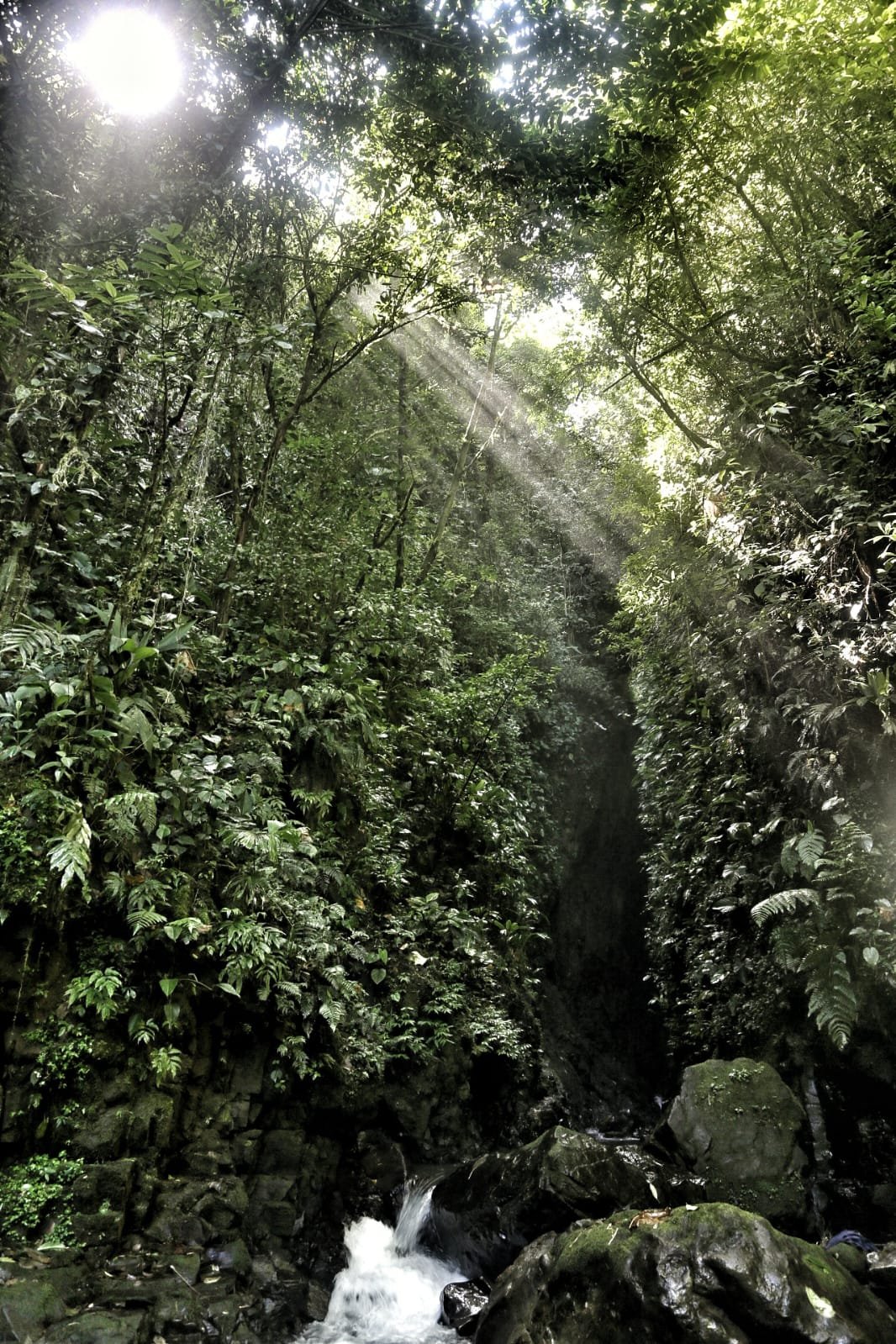
It is a jungle hostel reached by hiking uphill from the highway, surrounded by cloud forest, trails, wildlife and mountain views.
The location is one of its biggest advantages.
Lost and Found sits directly on Highway 10 between David and Bocas del Toro, meaning it naturally fits into the classic western Panama backpacker route rather than requiring you to make a major detour. The hostel itself describes its position as being along routes connecting Bocas, Boquete, Panama City, Santa Catalina and David.
That makes it the perfect place to break up the journey.
Instead of spending an entire day staring through a bus window while crossing western Panama, you can stop in the cloud forest for a couple of nights.
And then the character of the trip changes again.
The beaches disappear.
The heat fades.
The jungle takes over.
You hike through forest.
You search for wildlife.
You discover waterfalls and hidden swimming areas.
You meet other backpackers.
And because you're staying somewhere isolated from the normal tourist infrastructure, people tend to actually spend time together.
That social aspect is a huge part of the backpacking experience.
A traveller might arrive intending to stay one night and suddenly realize that another night would be a pretty good idea.
That's the magic of a good hostel.
It's not simply somewhere to sleep.
It's somewhere that changes the trip.
Lost and Found Is Also a Brilliant Travel Break
One of the cleverest things about the location is that it breaks up the journey between destinations.
The hostel is directly along the route between David and Bocas del Toro, and travellers can reach it by public bus or shuttle. The hostel's current directions note that buses from David and Bocas can drop travellers nearby.
The public bus option is particularly interesting for backpackers because you get to experience a more local side of Panama rather than travelling entirely by tourist shuttle.
And that's part of the fun.
Your backpacking trip becomes less about perfectly organized transportation and more about figuring things out.
You get on the bus.
You tell the driver where you're going.
You watch the scenery change.
And eventually you step off beside a jungle trail.
That is backpacking.
The Famous Jungle Treasure Hunt
Lost and Found also has something that is very different from the typical hostel experience.
Its famous treasure hunt turns the surrounding property into an adventure.
Instead of simply hiking from point A to point B, you're following clues and exploring the landscape.
It has become part of the hostel's identity and gives travellers something unusual to do together.
It's exactly the sort of experience that creates backpacker stories.
Years later, people may not remember the name of every restaurant they visited in Panama.
They'll remember getting lost in the jungle with a group of strangers while trying to solve a ridiculous clue.
That's what you want from backpacking.
From Lost and Found to Bocas del Toro
Eventually, you leave the mountains and continue toward the Caribbean.
And suddenly Panama changes again.
Bocas del Toro is chaos in the best possible way.
Boats replace buses.
Palm trees replace mountains.
Caribbean music drifts through the streets.
Backpackers fill hostels and bars.
People spend their days jumping between islands, beaches, snorkeling spots and boat trips.
Isla Colón is the main hub, with restaurants, accommodation, nightlife and transportation. From there you can explore other islands including Bastimentos and Carenero.
Starfish Beach is famous for its calm Caribbean atmosphere.
Red Frog Beach offers another classic island experience.
Playa Bluff attracts surfers.
And the boat rides themselves become part of the adventure.
Bocas has a reputation for being a party destination, and there is certainly nightlife, but you don't have to spend your entire stay drinking.
You can snorkel.
Kayak.
Surf.
Hike.
Look for wildlife.
Explore islands.
Watch sunsets.
Or simply sit beside the water and wonder why you ever thought you needed to return home.
The variety of islands is one of Bocas' biggest attractions, with different islands offering different atmospheres.
The Magic Is in the Contrast
This is why backpacking Panama works so well.
Imagine the sequence.
You begin surrounded by skyscrapers in Panama City.
Then you sleep on a tiny Caribbean island in San Blas.
You return to the city and travel into the mountains of El Valle.
You continue toward the Pacific and find yourself in Santa Catalina, where the ocean dominates everything.
You climb into the mountains and drink coffee in Boquete.
You disappear into cloud forest at Lost and Found Hostel.
Then you descend toward the Caribbean again and finish surrounded by boats, islands and backpackers in Bocas del Toro.
That is an astonishing amount of variety for one country.
And you don't need to take a plane between every stop.
Don't Rush It
The biggest mistake you can make backpacking Panama is trying to conquer it.
You can technically move incredibly quickly.
But why?
Panama rewards slow travel.
Stay an extra night when you meet a good group of people.
Stay longer in Boquete if you're enjoying the mountains.
Spend another day in Santa Catalina if the surf is good.
Don't immediately leave Bocas because your itinerary says you should.
And if Lost and Found is turning into one of those unexpected places where everyone is having a great time, don't be afraid to change your plans.
Backpacking is supposed to have some flexibility.
The best stories often begin with:
"We weren't actually planning to stay there."
The Route Is the Attraction
There is another reason Panama is so satisfying for backpackers.
The transportation itself becomes part of the experience.
You take buses through countryside.
You cross mountains.
You take water taxis between Caribbean islands.
You walk jungle trails.
You share shuttles with strangers.
You watch the landscape change through a bus window.
You learn which terminal you need.
You learn how much things cost.
You learn enough Spanish to tell a driver where you're going.
And eventually you stop feeling like a tourist being transported between attractions.
You start feeling like a traveller moving through a country.
That's a big difference.
Panama Is Not Just Beaches
One of the biggest misconceptions about Panama is that it's mainly about beaches.
The beaches are incredible.
But Panama's real strength is contrast.
You can have a beach morning and a mountain afternoon.
You can go from Caribbean islands to cloud forest.
You can go from modern skyscrapers to Indigenous communities.
You can go from surfing on the Pacific to drinking coffee in the highlands.
You can spend one night in a city and the next in the jungle.
And that's why Panama works so well for backpackers who want variety.
The Backpacker Route Doesn't Have to Be Perfect
There is no single correct Panama itinerary.
Some travellers start in Panama City and go straight to Bocas.
Others begin in Bocas and work westward.
Some skip San Blas.
Others consider it the highlight.
Some spend a week surfing in Santa Catalina.
Others barely stop.
Some fall in love with Boquete.
Others prefer the jungle.
And some arrive at Lost and Found intending to stay two nights and end up completely changing their plans.
That's the beauty of backpacking.
You don't have to travel Panama according to somebody else's schedule.
Use the famous destinations as a framework.
Then allow the country to interfere with your plans.
The Panama Backpacking Experience
The best thing about backpacking Panama isn't actually any single destination.
It's the feeling of moving between completely different worlds.
The skyline of Panama City.
The islands of San Blas.
The mountains of El Valle.
The waves of Santa Catalina.
The coffee country of Boquete.
The cloud forest and backpacker community at Lost and Found.
The Caribbean madness of Bocas del Toro.
Each destination gives you something different.
And when you put them together, they create a journey that feels much bigger than Panama's size suggests.
You don't need months.
You don't need luxury transportation.
You don't need an enormous budget.
You need a backpack, some flexibility, enough time to slow down and a willingness to occasionally take the road that looks a little less straightforward.
Because that's when Panama really starts to reveal itself.
The famous places are worth visiting. But the magic happens somewhere between them.
It happens on the bus climbing into the mountains.
It happens when a water taxi drops you onto a Caribbean island.
It happens when you step off a bus beside a jungle trail and realize your hostel is hidden somewhere up the hill.
It happens when strangers you met yesterday suddenly become your travel companions for the next week.
It happens when you intended to stay two nights and stay five.
And eventually, somewhere between the Pacific waves, cloud forests, Caribbean islands and Panamanian cities, you stop simply backpacking through Panama.
You realize you're actually backpacking inside it.
And that is when the country becomes unforgettable.