
Panama is one of those rare countries where you can be walking down a jungle trail one minute and suddenly find yourself being watched from the canopy by a monkey. Sometimes you hear them before you see them—a branch crashing somewhere above, a series of strange calls echoing through the forest, or the unmistakable roar of a howler monkey rolling across the mountains. With forests stretching from the Caribbean to the Pacific and from the lowlands into the cloud forests, Panama provides habitat for an impressive variety of tropical primates.
There are five native species of monkeys commonly recognized in Panama, representing several very different lifestyles. Some are loud and easy to locate, some are tiny and difficult to spot, and others can disappear into the vegetation so completely that you may walk directly beneath them without ever knowing they are there.
Howler Monkeys: The Jungle Alarm Clock
If you spend enough time in the Panamanian countryside, you will almost certainly hear a howler monkey before you see one.
The mantled howler monkey is famous for producing one of the loudest calls of any land animal. Their deep, booming roar can travel enormous distances through the forest. To someone hearing it for the first time, it can sound surprisingly dramatic—almost like some enormous creature is moving through the jungle.
Despite their intimidating voices, howler monkeys are largely peaceful, slow-moving animals. They spend much of their time high in the canopy eating leaves, flowers and fruit. Their digestive system is adapted to a diet containing large quantities of leaves, allowing them to survive on food that many other monkeys cannot efficiently process.
Their lifestyle is remarkably energy-efficient. Rather than constantly jumping around the forest searching for food, they often sit quietly for long periods, conserving energy while digesting their leafy meals.
Early morning is one of the best times to hear them. A group may begin calling from one part of the forest, followed by another group answering from somewhere far away. The result is a bizarre natural conversation bouncing through the trees.
White-Faced Capuchins: Panama's Curious Opportunists
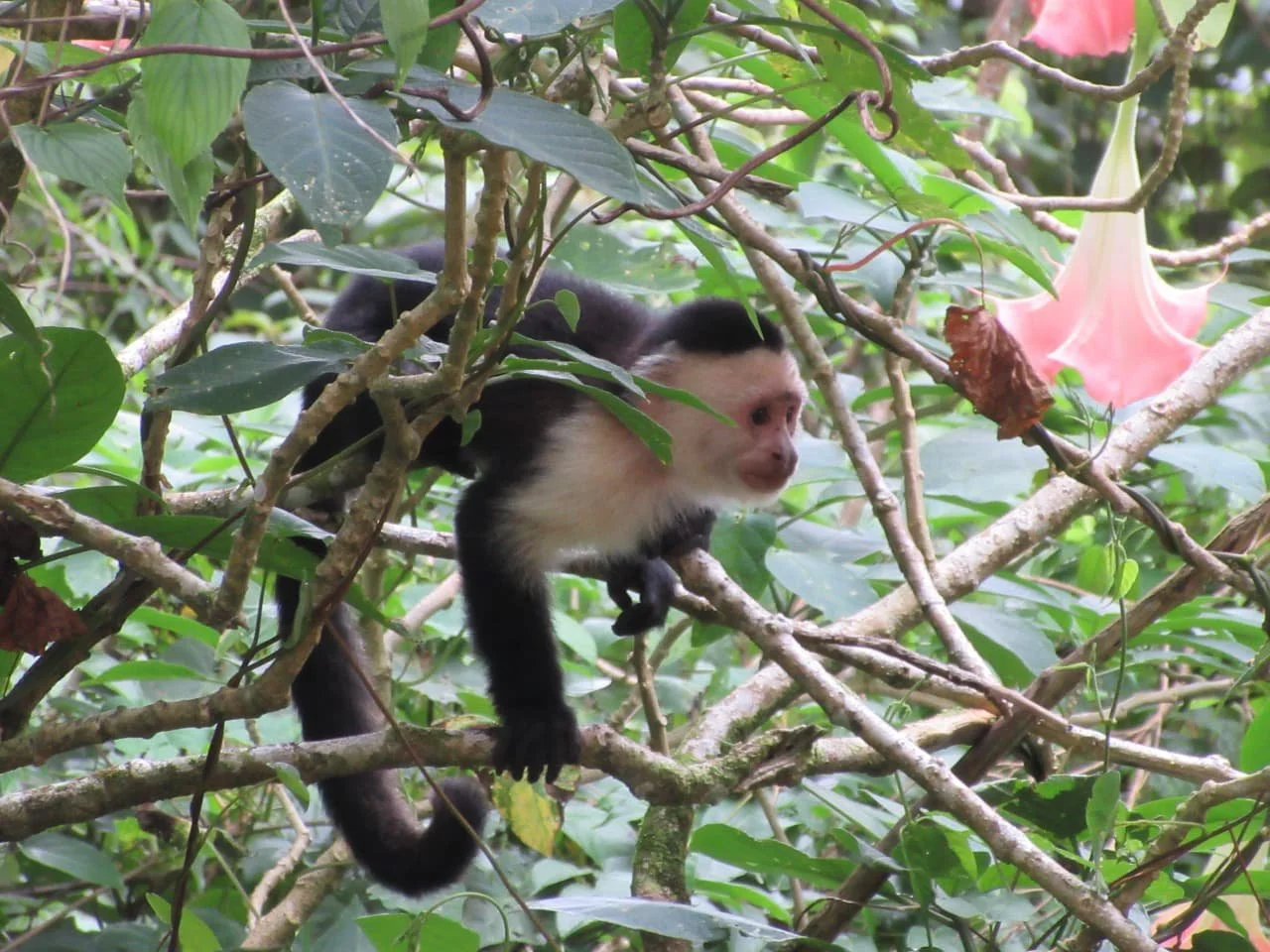
The white-faced capuchin, also called the white-headed capuchin, is probably one of Panama's most recognizable monkeys.
These intelligent animals are highly adaptable and can live in a remarkable variety of environments, from deep rainforest to secondary forest and areas influenced by humans. They are also extremely active. Unlike the relatively relaxed lifestyle of howler monkeys, capuchins are constantly investigating their surroundings.
A troop moving through the canopy can be an incredible spectacle. One monkey disappears behind a tree, another leaps across a gap, another hangs upside down from a branch, and suddenly the entire group seems to be moving in every direction.
Capuchins are omnivores and have an unusually varied diet. They eat fruit, seeds, insects, eggs and other small food items. Their intelligence allows them to exploit many different food sources.
They are also famously inquisitive. If you are carrying food through the forest, a capuchin may be considerably more interested in your backpack than you would prefer.
That curiosity is exactly why travelers should never feed wild monkeys. Once monkeys associate humans with food, their behavior can change rapidly. They can become aggressive, steal belongings and lose their natural fear of people.
Geoffroy's Tamarins: The Tiny Acrobats
One of Panama's smallest monkeys is the Geoffroy's tamarin.
These little primates are dramatically different from the large howler monkeys. They are lightweight, fast and incredibly agile, frequently moving through the vegetation with rapid jumps and short bursts of movement.
Their small size allows them to exploit food sources that larger monkeys cannot easily reach. They consume fruit, insects, nectar and other small food items.
Tamarins are particularly interesting because their social groups can be quite coordinated. When traveling through the forest, you may see several individuals moving together, communicating constantly with calls and visual signals.
Finding one can be considerably harder than finding a howler monkey. You might hear their calls and know they are nearby, yet still struggle to locate them among the leaves.
For wildlife watchers, however, that difficulty makes an encounter even more rewarding.
Spider Monkeys: The Acrobats of the Canopy
Spider monkeys are among the most spectacular primates you can encounter in Panama.
The Geoffroy's spider monkey, sometimes called the black-handed spider monkey, is built for life high above the forest floor. Their extraordinarily long arms, legs and prehensile tail allow them to travel through the canopy with remarkable efficiency.
That tail is particularly impressive. It functions almost like an additional limb, helping the monkey grip branches and stabilize itself while reaching for food.
Watching spider monkeys travel through mature rainforest can feel like watching a completely different form of movement. They don't necessarily climb down trunks and walk from tree to tree. Instead, they swing, stretch, reach and launch themselves between branches.
They are heavily dependent on healthy forest ecosystems, particularly large mature trees that provide food and pathways through the canopy. Consequently, habitat loss can be particularly damaging to them.
For travelers interested in wildlife, seeing spider monkeys in a genuinely wild forest is one of Panama's great experiences.
Squirrel Monkeys: The Hyperactive Little Troops
The Central American squirrel monkey is another small, highly active species found in Panama.
These monkeys are famous for their energetic behavior. A troop can move through vegetation at remarkable speed, with individuals constantly searching for fruit, insects and other food.
Unlike some larger monkeys that spend considerable amounts of time sitting and feeding, squirrel monkeys seem to operate at a completely different speed.
They are social animals and frequently travel in groups. Their small bodies and agility allow them to exploit the thinner branches and tangled vegetation where larger monkeys would have difficulty moving.
Squirrel monkeys are particularly associated with parts of western Panama and the forests of the country's Pacific side.
Not Every Monkey You See in Panama Is Wild
One important thing to remember while traveling around Panama is that seeing a monkey does not necessarily mean you've discovered a wild population.
Monkeys sometimes appear around tourist attractions, rescue centers and private properties. Some may have been rescued from illegal wildlife trafficking or the pet trade. Others may simply have become accustomed to humans.
A genuinely wild monkey will usually behave differently. It may watch you briefly, ignore you completely or disappear rapidly into the vegetation.
And that's exactly what you want.
The best wildlife encounter isn't necessarily the monkey that comes closest. It is the one you see behaving naturally.
Where Can You See Monkeys in Panama?
You can potentially encounter monkeys in forests throughout much of Panama, but your chances depend heavily on the species and habitat.
Bocas del Toro is particularly interesting for wildlife enthusiasts, with extensive rainforest and island ecosystems.
Chiriquí offers another fascinating environment, especially around the foothills and cloud forests. The transition from lowland tropical forest into higher elevations creates an impressive variety of habitats.
Soberanía National Park, close to Panama City, is one of the easiest places for travelers to experience genuine tropical rainforest without traveling deep into the country.
Coiba National Park is also famous for its wildlife, although its isolated ecosystems have their own distinctive character.
And then there are the countless smaller forests, reserves and jungle corridors scattered across the country.
For backpackers, this is one of Panama's great advantages: you don't necessarily need an expensive safari to encounter wildlife. Sometimes all you need is a trail, a little patience and the willingness to stop walking and listen.
The Secret to Finding Monkeys
The biggest mistake people make when searching for wildlife is walking too quickly.
The jungle can look completely still while being packed with animals.
Stop.
Listen.
Look upward.
Search the branches rather than just the ground.
With howler monkeys, listen for the enormous calls. With capuchins, watch for movement and falling leaves or branches. With tamarins and squirrel monkeys, listen for rapid vocalizations and scan the thinner vegetation.
And don't forget to look for evidence. Fruit dropping from trees, broken branches, feeding remains and animal calls can all tell you that something is nearby.
Panama's monkeys aren't zoo animals waiting beside a viewing platform. They are living pieces of the rainforest, following their own schedules and completely indifferent to whether a traveler manages to photograph them.
That unpredictability is what makes seeing one so exciting.
You might spend two hours walking through the jungle and see nothing.
Then suddenly, a branch moves above you.
You look up.
Two eyes are staring back.
And for a few seconds, the enormous rainforest feels much smaller.