
Panama is one of the most exciting birding destinations in the Americas, but you would never know it from the way birding is sometimes marketed. Pictures of expensive jungle lodges, professional guides, enormous camera lenses and private 4x4 vehicles can make it seem like seeing Panama’s birds is an activity reserved for wealthy wildlife enthusiasts. The reality is completely different. You do not need to spend a fortune to go birding in Panama. In fact, some of the best birding experiences can cost almost nothing beyond the accommodation, transportation and food you were already going to pay for as a backpacker. Panama is blessed with an extraordinary variety of habitats, from tropical rainforest and cloud forest to mangroves, wetlands, beaches, agricultural land and mountain forests. More than 1,000 bird species have been recorded in the country, and its position between North and South America makes it an incredibly important crossroads for both resident and migratory birds.
The greatest advantage of birding in Panama is that the birds do not care how much money you have. A toucan does not know whether you are staying in a luxury ecolodge or sleeping in a backpacker dorm. A hummingbird does not care whether your binoculars cost $2,000 or whether you are watching it with your eyes. A motmot does not care whether you hired a private guide. The bird is still going to sit in the tree, fly through the forest or feed on a flower regardless of your budget. This makes birding one of the most accessible wildlife experiences you can have while traveling through Panama.
You can begin without buying anything at all. Walk outside early in the morning and simply pay attention. Listen to the calls coming from the trees. Watch birds sitting on wires. Look at flowering plants. Scan fruit trees. Watch the edges of forests. Look above the canopy. Check open fields and rivers. Even if you don't know the names of the birds you see, you can begin learning their shapes, colors, behavior and calls. A smartphone is already enough to take photographs, record sounds and help identify species later. If you eventually decide that you enjoy birding, an inexpensive pair of binoculars can make an enormous difference, but you certainly don't need expensive equipment to begin.
One of the biggest secrets to successful birding in Panama is to stop thinking that you need to constantly walk. Sometimes the best thing you can do is simply sit down and wait. Tropical forests can appear chaotic at first, but once you become quiet, an incredible amount of activity begins to reveal itself. A hummingbird may appear at a flower for a few seconds. A small flock may move through the canopy. A woodpecker may begin hammering on a dead tree. A toucan may land on a distant branch. A strange call may come from somewhere behind you. The longer you stay in one place, the more you begin to notice. This is particularly important in Panama because many birds are easier to hear than see.
And then there is the most important rule of all: get up early. Birding at 10 in the morning is not the same experience as birding at dawn. As the sun begins to rise, the forest comes alive. Birds begin calling from every direction, insects become active and the cooler morning temperatures encourage enormous amounts of movement. If you are staying somewhere surrounded by forest, you can step outside before breakfast and potentially experience some of the best wildlife viewing of the entire day. You don't need a tour guide or expensive transportation. You just need to be awake.
This is one of the reasons that staying somewhere like Lost and Found Hostel can work so well for budget birders. Located in the Fortuna Forest Reserve in Chiriquí, the hostel is surrounded by cloud forest rather than being separated from nature by roads and developed areas. Its location gives backpackers the opportunity to explore forest trails directly from the property instead of paying for transportation to a distant birding site. The surrounding area is known for a variety of forest birds, including hummingbirds, tanagers, wrens and trogons.
That is an important concept for budget travelers. Instead of asking yourself, "How much does a birding tour cost?" ask yourself, "Can I stay somewhere where the birds already are?" Accommodation can become part of your birding strategy. A cheap bed beside a forest can be much more valuable to a birder than an even cheaper bed in the middle of a busy town. If you can walk outside your accommodation and immediately reach forest, gardens, rivers, mountains or wetlands, you have essentially eliminated one of the biggest costs of wildlife watching: transportation.
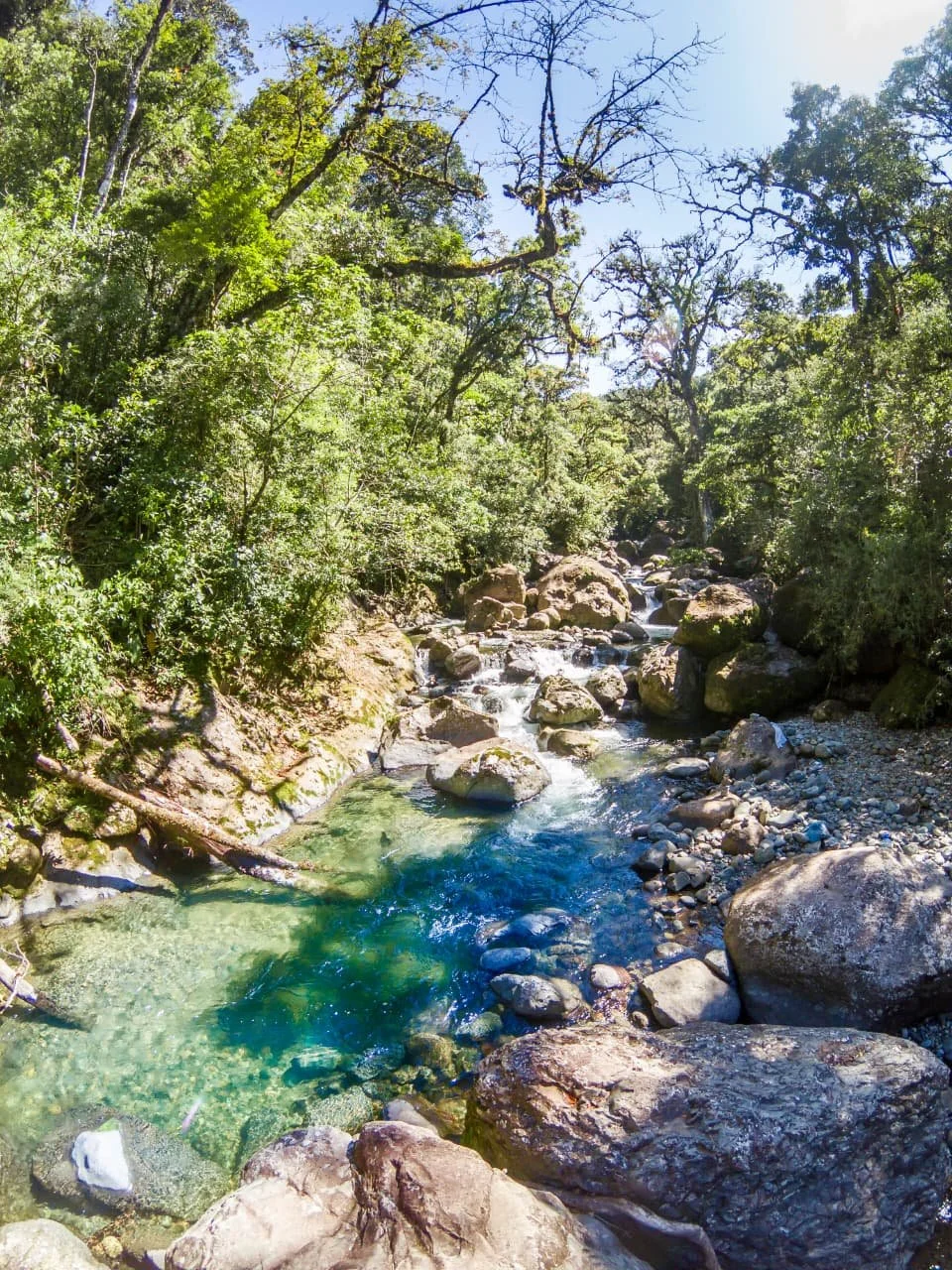
The Fortuna Forest Reserve is particularly interesting because of its elevation and cloud-forest environment. The combination of mountains, humidity and dense vegetation creates habitat for a different collection of birds than you would encounter on Panama's lowland Caribbean or Pacific coasts. Walking through the forest early in the morning can feel almost surreal. Mist hangs between the trees, the vegetation is covered in moisture and the forest constantly changes as birds move through different layers of the canopy. For a backpacker, this is an extraordinary experience because you can spend hours exploring without having to organize an expensive excursion.
Hummingbirds are one of the easiest groups to become obsessed with. They are tiny, incredibly fast and often spectacularly colorful. Panama has numerous hummingbird species, and mountain areas such as Fortuna and the Chiriquí highlands can be particularly rewarding. The Violet Sabrewing, for example, is one of the spectacular hummingbirds associated with the region around Fortuna. You don't need a professional camera to appreciate one. In fact, trying to photograph a hummingbird with a phone can become a comedy routine. You point the camera at it, it disappears, you take a photograph of an empty flower, then it suddenly appears somewhere else. Eventually you get one blurry photograph and become ridiculously proud of it.
Toucans are another obvious attraction. There is something almost absurd about seeing a toucan for the first time in the wild. The huge bill, bright colors and strange proportions make it look almost unreal. Panama is home to several toucan species, including the spectacular Keel-billed Toucan. Once you learn their calls and silhouettes, you may start noticing them far more frequently. They can occur in forest, forest edges and other wooded environments, meaning you don't necessarily need to visit an expensive birding reserve to have a chance of seeing one.
Trogons are another group that can make a normal hike suddenly become unforgettable. These birds can be surprisingly quiet and easy to miss, which makes finding one feel like discovering a secret. You may be walking along a trail when you notice a flash of color sitting motionless on a branch. You raise your binoculars and suddenly realize that you have been walking past an incredibly beautiful bird without even knowing it was there. Collared Trogons are among the birds highlighted in the Fortuna area. This is where patience becomes more valuable than expensive equipment. Someone with modest binoculars who knows how to search the forest can have a much better experience than someone carrying thousands of dollars of camera equipment without knowing what to look for.
Motmots are another favorite among travelers. Their unusual appearance, long tails and relaxed behavior make them particularly memorable. Once you learn what they look like, you start noticing places where they might occur. Again, the trick is not necessarily to find the most expensive birding location. Forest edges, trails, gardens and quiet roads can all produce interesting sightings. One of the great revelations of birding is realizing that you don't necessarily need to travel farther to see more wildlife. Sometimes you simply need to become better at noticing what is already around you.
Another fascinating phenomenon to learn about is the mixed-species flock. In tropical forests, several bird species may move through the vegetation together, feeding as they travel. This can create an extraordinary few minutes for a birder. One small bird catches your attention, then you realize another species is nearby. Then another appears. Instead of seeing a single bird, you suddenly have an entire moving community passing through the forest. When this happens, don't chase the flock. Find a comfortable position and watch carefully. The obvious bird may only be the beginning.
Panama City itself can also be surprisingly good for budget birding. You don't necessarily have to disappear into remote jungle to see interesting species. Parque Natural Metropolitano provides forest habitat within the metropolitan area, and Audubon Panamá organizes birding activities and outings that can be useful for people who want to learn more about Panama's birds. This is perfect for backpackers because you can combine birding with normal sightseeing without spending money on an elaborate expedition.
The forests around the Panama Canal are another major advantage. The Canal Zone contains extensive forest and freshwater habitats, creating opportunities to see an extraordinary range of tropical birds relatively close to the capital. This is one of Panama's great advantages as a birding destination: you can access serious wildlife habitat without having to spend days traveling into remote wilderness.
You can also use public transportation to build your own birding adventure. Instead of paying for private transfers, take a local bus to a town, walk around and explore the surrounding area. Roads through agricultural landscapes can be surprisingly productive. Look at forest edges, fruit trees, streams, fences and isolated trees. Agricultural areas aren't necessarily bad birding habitat. In fact, the boundary between forest and open land can be particularly interesting because it attracts species from both environments.
The same principle applies along the coast. Coastal birding is completely different from cloud-forest birding. Instead of searching through dense vegetation, you can scan beaches, mudflats, mangroves and open water for pelicans, herons, terns, kingfishers, frigatebirds, shorebirds and other species. Panama Bay is especially important for migratory shorebirds, and enormous numbers of birds pass through Panama during migration. Standing beside a wetland and watching birds that have traveled thousands of kilometers is an experience that doesn't require a luxury lodge.
Migration is one of the most incredible aspects of birding in Panama. The country's geographical position means that birds moving between North and South America pass through the country in enormous numbers. Raptors are particularly spectacular during migration, with Panama serving as an important corridor for species such as Turkey Vultures, Broad-winged Hawks and Swainson's Hawks. Audubon Panamá has conducted long-term monitoring of migratory raptors in the country, demonstrating just how significant Panama is for these movements. And once again, you don't necessarily have to spend money to experience it. Sometimes the best birding experience is simply finding a good viewpoint and looking at the sky.
One of the most enjoyable ways to make budget birding more interesting is to create your own Panama bird list. Don't worry about competing with serious birders who have recorded hundreds of species. Start with twenty. Then try to reach fifty. Record the first toucan you see, your first hummingbird, your first trogon, your first motmot, your first kingfisher and your first bird of prey. Eventually, try to identify a bird entirely by its call. That can be surprisingly satisfying. You begin the trip simply looking at colorful animals, and by the end you are walking through the forest listening for specific sounds.
Learning bird calls may actually be the single best way to improve your birding. You don't need to memorize hundreds. Start with a handful of common species. Eventually, the forest begins to sound different. Instead of hearing random noise, you recognize patterns. You hear a familiar call and immediately start looking in the right direction. Sometimes you find the bird. Sometimes you don't. But even when you don't see it, you have learned something.
You can also learn a tremendous amount simply by talking to other birders. Panama has a strong birding and conservation community, and organizations such as Audubon Panamá provide activities, education and birding events. Joining a group outing can give a backpacker access to local knowledge without requiring the cost of a private guide. Someone who knows an area may recognize a bird by its call instantly or know exactly which tree a particular species likes to visit.
Perhaps the most important thing for budget birding is not to measure success by the number of species you see. You might spend three days hoping to see a spectacular bird and instead become fascinated by a common species that you watched for twenty minutes. You might see a toucan for five seconds, or you might watch one feeding for half an hour. Both experiences are valuable. Birding is not simply about collecting names. It is about learning how animals behave and becoming more aware of the environment around you.
And that is where birding becomes much more than another activity to add to a Panama itinerary. It changes the way you travel. You begin noticing which trees are flowering because hummingbirds visit them. You start watching fruit trees because toucans and tanagers may be feeding there. You pay attention to rivers because kingfishers hunt along them. You notice dead trees because woodpeckers use them. You start looking at the sky because migratory raptors might be passing overhead. The jungle stops being a wall of green and becomes a living ecosystem filled with relationships.
That is why Panama is such a fantastic destination for the budget birder. You don't need to spend hundreds of dollars every day. You don't need a private vehicle. You don't need a professional camera. You don't need to stay in a luxury ecolodge. You can take the bus, stay in a hostel, walk into the forest and simply pay attention. A place such as Lost and Found makes that philosophy particularly easy because the accommodation itself is surrounded by the habitat you came to experience.
Ultimately, the cheapest birding trick in Panama is also the simplest: slow down. Walk for ten minutes, then stop for ten minutes. Listen. Look into the canopy. Watch the flowers. Check the branches. Scan the sky. Let the forest forget you are there. Eventually something will move. A hummingbird will flash past. A toucan will call from somewhere above you. A motmot will appear beside the trail. A flock will move through the canopy. And for a few moments, you will be completely absorbed in something that didn't cost you anything.
That is the beauty of birding in Panama. You can spend thousands of dollars if you want to, but you absolutely don't have to. The forest is free, the birds are free, and some of the most extraordinary wildlife experiences in Panama can begin with nothing more than an inexpensive bed, a pair of shoes and the decision to wake up before sunrise.