
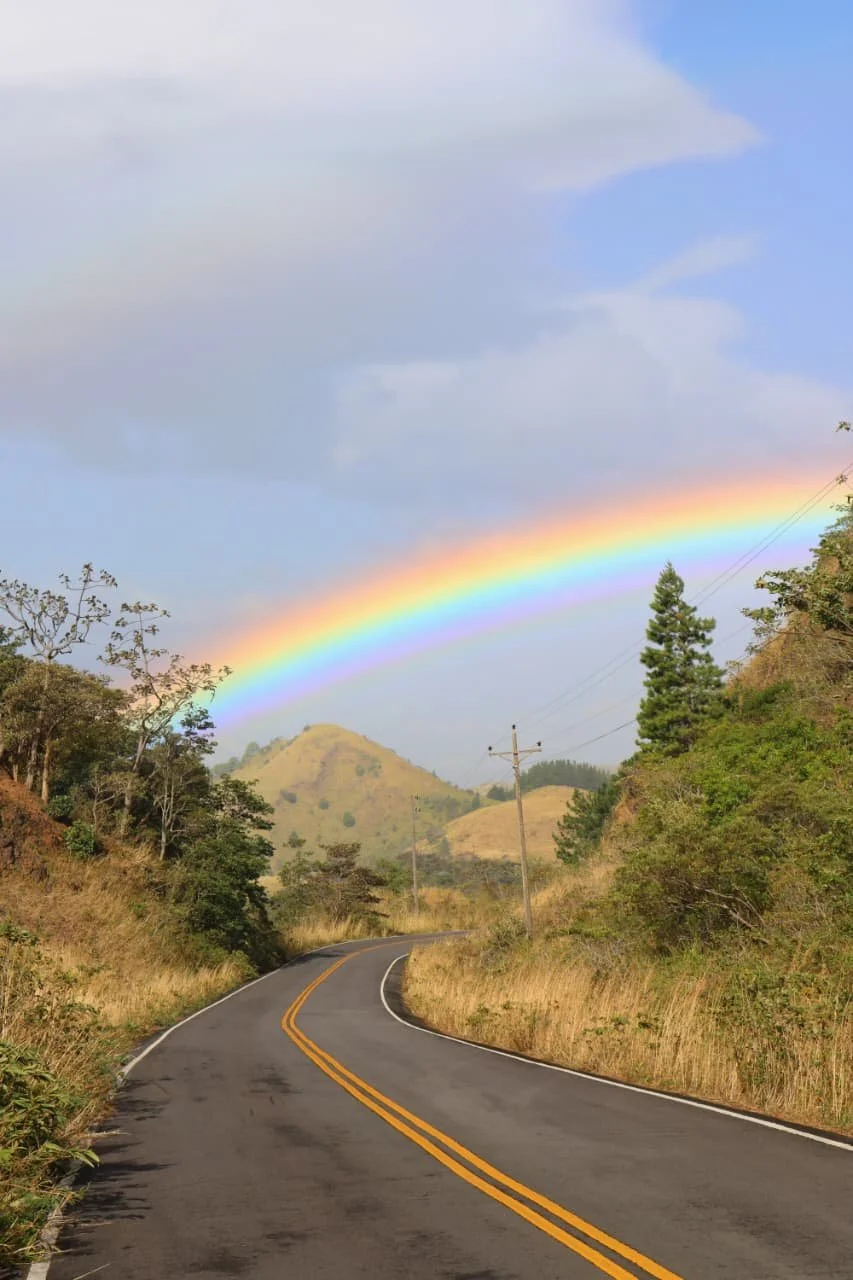
Driving in Panama can be a fantastic way to explore the country. You get freedom, you can stop at roadside fruit stands, detour toward waterfalls, discover tiny villages and reach places that buses simply pass by. But there is one part of driving in Panama that many tourists underestimate: driving after dark.
Panama is not necessarily a dangerous country to drive at night, but nighttime driving can be considerably more challenging than daytime driving, particularly once you leave Panama City and the major highways. A road that looks simple on Google Maps during the day can feel like an entirely different adventure at 9 PM.
For tourists unfamiliar with Panama, arriving somewhere before sunset is often one of the smartest decisions you can make.
The biggest problem is not always the road itself
Panama has some excellent highways, but road quality varies dramatically depending on where you are going. On major routes, you may find well paved roads with clear markings and plenty of traffic. Then you can suddenly turn onto a smaller road where things become much more primitive.
There can be potholes, uneven pavement, construction, missing lane markings, narrow bridges and sections with little or no lighting.
During daylight, most of these things are relatively easy to see.
At night, they can appear only a few metres in front of you.
And that is when driving somewhere unfamiliar becomes much more stressful.
Darkness arrives quickly
Panama is close to the equator, so there is not a long northern European or Canadian style twilight. Once the sun goes down, darkness arrives fairly quickly.
That matters when you are driving toward a destination in the mountains or countryside.
You might leave Panama City at 3 PM thinking you have plenty of time. Suddenly it is 6:30 PM, the sun has disappeared and you still have an hour and a half of winding mountain roads ahead of you.
The destination may not actually be far away.
But the final part of the journey can take much longer than Google Maps suggests, especially if you encounter traffic, roadwork, rain or slow vehicles.
Pedestrians can be difficult to see
One of the biggest surprises for visitors is that people may walk along roads that tourists would consider unsuitable for walking.
In rural areas, pedestrians can be found along the edges of highways and smaller roads, sometimes wearing dark clothing and without reflective material.
At night, they can be extremely difficult to see.
You may also encounter people crossing roads unexpectedly, particularly around villages, shops, bus stops and small communities.
Daylight gives you a much better chance of seeing what is happening around you.
Motorcycles, bicycles and other vehicles
The same applies to motorcycles and bicycles.
Panama has plenty of people who use roads as their everyday transportation, and not every vehicle is equipped or positioned exactly as a North American tourist might expect.
You can also encounter vehicles travelling slowly, vehicles stopping unexpectedly, taxis pulling over or buses picking up passengers.
And then there are the classic nighttime surprises: someone suddenly pulling onto the highway, a motorcycle appearing from nowhere or a vehicle travelling very slowly without much lighting.
Your headlights may reveal the problem eventually.
The problem is that "eventually" is not always soon enough.
Rural Panama gets very dark
This is especially important when heading into the mountains.
Once you leave the larger towns, there may be surprisingly little artificial lighting.
Imagine driving through a tropical forest at night with no streetlights, no buildings and very little traffic. You have headlights illuminating a small tunnel of road in front of you, while everything outside that tunnel is basically black.
It can be beautiful.
It can also be unnerving when you have never driven there before.
In the mountains around places such as Boquete, Santa Fe and the highlands of Chiriquí, roads can become winding and steep. Curves that are easy to read during daylight can be much more difficult after dark.
Rain makes nighttime driving another level of fun
And then Panama decides to add tropical rain.
Heavy rain can arrive suddenly, particularly during the rainy season. Visibility can drop dramatically, water can accumulate on the road and headlights from oncoming vehicles can create additional glare.
Combine:
darkness + unfamiliar road + tropical rain + mountain curves
and suddenly that leisurely afternoon road trip has become considerably more demanding.
This does not mean you cannot drive in the rain.
It means that if you have the choice between arriving at 4 PM or arriving at 9 PM during a tropical downpour, 4 PM is probably going to feel like the better life decision.
Animals are another reason to be careful
Panama is a wildlife rich country, and animals do not understand traffic laws.
At night, wildlife becomes more active. In rural and forested areas you may encounter animals crossing roads or moving along the roadside.
Dogs are particularly common around communities and rural properties. You can also encounter cattle, horses and other livestock near roads.
In more remote areas, wildlife can include everything from small mammals to larger animals.
During daylight, you have a much better chance of spotting an animal before it enters your path.
And if you are driving through Panama's forests, remember that the darkness is not empty.
There may be an extraordinary amount of life happening just outside your headlights.
Google Maps can be optimistic
Another reason to arrive during daylight is simply finding your destination.
Google Maps is extremely useful in Panama, but a navigation app cannot tell you what a road actually feels like.
It may tell you to turn onto a tiny road that appears perfectly reasonable on the map.
Then you arrive and discover a steep dirt track, a narrow concrete road, a rough mountain route or a road that looks completely different from what you imagined.
During daylight, you can stop, look around, ask someone for directions and figure things out.
At midnight, after driving for six hours, it is considerably less amusing.
This becomes particularly relevant with remote hotels, eco lodges, jungle properties and rural accommodations. The final kilometre can sometimes be more complicated than the previous 100 kilometres.
Getting lost is different at night
Getting lost during the day can actually be part of the adventure.
You discover a little town, stop for a coffee, ask someone for directions and eventually find your way.
Getting lost at night is another story.
You may find yourself on an unfamiliar road with poor lighting, weak mobile coverage and no obvious landmarks.
If your accommodation is somewhere surrounded by jungle or mountains, there may be almost nothing outside your headlights to tell you where you are.
That is why arriving before dark is particularly valuable for your first visit to a remote destination.
Once you know the route, driving it later becomes much easier.
Some roads are much more enjoyable during the day
Panama is a country where the journey itself is often part of the attraction.
Driving through the mountains around Chiriquí, for example, can give you spectacular views of valleys, forests, farms and volcanic landscapes.
You can see the Pacific.
You can see mountains.
You can see tropical vegetation exploding across the landscape.
At night, you see... headlights.
That is one of the great tragedies of arriving somewhere beautiful after dark.
You may spend hours driving through some of the most spectacular scenery in Central America without seeing any of it.
Arriving during daylight means you get to experience the landscape rather than simply crossing it.
The first night is the one to plan carefully
If you are renting a car for a Panama trip, consider making your first driving day relatively conservative.
Pick up your vehicle, get comfortable with it and try to reach your destination before sunset.
Once you have driven in Panama for a few days, you will have a much better understanding of local traffic, road conditions, buses, motorcycles, speed differences and how navigation works.
Then you can decide how comfortable you are with nighttime driving.
There is a big difference between choosing to drive at night because you know the route and being forced to drive at night because you underestimated the journey.
The first can be perfectly reasonable.
The second is where problems begin.
What about Panama City?
Driving at night in Panama City is a different experience from driving through rural Panama.
There are plenty of illuminated roads, significant traffic and busy neighbourhoods. But traffic, unfamiliar intersections, motorcycles, pedestrians and confusing road layouts can still make driving more demanding for visitors.
If you are staying in Panama City for your first night, you may actually find it easier to return your rental car or leave it parked and explore using taxis or ride-hailing rather than immediately attempting to navigate the city yourself.
Once you leave the capital, the character of the driving changes considerably.
A good rule for tourists
A simple rule works surprisingly well:
If you are going somewhere you have never driven before, especially somewhere rural or mountainous, try to arrive before dark.
It is not because Panama becomes dangerous when the sun goes down.
It is because everything becomes harder to see and harder to understand.
Roads become less obvious. Animals become harder to spot. Pedestrians become harder to see. Rain becomes more challenging. Navigation becomes less intuitive. Remote properties become harder to find.
And after a long day of travelling, your concentration is probably not at its peak either.
The Panama road trip sweet spot
The best Panama road trips often involve starting reasonably early, enjoying the scenery along the way and reaching your destination with enough daylight left to find your hotel without feeling rushed.
Then you can park the car, grab a cold drink, check in, watch the sunset and start enjoying your destination.
Instead of arriving at 10 PM thinking:
"Where the hell is this place?"
You arrive at 4 PM thinking:
"Wow. Look at this place."
And honestly, in Panama, that extra few hours of daylight can make a surprisingly big difference.