
If you are planning a trip through Central America and someone tells you that Panama and Costa Rica have a rainy season, the obvious response is probably, “Okay, so it rains.” Technically, yes. But that description misses almost everything interesting about travelling through these two countries during their wetter months.
Panama and Costa Rica sit next to each other, share a tropical climate, have mountains covered in rainforest, Caribbean coastlines, Pacific beaches and enough jungle to make you suspicious that the vegetation is actively trying to take over the roads. Yet rainy season can feel surprisingly different depending on where you are. In one place you can wake up to brilliant sunshine, spend the morning hiking, get absolutely hammered by a tropical downpour at three in the afternoon and then be sitting outside drinking a beer under a clear sky by dinner. Somewhere else, you might get cloud and drizzle for most of the day. And on the Caribbean side, the weather can behave as though it never received the memo that there was supposed to be a dry season at all.
This is one of the biggest misconceptions about travelling in Central America: people imagine rainy season as six months of endless rain.
It usually isn't.
In much of Panama and Costa Rica, rainy season is better thought of as a change in the personality of the weather. The atmosphere becomes wetter, the forests become explosively green, waterfalls become more impressive, rivers rise, afternoon storms become more common and the mountains frequently disappear into clouds. Some days can be spectacularly sunny. Other days can be spectacularly wet. Quite often you get both on the same day.
And that is where comparing Panama and Costa Rica becomes interesting.
The basic difference
Costa Rica is probably more famous internationally for its rainforests, wildlife and dramatic wet season, while Panama is sometimes underestimated because people associate it more with the Panama Canal, skyscrapers and tropical beaches. Once you get into the mountains and forests, however, Panama can be every bit as wet, wild and ridiculously green.
Both countries have enormous regional differences, so there is no single “rainy season” that behaves identically everywhere.
Costa Rica's Pacific side generally has a pronounced wet season, with a relatively drier period toward the beginning and end of the year depending on location. The Caribbean side behaves differently and can have substantial rainfall at times when the Pacific coast is enjoying much better weather.
Panama has a similarly complicated situation. The Pacific side generally follows a more recognizable wet and dry season pattern, while the Caribbean side receives more moisture and can have significant rainfall throughout the year. The mountains of western Panama add another layer to the story because elevation changes temperature, cloud formation and rainfall.
So when somebody says, “I'm going to Costa Rica in the rainy season,” or “I'm going to Panama during the rainy season,” the next question should really be:
Where?
Because the weather in Panama City is not the weather in Bocas del Toro, and the weather in Bocas is certainly not the weather in the highlands of Chiriquí. The same is true of San José, Tamarindo, Monteverde, Manuel Antonio and the Caribbean coast of Costa Rica.
Costa Rica's rainy season has a reputation for a reason
Costa Rica's Pacific coast is famous for its wet season. The landscape can transform dramatically once the rains arrive. Dry forests turn green, rivers become stronger, waterfalls become more impressive and the countryside starts looking like somebody has increased the saturation on every colour.
The timing and intensity vary by region, but broadly speaking, the Pacific side experiences a distinct rainy period that runs through much of the middle and later part of the year.
And then there is the rain itself.
Costa Rican tropical rain can be spectacular.
You might be walking along a trail beneath blue skies when you notice the clouds building over the mountains. At first it is nothing. Then the wind changes. The birds get quieter. The first drops hit the leaves. Within minutes, the jungle can be receiving an astonishing amount of water.
If you are prepared, it is actually fun.
If you are wearing your only pair of dry clothes and carrying a paper map, it is less fun.
One of the great things about tropical rain is that it can be incredibly localized. You can see a storm pouring over one mountain while another valley remains sunny. This is especially noticeable in mountainous regions, where elevation and geography can produce dramatically different conditions within a relatively short distance.
Costa Rica's famous cloud forests take this to another level. Places such as Monteverde can be cool, damp and misty rather than simply hot and rainy. The forest can literally exist inside the clouds.
And that brings us to one of the biggest differences between travelling in rainy season and travelling in dry season.
Rainy season is often better for the forest.
Not necessarily better for every traveller.
But definitely better for the forest.
Panama can be spectacularly wet too
Panama's rainy season is often underestimated by travellers who imagine that the country is simply hot and tropical all year.
It is hot and tropical.
And then it rains.
Sometimes impressively.
Panama's Pacific side generally has a pronounced wet season, while the Caribbean side receives much more variable rainfall throughout the year. The mountainous interior can be particularly wet because moist air is forced upward by the terrain.
This is especially obvious in western Panama.
The mountains around Chiriquí, Boquete, Cerro Punta and the forests associated with La Amistad can become incredibly lush. Clouds frequently gather around the higher elevations, and cloud forest vegetation thrives in the damp conditions.
Then there is Bocas del Toro.
Bocas is on the Caribbean side of Panama, and its weather does not always follow the same script as the Pacific side. You can have rain when other parts of Panama are enjoying sunshine. You can also get beautiful stretches of weather when somebody back in Panama City is complaining about being soaked.
This is important for backpackers because Panama gives you the opportunity to move around the country according to the weather.
If the Pacific is getting hammered, the Caribbean may offer something different.
If the Caribbean is wet, perhaps the mountains are worth exploring.
And if everything is wet?
Congratulations.
You are in Central America.
Panama vs Costa Rica: which one gets more rain?
This is where things get complicated.
It is tempting to ask which country is wetter, but there isn't really a single useful answer. Both countries contain extremely wet environments and considerably drier ones.
Some locations in Costa Rica receive enormous amounts of rainfall, particularly on the Caribbean side and in certain mountainous regions.
Panama also has extraordinarily wet regions, particularly along the Caribbean coast and in the western mountains.
What matters more than the national average is where you are going.
A beach destination on the Pacific side of Costa Rica can have a completely different rainy season from a Caribbean destination.
The same is true in Panama.
This is why experienced travellers tend to think in terms of regions rather than countries.
Costa Rica is not one climate.
Panama is not one climate.
They are collections of little weather worlds connected by roads.
The Caribbean changes everything
If you are comparing Panama and Costa Rica, the Caribbean deserves special attention.
Both countries have Caribbean coastlines, but the weather patterns can be very different from their Pacific sides.
Costa Rica's Caribbean coast includes destinations such as Puerto Viejo and Tortuguero, where rainfall patterns are quite different from the Pacific beaches.
Panama's Caribbean side includes Bocas del Toro and the mainland around Almirante and Changuinola.
This means that a traveller who plans a Panama and Costa Rica trip entirely around a “dry season” calendar can get caught out.
You might leave one coast during a beautiful sunny morning and arrive somewhere else to discover that it has been raining for hours.
Welcome to tropical geography.
The good news is that tropical rain is not necessarily a disaster.
In fact, it can be one of the best parts of the trip.
Rain makes the jungle ridiculous
There is no better word for it.
After rain, the jungle can look ridiculous.
Green leaves become brighter. Streams roar. Waterfalls appear where there was previously only a damp rock face. Tiny frogs become easier to hear. Mushrooms emerge. Insects become active. Flowers open. The entire forest seems to have been plugged into an electrical outlet.
Costa Rica is famous for this.
Panama is too.
And if you enjoy wildlife, rainy season can be fascinating because the forest is responding to an enormous influx of water.
This is particularly noticeable in the cloud forests.
The mountains can disappear behind mist, trees drip long after the rain stops and moss becomes intensely green. Bromeliads and other plants collect water in the canopy. The forest becomes a giant living sponge.
In western Panama, this can make travelling through the highlands during rainy season a completely different experience from visiting during dry weather.
Instead of looking across the mountains, you might find yourself walking through them.
The mornings are your friend
One of the most useful pieces of advice for rainy season travel in either country is simple:
Get moving early.
In many tropical regions, mornings can offer some of the best weather windows for hiking, wildlife watching and sightseeing.
The day begins relatively calm.
Birds are active.
Temperatures are comfortable.
The forest is waking up.
Then the atmosphere gradually becomes more unstable and clouds build.
This is not guaranteed every day, but it happens often enough that early starts are one of the best rainy season strategies.
If you are staying at a jungle hostel, getting up early can be especially rewarding.
You might have coffee while watching hummingbirds.
You might hear monkeys moving through the trees.
You might find a trail completely empty.
And you may finish your hike just as the afternoon rain arrives.
That is a much better situation than deciding to begin a four hour jungle hike at 2 PM because you were tired from breakfast.
The rain can actually make waterfalls worth visiting
This is one area where rainy season has a huge advantage.
Waterfalls need water.
During dry periods, some waterfalls can become dramatically smaller, and smaller streams may disappear entirely.
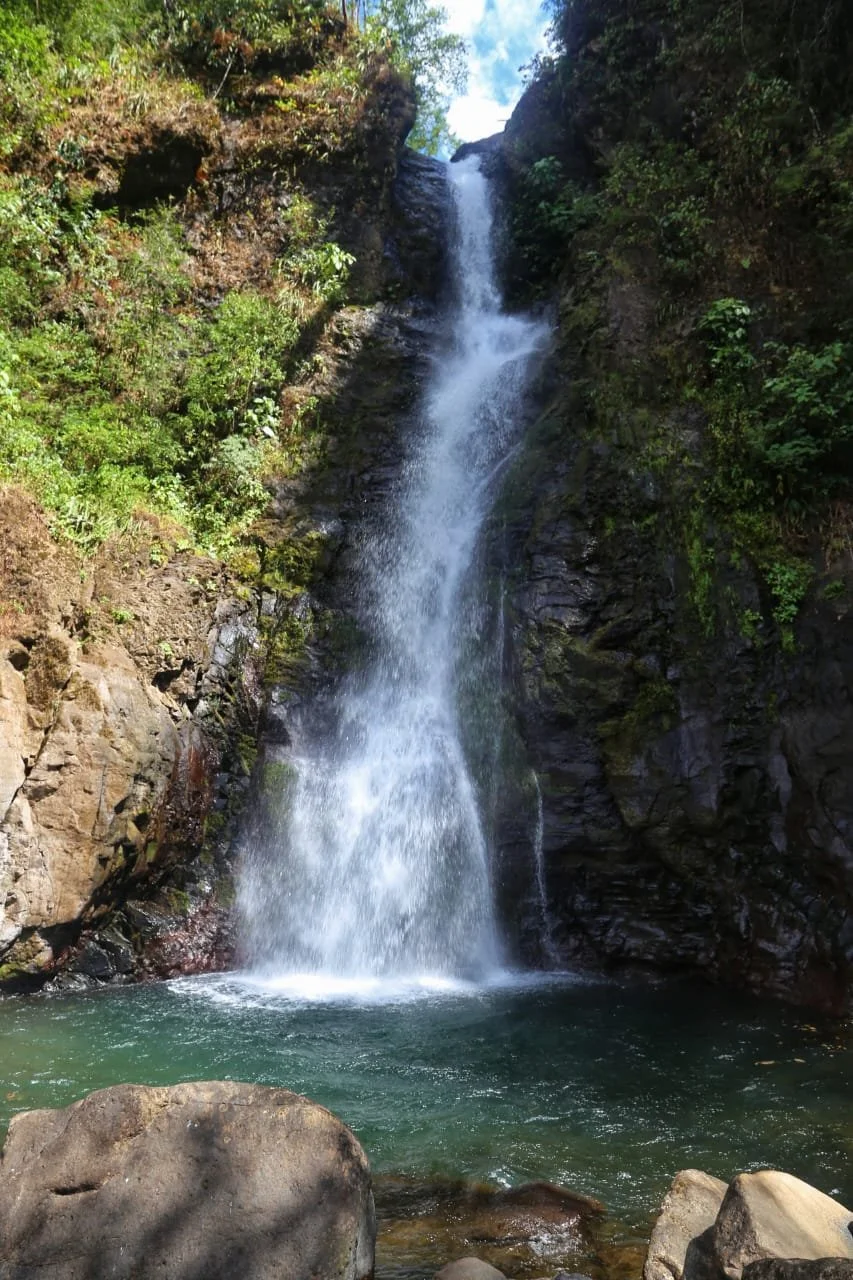
During rainy season, waterfalls can become spectacular.
In Panama, this is particularly obvious in the mountains around Chiriquí. Rivers and streams swell, canyon systems become more dramatic and hidden waterfalls can suddenly have enormous amounts of water moving through them.
Costa Rica has the same phenomenon.
Waterfalls, rafting rivers and jungle streams can become much more impressive during wetter periods.
There is a trade off, however.
More water can also mean stronger currents, muddy trails and potentially unsafe river crossings.
A waterfall is beautiful.
A waterfall that has turned into a brown freight train of water is something you admire from a safe distance.
Hiking in Panama vs Costa Rica during rainy season
Costa Rica has an enormous tourism infrastructure built around adventure travel, and many trails and parks are well known internationally. Panama has plenty of excellent hiking as well, although some areas feel considerably less developed.
During rainy season, this difference can become noticeable.
In Costa Rica, popular trails may still be accessible and organized even when wet.
In Panama, some less developed trails can become muddy, slippery and genuinely adventurous.
Neither is automatically better.
It depends on what you want.
If you want polished infrastructure, Costa Rica has an advantage in many tourist areas.
If you want the feeling that you have wandered somewhere less discovered, Panama can be incredibly appealing.
There is something particularly satisfying about finding a trail in Panama where the forest seems to have forgotten that humans exist.
Then you step in mud up to your ankle.
Suddenly you remember.
What about beaches?
This is where the comparison becomes more complicated.
Costa Rica's Pacific beaches are heavily influenced by the wet season. Some destinations can experience substantial rainfall, while others have long periods of sunshine between storms.
Panama's Pacific beaches behave similarly.
But the Caribbean coast can throw a completely different weather pattern into the equation.
For a backpacker travelling through both countries, flexibility is therefore extremely valuable.
Don't plan your entire trip around the assumption that every beach will be sunny because the calendar says “dry season.”
And don't automatically cancel a beach destination because the calendar says “rainy season.”
Tropical weather is not a train schedule.
There is no guarantee.
You might get six hours of sunshine followed by one spectacular storm.
Then the sun comes back.
Costa Rica is more famous, but Panama can feel wilder
This is not really a weather difference.
It is a travel experience difference.
Costa Rica has spent decades building its reputation as a nature and adventure destination. Its national parks, wildlife tourism, eco lodges, surf towns and adventure operators are extremely well known.
Panama has many of the same ingredients but generally receives fewer international nature tourists outside its best known destinations.
During rainy season, that can be particularly appealing.
The landscape becomes incredibly green, wildlife is active and some areas can feel surprisingly quiet.
In western Panama, the route between Boquete and Bocas del Toro is a great example.
You can go from the highlands into cloud forest, through mountain valleys and eventually toward the Caribbean. Along the way, the weather can change dramatically.
A traveller can wake up in the cool mist of Chiriquí, watch the clouds roll across the mountains, travel through increasingly tropical landscapes and eventually end up surrounded by Caribbean vegetation.
That diversity is one of Panama's greatest strengths.
And Lost and Found Hostel sits right in the middle of that kind of journey, making it a natural place to break up the trip between Boquete and Bocas rather than simply treating the journey as transportation between two destinations.
Rainy season is also cheaper in some places
This is another major reason backpackers should not automatically avoid the wet season.
Depending on destination and time of year, rainy season can mean fewer tourists and better value.
The famous destinations of both Costa Rica and Panama can become expensive during their busiest periods.
In the wetter months, you may find more accommodation choices, less competition and a more relaxed atmosphere.
For backpackers, that can be a major advantage.
You may have more freedom to decide where to stay.
You may not need to book every night weeks in advance.
You may be able to change your plans according to the weather.
And flexibility is one of the greatest advantages you can have in Central America.
The animals don't care about your forecast
This is perhaps the biggest reason I would hesitate to tell anybody to avoid rainy season.
Wildlife does not disappear because it is raining.
Quite the opposite.
The forest is alive.
Birds are still feeding.
Monkeys are still moving.
Sloths are still hanging around looking as though they have absolutely nowhere to be.
Frogs become particularly noticeable.
Insects become extremely active.
And the forest itself becomes more dramatic.
In Panama's cloud forests, you can even find that mist improves the atmosphere for wildlife watching. You may not get the spectacular mountain views you were hoping for, but you may experience something much more intimate.
You are no longer looking across the forest.
You are inside it.
So which is better: Panama or Costa Rica in rainy season?
The honest answer is that neither country wins outright.
Costa Rica has an incredible wet season. Its Pacific forests, cloud forests, national parks and mountain ecosystems can be spectacular, and the country has excellent infrastructure for people who want organized adventure travel.
Panama offers a similarly impressive tropical experience but with enormous regional variation, particularly between the Pacific, Caribbean and mountainous regions. Western Panama is especially interesting because you can combine cloud forest, mountains, rivers, waterfalls, wildlife and Caribbean destinations within a relatively compact journey.
If you want polished tourism infrastructure and famous nature destinations, Costa Rica is difficult to beat.
If you want more flexibility, fewer tourists in some areas and the feeling that you are discovering parts of Central America rather than following the most established route, Panama can be incredibly rewarding.
But there is one thing both countries have in common.
Rainy season is not something you simply endure.
It is part of the experience.
The rain is what turns the forest green.
It fills the rivers.
Feeds the waterfalls.
Creates the clouds.
Brings out the frogs.
Keeps the moss alive.
Feeds the mountains.
And gives tropical Central America that slightly insane, overflowing, everything-is-growing-everywhere appearance that travellers remember long after they have gone home.
So bring a rain jacket.
Bring shoes that can survive mud.
Bring a waterproof bag for your phone.
Don't trust the weather forecast too much.
And most importantly, don't spend your entire trip hiding from the rain.
Sometimes the best thing you can do when the clouds start gathering is simply keep walking.
Because five minutes later you may find yourself standing in the middle of a cloud forest, listening to rain hammering the canopy while mist moves between the trees, a waterfall thunders somewhere below you and a hummingbird disappears into the jungle.
And suddenly you realize that the rain wasn't ruining your Panama or Costa Rica adventure.
It was the reason the adventure looked so damn good in the first place.