
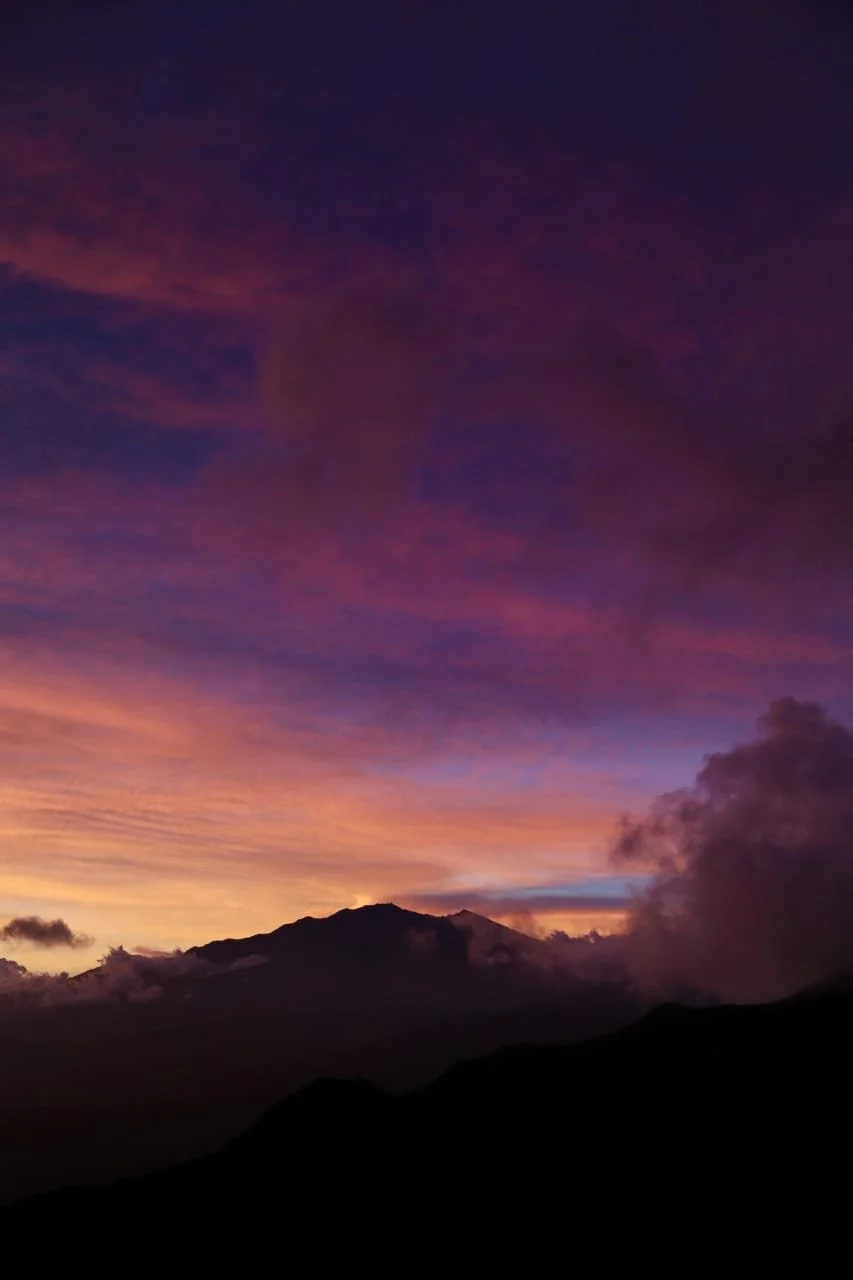
There is a moment in the mountains of Panama when the forest seems to stop being a forest and turn into something completely different. You can be walking along a trail beneath enormous trees, looking at hummingbirds, orchids and vines, with distant mountains visible through gaps in the vegetation, and then the air begins to change. The temperature drops slightly. The distant view disappears. A faint white haze starts slipping between the trees. A few minutes later, the forest is surrounded by mist. The mountains are gone. The sky is gone. Even the trees twenty metres away seem to fade into the whiteness. Water begins collecting on leaves, moss becomes even greener, spider webs suddenly sparkle, and everything takes on the appearance of a scene from a fantasy movie. It can feel as though the clouds have fallen out of the sky and landed directly on the forest floor.
In a very real sense, that is exactly what has happened.
A cloud forest is not simply a wet forest that happens to be located on a mountain. It is an ecosystem that spends a significant amount of its time interacting directly with clouds. Panama is particularly good at producing these conditions because of its geography. The country is a narrow tropical bridge between two enormous bodies of water, the Caribbean Sea and the Pacific Ocean, and it contains a remarkable series of mountains running through its western regions. Warm tropical air loaded with moisture moves toward the mountains, rises as it encounters higher terrain, cools as it climbs and eventually reaches a point where the atmosphere can no longer keep all that water invisible. The water vapor begins turning into microscopic droplets. Instead of a cloud floating above the forest, the cloud becomes part of the forest.
And this is where things get wonderfully weird.
Imagine taking a tropical rainforest and putting it inside a cloud. That is the basic idea, although nature has spent millions of years making the result much more complicated. The trees become covered in moss. Ferns grow from trunks. Orchids establish themselves on branches. Bromeliads sit in the canopy collecting water. Lichens spread across bark. Vines climb toward whatever sunlight they can find. Tiny insects live in the damp vegetation. Frogs hide among leaves. Hummingbirds patrol flowering plants. Toucans and toucanets move through the canopy. And somewhere above all of it, if you are extraordinarily lucky, a resplendent quetzal may be watching the entire performance from a branch.
The mist is not just scenery.
It is part of the plumbing system.
Rainfall is obviously important in a tropical forest, but cloud forests have another trick. When clouds and mist move through vegetation, their microscopic droplets collide with leaves, branches, mosses, vines and other surfaces. The droplets collect, grow larger and eventually fall toward the ground. This process is sometimes called cloud water interception, and it means the forest can collect water directly from the clouds.
Think about that for a second.
The trees are not merely standing underneath the rain waiting to get wet. They are reaching into the clouds and taking water out of the air.
A large tree covered in moss and epiphytes becomes an enormous biological net. Every branch provides another surface for moisture to collect. Every patch of moss can hold water. Every bromeliad can capture droplets. Every leaf can become a tiny water collector. The forest effectively turns itself into a gigantic sponge suspended on the side of a mountain.
This helps explain why the vegetation in Panama's cloud forests can look almost ridiculously green. There are places where green seems to be the only colour nature has bothered to use. Light green moss covers dark green moss. Ferns emerge from green tree trunks. Leaves overlap leaves. Vines disappear into foliage and then reappear somewhere completely unexpected. Bromeliads grow out of branches several metres above the ground. Orchids appear in tiny pockets where you would swear there could not possibly be enough soil, water or space for anything to live.
But there is water.
There is always water.
And where there is water in the tropics, life tends to get creative.
One of the most fascinating things about walking through a Panamanian cloud forest is realizing how much of the forest is not actually growing in the ground. Look up into the branches and you discover an entire second garden living above your head. Epiphytes use trees as apartments rather than dinner. They attach themselves to branches and trunks, collecting moisture and organic material without needing to take nutrients directly from their host. Some trees become so heavily decorated with mosses, orchids, bromeliads and ferns that they barely look like trees anymore.
It is easy to look at this and think the forest is simply overgrown.
It isn't.
It is highly organized chaos.
Every plant is trying to find its own little opportunity. Some want the sunlight at the top of the canopy. Some prefer the filtered light beneath it. Some thrive on the forest floor. Some live halfway up a tree. Some collect water in their leaves. Others depend on roots reaching into damp bark. Some wait for flowers. Others wait for fruit. Some specialize in attracting hummingbirds. Others rely on insects.
The mist helps make all of this possible.
It also changes the personality of the forest.
A sunny tropical forest can feel energetic and explosive. Birds are calling, insects are buzzing, leaves are shining and sunlight is pouring through the canopy. A cloud forest can feel almost secretive. Sounds travel differently through the damp vegetation. Distant mountains vanish. Colours become deeper. The air becomes cooler. The forest seems to close in around you.
Then something moves.
You look up.
Nothing.
You hear a bird.
Nothing.
Another sound comes from behind you.
You turn around.
Still nothing.
This is one of the great jokes of birdwatching in cloud forests. You can hear twenty birds before you see one. The forest is full of movement, but it has an incredible ability to hide that movement from humans.
And then suddenly, a hummingbird appears three feet from your face.
It hovers for a moment.
You see its wings moving so quickly they almost disappear.
Then it turns, catches the light, flashes an impossible colour and vanishes.
You stand there wondering whether you actually saw it.
This is particularly true around the highlands of Chiriquí. Panama's western mountains are famous among birdwatchers because the combination of elevation, forests, moisture and geographic isolation has produced an extraordinary variety of birdlife. The region around Boquete, Cerro Punta, the forests of La Amistad and other mountain areas offers habitat for an impressive collection of species.
And cloud forest mist is one of the reasons the habitat works.
Flowers benefit from the humid conditions. Insects benefit from the vegetation. Fruit bearing trees provide food. The dense vegetation creates shelter and nesting opportunities. Streams and springs remain alive. The entire food chain gets built on top of this damp foundation.
The birds are simply the most visible part.
One of the most famous inhabitants of Panama's mountain forests is the resplendent quetzal, a bird that looks as though somebody designed it after becoming slightly too enthusiastic with the colour palette.
The male has brilliant green plumage, a red breast and extraordinarily long tail feathers. It is the kind of bird that causes people to stop talking when they see it. Even people who have never cared about birds suddenly become very interested in birds when a quetzal appears.
But there is an important reality about cloud forest birdwatching.
The quetzal does not care about your itinerary.
It does not know that you paid for a tour.
It does not know that you woke up at 5:00 AM.
It certainly does not know that you have a bus to catch.
You can walk for hours and see nothing.
Then somebody quietly points upward and whispers, "There."
And suddenly everyone is staring at a branch.
This is one of the reasons cloud forest birdwatching becomes addictive. You never completely know what the next ten seconds are going to bring.
Perhaps it will be a quetzal.
Perhaps it will be a hummingbird.
Perhaps it will be a toucanet.
Perhaps it will be a squirrel.
Perhaps it will be a leaf falling out of a tree and fooling everybody.
And occasionally it will be something so strange that you have to ask someone what on earth you just saw.
The three wattled bellbird is another famous inhabitant of the region, and it has one of the great voices of the tropical forest. You can hear it before you have any idea where it is. Its call can seem to come from deep inside the forest, making you feel as though some enormous invisible creature has just announced your arrival.
Cloud forests are full of these moments.
You hear something before you see it.
You smell wet vegetation before you realize the mist is arriving.
You feel the temperature change before you see the clouds.
You notice a single water droplet hanging from a leaf, then realize hundreds of thousands of them are hanging everywhere.
The forest communicates through tiny clues.
And the mist makes those clues more obvious.
Take a spider web.
Normally, you might walk straight past it.
After mist arrives, every strand becomes decorated with tiny droplets. Suddenly the web is a miniature piece of jewellery hanging between two branches. A whole forest that was invisible ten minutes earlier becomes covered in sparkling networks.
Moss behaves the same way.
Dry moss can look ordinary.
Wet moss looks alive.
It becomes intensely green and soft, almost glowing beneath the grey light.
The same thing happens with leaves. Water gathers along their edges and forms little beads that eventually become drops. One falls. Then another. Then another. Sometimes the sound of falling water continues long after the rain has stopped because the entire canopy is slowly releasing the water it collected.
This is one of the most beautiful things about cloud forests: the forest can continue raining after the sky has stopped.
A storm moves through.
The rain ends.
The clouds begin lifting.
But the trees are still dripping.
Branches release water.
Leaves shake droplets onto the vegetation below.
Moss releases its stored moisture.
The forest slowly empties its enormous reservoir.
This is also why a cloud forest can be surprisingly comfortable in light rain. The problem is not usually getting wet. You are in Panama. Getting wet is part of the deal.
The real challenge is accepting that you cannot control the weather.
You may set out under blue skies and return through a cloud.
You may start a hike expecting spectacular mountain views and discover that you can see approximately six metres.
You may complain about the mist for ten minutes and then realize that the mist is exactly what makes the forest beautiful.
And that is one of the great lessons of travelling through Panama's mountains.
Sometimes the weather you think is ruining your experience is actually the experience.
A mountain disappearing into cloud can be more memorable than a perfect sunny panorama.
A trail covered in mist can feel more adventurous than a dry trail.
A wet forest can reveal things you would never notice in bright sunlight.
The cloud itself becomes part of the landscape.
There is another reason the mist matters enormously to Panama: water.
Mountain forests are important sources of water for ecosystems and communities downstream. The moisture captured by forests eventually becomes part of streams, rivers and groundwater systems. The forest is not simply consuming water. It is helping regulate how water moves through the landscape.
The mountains catch moisture.
The vegetation slows it down.
The soil absorbs some of it.
Streams carry some away.
Plants use some and return some to the atmosphere.
The cycle continues.
Destroy the forest and you change that system.
This is one reason protecting cloud forests matters far beyond the boundaries of the forest itself. A mountain forest may look remote, but the water moving through it can eventually become somebody's drinking water, irrigation water or river habitat far below.
And there is another hidden character in this story: temperature.
Cloud forests exist within relatively narrow climatic conditions. As the world warms, mountain ecosystems can be particularly vulnerable because species adapted to cool, humid conditions may have limited places to move. A species living near the top of a mountain cannot simply keep climbing forever.
This makes cloud forests fascinating but also fragile.
The same conditions that create their incredible biodiversity can make them sensitive to changes in climate, deforestation and water availability.
Which makes it even more remarkable that some of these forests still feel so wild.
In parts of western Panama, you can stand beneath enormous trees and hear almost nothing human. There may be a road somewhere nearby, a village farther down the mountain and a phone in your pocket, but for a few minutes none of that seems relevant.
You are surrounded by moss.
Mist moves between the trees.
Something calls from the canopy.
A hummingbird appears.
A drop of water falls on your head.
And suddenly your phone seems like the least interesting object in the forest.
This is one of the reasons cloud forests have such a powerful effect on travellers. They encourage you to pay attention.
You cannot really rush through them.
Well, you can physically rush through them, but you will miss half the point.
Cloud forests reward people who stop.
Stop beside a flowering plant.
Stop beside a huge tree.
Stop when you hear a strange bird.
Stop when the mist rolls in.
Stop and look at the underside of leaves.
Stop and watch the branches.
Stop and listen.
After a while, the forest begins to reveal itself.
And then you start noticing things that you would have completely ignored before.
A tiny frog.
A strange mushroom.
A caterpillar.
An orchid no larger than your thumbnail.
A line of ants carrying something much larger than themselves.
A hummingbird defending a flower.
A snail slowly crossing a wet branch.
A spider web decorated with hundreds of droplets.
Suddenly, birdwatching turns into wildlife watching.
Wildlife watching turns into plant watching.
Plant watching turns into staring at moss for five minutes.
And eventually you realize that you have been standing in exactly the same place for half an hour and you are perfectly happy about it.
That is the strange power of the cloud forest.
It slows you down without asking permission.
There is also something wonderfully unpredictable about the mist. It can arrive slowly or suddenly. Sometimes you see it approaching across a valley like a giant white blanket. Sometimes the forest is clear one minute and completely obscured the next. Sometimes clouds drift through the trees so lightly that you barely notice them. Other times the entire landscape disappears.
At higher elevations, you can sometimes watch clouds forming below you.
This is one of those experiences that makes geography suddenly understandable.
You realize that the mountain is literally sticking into the atmosphere.
Moist air rises.
The temperature falls.
Clouds form.
And you are standing inside them.
From above, it looks like a sea of clouds.
From inside, it feels like walking through smoke.
From the perspective of the forest, it is breakfast.
Because the plants are waiting for it.
The moss is waiting.
The bromeliads are waiting.
The orchids are waiting.
The trees are waiting.
And once the droplets begin collecting, the forest gets to work.
This is why nature loves mist in Panama's cloud forests.
Mist brings water to places where ordinary rainfall is not the entire story. It keeps plants hydrated. It creates ideal conditions for mosses, ferns, orchids and epiphytes. It supports insects and amphibians. It helps maintain streams. It moderates the environment. It creates habitat for an extraordinary collection of birds and other wildlife.
And perhaps most importantly, it creates an ecosystem where thousands of different species can specialize in tiny pieces of the same environment.
The cloud forest is not simply a rainforest with bad visibility.
It is a completely different world.
The next time you are travelling through Panama and somebody tells you that the mountains are covered in clouds, do not automatically think you are missing the view.
You might actually be arriving at the best part.
Because when the mist comes down, the forest comes alive in a different way.
The mountains disappear, but the details become clearer.
The distant view vanishes, but the moss suddenly glows.
The sky disappears, but water begins falling from the leaves.
Birds become harder to see, but easier to hear.
The forest becomes quieter, wetter, stranger and somehow more intimate.
And if you are lucky, somewhere beyond the curtain of mist, a brilliant green quetzal is sitting silently in a tree, completely unimpressed by the fact that you have spent the last three hours looking for it.
That is the cloud forest.
You don't really visit it.
For a while, you enter it.
And when the clouds finally lift, the forest lets you leave.