
There are hostels where you check in, throw your backpack on a bunk, meet a few people and eventually move on to the next place. Then there is Lost and Found Hostel, where the hostel itself becomes part of the adventure. Hidden high in the mountains of western Panama, inside the Fortuna Forest Reserve, Lost and Found has always been difficult to put into one simple category. It is a hostel, but it feels like a jungle lodge. It is an adventure base, but it is not a conventional tour company. It is a social gathering place, but it is also surrounded by enough wilderness to make you feel like you have temporarily disappeared from civilization. In other words, it is a destination hostel.
That distinction matters. A destination hostel is somewhere you actually want to spend time rather than simply somewhere you sleep between destinations. At Lost and Found, the journey does not stop when you arrive. In many ways, it begins again. You arrive with a backpack and perhaps a rough plan for getting to Boquete, Bocas del Toro or somewhere else in Panama, and suddenly you find yourself looking at a jungle trail, talking to somebody from the other side of the world, planning a waterfall adventure, joining dinner, watching hummingbirds at the feeders or wondering what strange animal might appear after dark.
The setting is a huge part of the experience. Lost and Found is built in the mountains in the middle of a cloud forest environment, with sweeping views toward Boquete and Volcán Barú and jungle surrounding the property. This is not the sort of hostel where you step outside onto a busy city street and immediately find twenty restaurants and a supermarket. The isolation is part of the attraction. You are surrounded by forest, mountains, wildlife and trails, while still having the social atmosphere that backpackers usually look for in a hostel.
That is where the lodge side of Lost and Found comes in. The buildings, views, hammocks, jungle lounge and surrounding forest give the place a very different feeling from a standard backpacker dormitory. There are places to sit and watch the mountains, quiet corners to read, hammocks scattered around the property and communal areas where people naturally end up talking. You can have a beer while watching the clouds roll through the mountains, spend an afternoon doing absolutely nothing, or suddenly decide that doing absolutely nothing is boring and go looking for a waterfall.
Then there is the hostel side.
The social atmosphere has become one of the defining characteristics of Lost and Found. The idea was never simply to provide cheap beds. The property was developed around human interaction, shared experiences and the slightly unpredictable social life that happens when a bunch of independent travellers are thrown together in the middle of the jungle. People arrive as strangers and regularly end up hiking, eating, drinking, playing games and travelling onward together.
The communal dinner is a good example. Instead of everyone disappearing behind individual doors with their phones and laptops, dinner becomes an opportunity for people to sit together and meet one another. Games, challenges and spontaneous adventures tend to develop naturally from there. Someone mentions a waterfall. Someone else has heard about a trail. Another person is heading toward Bocas the next morning. Before long, a group has formed.
And that is something that is difficult to manufacture.
Lost and Found has developed a reputation for being an unusually social hostel because the environment encourages people to participate. There are plenty of places where you can stay in a dormitory without ever learning the name of the person in the bunk beside you. Lost and Found was designed almost as the opposite of that experience. The common areas, activities and isolated location create the conditions for people to actually interact.
But the third personality of Lost and Found is perhaps the most interesting: the adventure company.
You do not have to book a different tour every morning and leave the property in a van to experience Panama. Adventure is built into the place itself. There are trails, waterfalls, jungle walks, wildlife encounters and opportunities to explore the surrounding environment. Some activities are guided while others can be enjoyed independently. The property has developed a network of experiences that allows travellers to discover the surrounding forest without turning every activity into a formal commercial excursion.
There are free waterfalls and hiking opportunities, jungle exploration, wildlife watching and a guided night walk for those who want to see what comes alive after sunset. The night can completely change the character of the forest. Creatures that remain hidden during the day become active, and the possibility of encountering insects, frogs, reptiles, porcupines and nocturnal mammals turns a simple walk into something considerably more exciting.
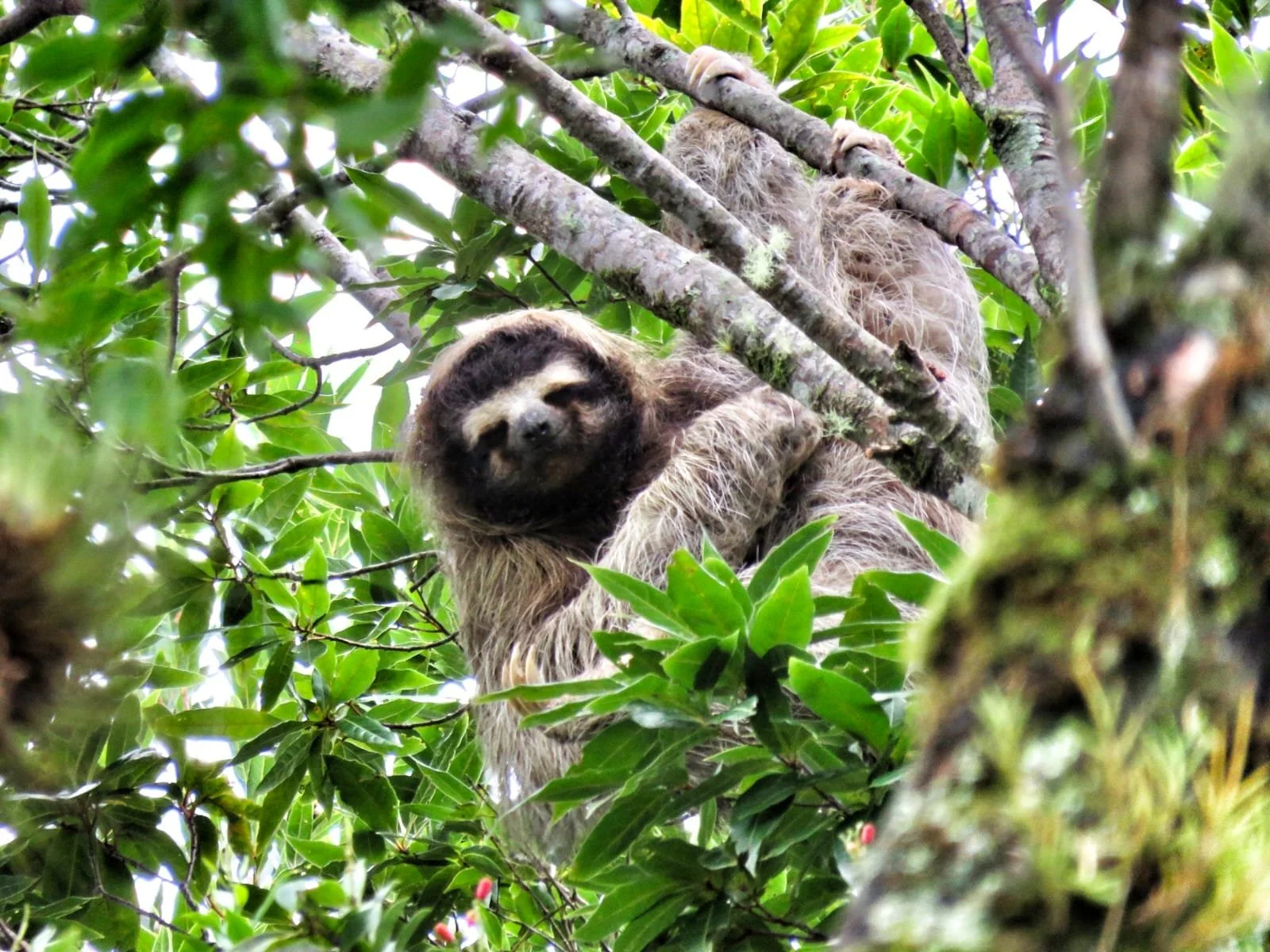
Wildlife is another reason the hostel feels more like an adventure destination than a normal backpacker property. The surrounding forest provides habitat for an extraordinary range of animals, and the feeders around the social areas attract colourful hummingbirds and other birds close to the hostel. Depending on the time and luck, travellers may encounter monkeys, sloths, agoutis, armadillos, peccaries, deer and a variety of nocturnal creatures.
You might even be sitting around having a beer when someone suddenly says, "There's something in the trees."
And everybody gets up.
That spontaneous quality is part of the magic.
Lost and Found also occupies an interesting position for travellers moving around western Panama. It sits between major backpacker destinations, making it possible to use the hostel as more than just a place to sleep. Travellers heading between Boquete and Bocas del Toro can turn the journey itself into part of the trip by stopping in the mountains for a few nights rather than simply passing through.
This creates a very different travel experience. Instead of thinking of Panama as a checklist of destinations, Lost and Found encourages travellers to slow down and add something unexpected to the route. You might have originally planned Boquete, Bocas and the beach. Then Lost and Found appears on the map and suddenly there is a mountain jungle adventure in the middle of the itinerary.
That is essentially what makes a destination hostel different.
A normal hostel is often defined by its beds.
A destination hostel is defined by what happens after you leave your backpack on the bed.
At Lost and Found, the accommodation is only one part of the equation. The other parts are the forest, the views, the people, the food, the games, the wildlife, the trails, the waterfalls, the hammocks, the nighttime adventures and the strange little moments that travellers remember long after they have forgotten the colour of their hostel room.
There is also something deliberately old school about the experience. Backpacking used to involve a lot of wandering, meeting strangers and figuring things out as you went. Today it is remarkably easy to travel through an entire country while staring at a phone. You can have your accommodation booked months ahead, your transportation arranged, your restaurant selected and your entire day mapped out before you even arrive.
Lost and Found works better when you leave some room for the unexpected.
Maybe you arrive intending to stay two nights and remain for five. Maybe you meet somebody at dinner and spend the next week travelling together. Maybe you discover a trail you had never heard about. Maybe you spend half a day lying in a hammock because the view is too good to leave. Maybe you go on a night walk and see something you have never seen before. Maybe you simply sit around talking to other travellers until far later than you intended.
Those experiences cannot really be packaged into a traditional tour.
That is why calling Lost and Found simply a hostel does not quite explain it.
It is part hostel, part jungle lodge, part adventure base and part social experiment. It is somewhere to sleep, but also somewhere to explore. Somewhere to meet people, but also somewhere to disappear into nature. Somewhere to relax, but also somewhere where a quiet afternoon can suddenly turn into a jungle adventure.
It has grown over the years into its own little destination, rather than simply being accommodation along the road.
And perhaps that is the best way to describe Lost and Found: you don't just stay there. You experience it.
You can arrive because it happens to be on your route through Panama. But once you are there, the route may suddenly become secondary. The hostel becomes the destination itself.