
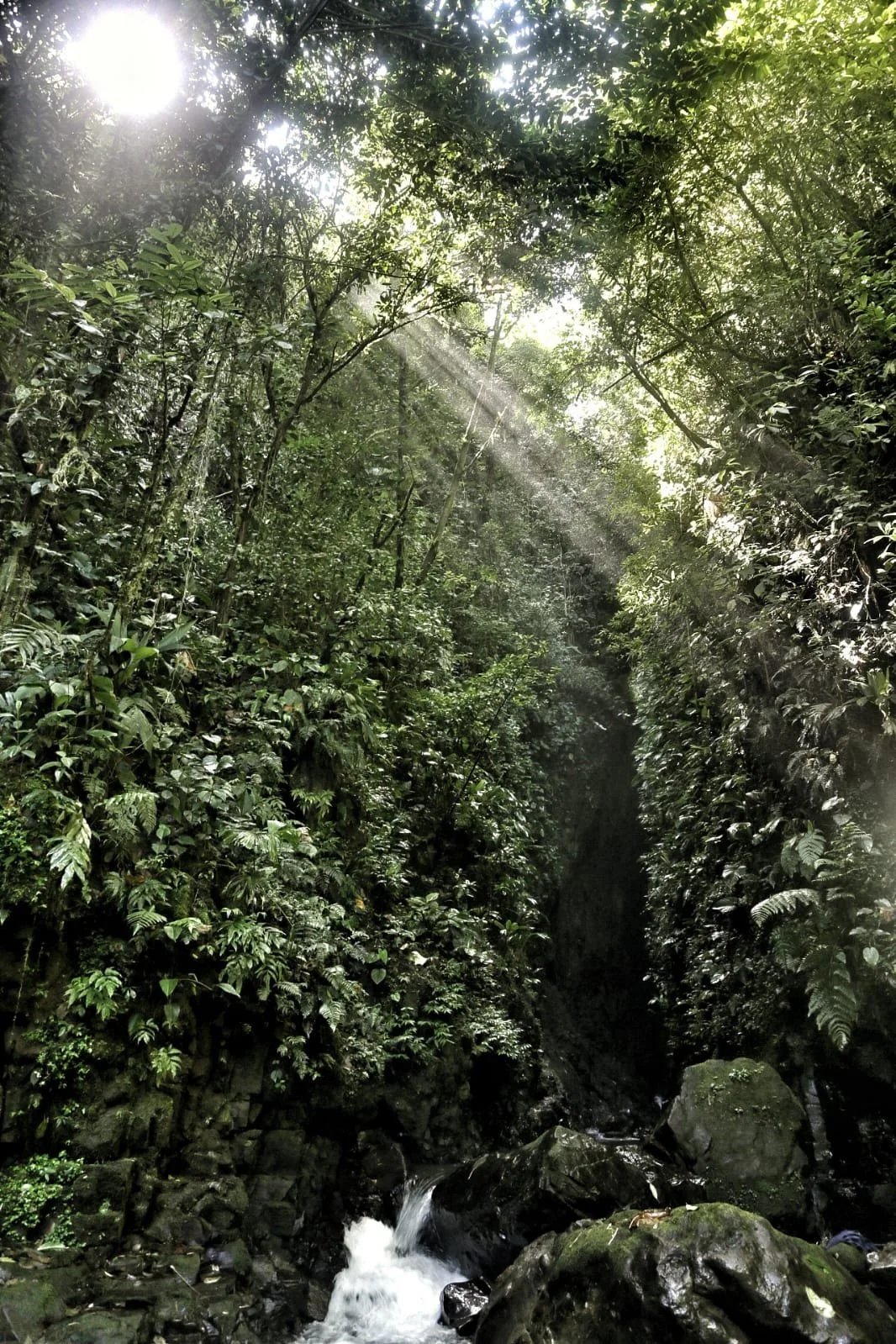
Walk through a Panamanian rainforest after rain and look down for a moment. Between the leaves, roots and patches of moss, you may notice something that most visitors completely overlook. A tiny spiral shell is moving slowly across the forest floor. Another snail is climbing a tree trunk. One is hiding beneath a fallen leaf while another is crossing a wet trail as if it has absolutely nowhere else to be.
Panama is an extraordinary country for snails because it contains an enormous variety of habitats in a relatively small area. There are terrestrial snails living in rainforest, cloud forest, gardens and leaf litter, freshwater snails inhabiting rivers and ponds, and marine gastropods living along both the Pacific and Caribbean coasts. In fact, studies around Panama have repeatedly revealed surprisingly high gastropod diversity. A survey at La Escucha Beach in Colón, for example, recorded 30 species belonging to 21 genera and 16 families.
And that is just one coastal location.
The Jungle Snails
When people imagine a snail, they usually picture the classic slow moving creature crawling through a garden. Panama's forest snails can be much more interesting. Some have elongated shells, some have beautifully patterned shells, some are tiny enough to disappear into moss, and others are predators rather than peaceful vegetarians.
The rainforests are particularly important habitats because snails need moisture. During the dry part of the year, many terrestrial species become much harder to find, retreating beneath leaves, logs, rocks or other protected places. After a good tropical rain, however, the forest floor can suddenly become a snail highway.
Research in Darién National Park found terrestrial mollusks living on an assortment of surfaces including trunks, stems, leaves, soil, moss, leaf litter and branches. Researchers recorded ten species in their study area, including Labyrinthus otis orthorhinus and Drymaeus mesembrinuseus.
This gives you an idea of why simply walking around looking at the ground doesn't tell the whole story. In a tropical forest, the snail you are looking for might be six inches below your feet or six feet above your head.
Panama Has Snail Predators Too
One of the coolest things about tropical land snails is that not all of them are vegetarian. Some species of terrestrial gastropods are predators, feeding on other snails and small invertebrates.
That makes the snail world considerably more dramatic than it appears. A creature moving at a speed that seems almost comically slow can still be an active hunter.
The family Spiraxidae is particularly interesting. Scientific work on Costa Rican and Panamanian land snails has described four species from the region, including two species that were new to science at the time of publication.
This is one of the great lessons of tropical biology. Even something as familiar as a snail can contain species that scientists are still trying to understand.
The Giant Snail Question
Whenever people talk about tropical snails, eventually someone asks about giant snails.
Panama does have large terrestrial gastropods, but it is important not to assume that every enormous snail spotted in a tropical country is a native Panamanian species. Large exotic snails can become agricultural and ecological problems, and Panama has specifically monitored land mollusks arriving through cargo and international trade.
A recent study of international loading and unloading areas in Panama City and Colón identified seven species of land snails and slugs among thousands of specimens. These included Allopeas gracile, Subulina octona, Bulimulus unicolor, Praticolella griseola, Diplosolenodes occidentales, Leptinaria unilamellata and Sarasinula plebeia.
Another study of mollusks associated with cargo ports found Allopeas gracile to be particularly abundant in the sampled areas, with activity increasing during the rainy season.
So Panama's snail story isn't only about beautiful rainforest creatures. It is also connected to agriculture, international trade and biosecurity.
Freshwater Snails
Move away from the forest floor and into Panama's rivers, streams, ponds and wetlands and you enter another completely different snail universe.
Freshwater gastropods have evolved to live underwater and can be found attached to rocks, vegetation and submerged surfaces. Some have distinctive spiral shells, while others look remarkably different from the snails people encounter on land.
Apple snails, for example, belong to the family Ampullariidae and include species in the genus Pomacea. These are freshwater snails with both gills and an operculum, the little structure that can close the shell opening.
Freshwater snails are also fascinating because they can occupy an important position in aquatic food webs. They scrape algae and consume vegetation or organic material, while becoming food for fish, birds, turtles and other animals.
In a country with so many rivers and wetlands, there are plenty of aquatic environments for these small mollusks to exploit.
The Snails of the Ocean
Then there are the marine snails, and this is where Panama's geography becomes particularly spectacular.
Panama has an extraordinary coastline because it faces two completely different oceans. The Caribbean coast and Pacific coast have different physical conditions, habitats and marine communities. Rocky shores, mangroves, sandy beaches, coral environments and tidal pools can all support different gastropods.
The Authority of Aquatic Resources of Panama describes gastropods as the largest and most diverse group of mollusks and notes that they are particularly common around coral reef environments, especially among coral rubble and dead coral as well as sandy areas.
A snail on a tropical beach can therefore be something entirely different from the snail you find crawling through a rainforest.
Nerites: The Little Tanks of the Tide Pools
Among the marine snails of Panama are nerites, compact little gastropods commonly associated with rocky intertidal environments.
They are remarkably well adapted to life where waves constantly crash over them. Their shells can be rounded and solid, and their muscular foot allows them to cling tightly to rocks.
At La Escucha Beach in Colón, Nerita fulgurans was the most abundant species recorded in the study, followed by Nerita tessellata. Together with species such as Planaxis nucleus, they accounted for a substantial portion of the collected specimens.
This is a completely different snail experience from wandering through a rainforest. Instead of hiding under leaves, these snails are dealing with waves, tides, saltwater and predators in one of the most physically demanding environments imaginable.
Mangrove Snails
Mangroves are another fantastic place to look for gastropods.
These strange forests exist between land and sea, and the animals living there have to cope with changing water levels, mud, salt and fluctuating conditions. Snails can be incredibly important inhabitants of this environment.
A 2026 study of gastropod diversity in mangroves at El Líbano in Panama Oeste investigated mollusks at four stations around the Bay of Chame.
Mangrove snails demonstrate something fundamental about Panama's biodiversity: you don't necessarily have to enter deep jungle to discover unusual wildlife. Sometimes the mud beside a mangrove is hiding an entire miniature ecosystem.
Why Snails Matter
It is easy to walk past a snail because they don't make much noise, don't run away and don't have the charisma of a monkey or toucan.
But they are important.
Snails can consume vegetation, algae, fungi and decaying organic matter. They can help recycle nutrients and become food for birds, mammals, reptiles, amphibians and insects. Some predatory species help regulate populations of other small invertebrates.
Their shells can also become miniature homes for other organisms after the snail dies.
And because many land snails are sensitive to moisture and habitat conditions, their presence and abundance can tell scientists something about the environment. Researchers studying Darién's terrestrial mollusks specifically described them as potential bioindicator organisms.
The Rain Is When the Magic Happens
If you really want to see Panama's land snails, learn to appreciate rain.
A forest that looks almost empty during a hot afternoon can become dramatically more active after rainfall. Moisture allows snails and slugs to move around without rapidly losing water, so suddenly you begin noticing them on trails, leaves, tree trunks and rocks.
This is one reason nighttime walks can be particularly interesting. The tropical forest changes character after dark, and many creatures that remain hidden during the day become active.
You might be looking for frogs, insects, spiders or sleeping birds and suddenly discover a beautifully patterned snail slowly crossing the path.
And once you start noticing them, you begin seeing them everywhere.
Panama's Slowest Wildlife Safari
There is something wonderfully appropriate about looking for snails in Panama. The country is famous for wildlife that moves quickly through the jungle: monkeys jumping between branches, birds flying overhead, frogs disappearing into vegetation and insects vanishing before you can photograph them.
Snails don't do any of that.
They give you time.
You can actually watch one move. You can see the tentacles exploring the world in front of it. You can watch the shell slowly rotating as the animal progresses across a leaf. You can see the trail of mucus left behind on a wet surface.
And that makes snails surprisingly good wildlife for travellers who are willing to slow down.
The next time you are hiking through a Panamanian rainforest after rain, don't just look up for monkeys and birds. Look down. Check the underside of leaves. Look at fallen logs. Examine mossy tree trunks. Look along the edges of streams.
There may be a whole miniature world moving through the forest that you would otherwise never notice.
Panama's snails may not have the celebrity status of its sloths, monkeys, toucans or frogs, but scientifically they are every bit as fascinating. From tiny terrestrial species in the Darién to freshwater snails in rivers and ponds, from mangrove specialists to colorful marine gastropods clinging to Pacific and Caribbean rocks, Panama's snail fauna is another reminder that tropical biodiversity isn't always spectacular from a distance.
Sometimes the most fascinating animal in the jungle is the one moving about three centimetres while you're standing there wondering whether it is actually moving at all.