
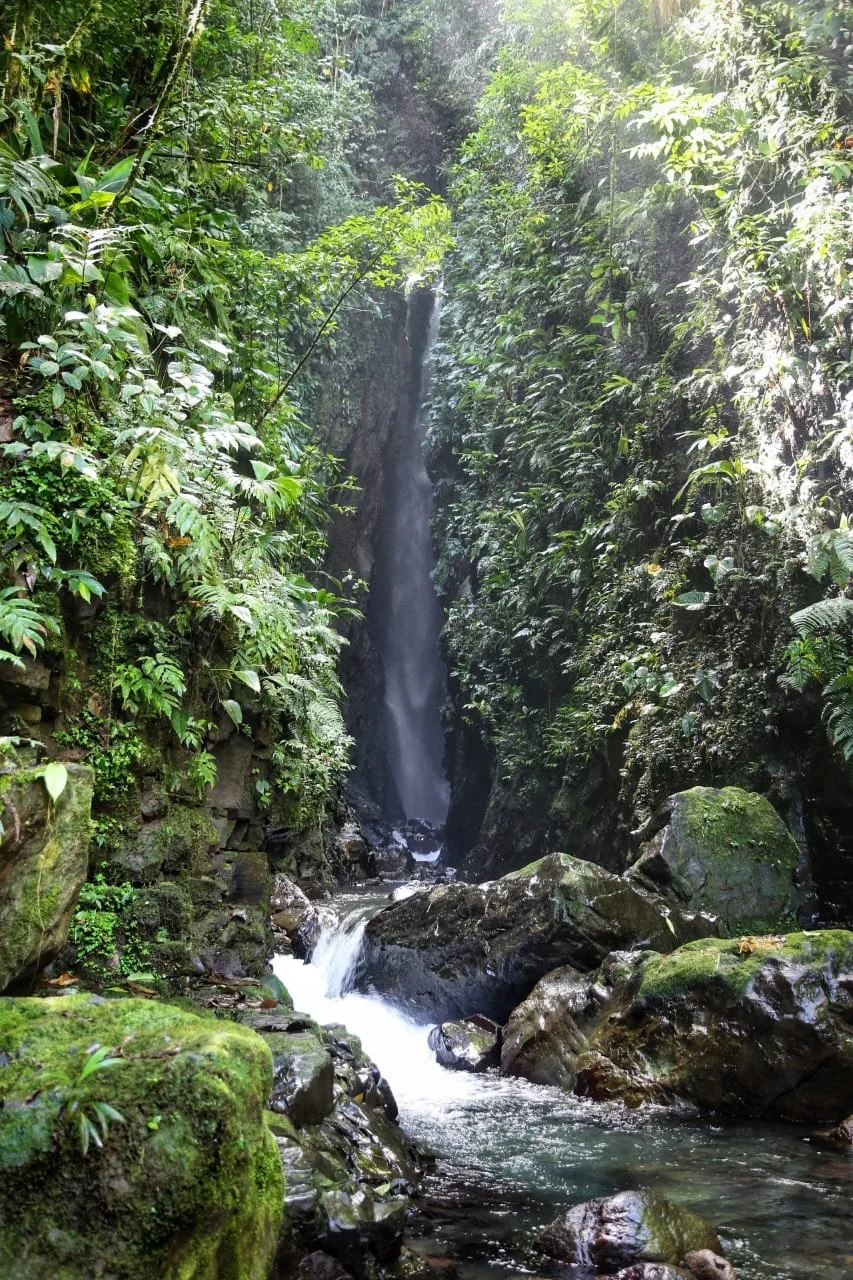
Panama has an incredible collection of wild cats, but few are as mysterious as the puma. You can spend days walking through the country's forests and never see one, even though pumas may be living in the very same landscape. They are powerful, adaptable and remarkably secretive animals that have learned how to move through the jungle without announcing their presence. For visitors, the puma is less an animal you expect to see and more a possibility hanging somewhere in the background of the forest.
The puma, Puma concolor, is one of Panama's six native wild cat species, alongside the jaguar, ocelot, margay, oncilla and jaguarundi. Unlike the spotted cats, however, the puma has a relatively plain tawny coat. There are no dramatic rosettes or stripes to give it away. Its colour can blend remarkably well with vegetation, soil, shadows and fallen leaves. Add its mostly nocturnal habits and its tendency to avoid people, and you have an animal that can be remarkably difficult to find.
A surprisingly widespread wild cat
Pumas have an enormous geographic range. They occur from Canada through much of Central America and all the way into South America. Panama is particularly important because it sits between North and South America, providing a natural land bridge through which wildlife can move.
That makes Panama much more than simply another place where pumas happen to live. Its forests form part of a continental wildlife corridor.
Pumas have been documented in several regions of Panama, including Darién, central Panama, the Azuero Peninsula and western Panama. Researchers have also recorded them in protected mountainous forests in Chiriquí.
One of the best ways scientists discover where pumas live is through camera traps. These motion activated cameras can sit quietly along forest trails for months, photographing animals that humans might almost never encounter. Studies in Panama have repeatedly captured pumas this way.
In La Amistad International Park in Chiriquí, camera trapping recorded pumas among the medium and large mammals using the forest, with activity occurring predominantly at night.
That tells us something important about the puma.
You don't have to see one for one to be there.
The cat that doesn't want to be found
Pumas are masters of avoiding attention.
Unlike some animals that advertise their presence with loud calls, bright colours or obvious movements, pumas can move almost silently through dense vegetation. Their large paws help them move over uneven ground, and their bodies are built for powerful bursts of movement rather than making lots of noise.
A puma may travel through a forest trail during the middle of the night and leave behind almost no evidence that it was there.
This is why walking through a Panamanian jungle can sometimes be misleading.
The forest may appear completely empty.
You might see a few insects and hear frogs calling somewhere in the distance. Perhaps a bird moves in the canopy. Otherwise, nothing.
But "nothing" doesn't necessarily mean nothing is happening.
A puma could be somewhere beyond the vegetation.
An ocelot could be hunting nearby.
A snake could be crossing the trail.
A kinkajou could be moving through the trees overhead.
The rainforest is full of animals that have become experts at remaining invisible.
Pumas in the mountains of Chiriquí
For anyone travelling around western Panama, the puma is particularly interesting because it occurs in the mountainous forests of Chiriquí.
The province contains a dramatic range of elevations, from relatively warm lowlands to cool cloud forests and much higher mountain environments.
The forests around La Amistad provide important habitat for large mammals, and pumas have been documented there through camera trapping.
This doesn't mean that every mountain forest has a resident puma waiting around the next corner. Large carnivores require substantial areas in which to find food and move around, and their distribution can vary considerably depending on habitat and prey.
But knowing that pumas use these forests changes the experience of walking through them.
The cloud forest isn't simply a place containing birds, orchids and hummingbirds.
It is also part of a much larger ecosystem that includes predators operating largely after dark.
What does a Panamanian puma eat?
Pumas are remarkably flexible predators.
Rather than specializing on one particular type of prey, they can hunt a wide range of animals depending on what is available.
In Panama, their prey can include mammals such as deer and peccaries, along with smaller animals when the opportunity arises.
Research from Darién has found evidence of pumas consuming prey including collared peccaries, white lipped peccaries and Hoffmann's two toed sloths.
That variety is important.
A predator that can change its diet according to its surroundings has a better chance of surviving when particular prey species become less abundant.
This flexibility is one of the reasons pumas have managed to occupy such a huge geographic range.
The puma and the jaguar
Panama is one of those unusual places where two major American predators can overlap.
The jaguar is larger and considerably more heavily built. It also has a very different appearance, with its famous black rosettes.
The puma is generally more slender, with a much longer tail and an unspotted coat.
But the difference goes beyond appearance.
Research in Panama has found evidence that pumas can make use of landscapes containing secondary forest and agricultural areas more readily than jaguars. This flexibility may allow pumas to persist in areas where habitat has been altered, although they still depend on sufficient habitat and prey.
The two species therefore aren't simply competing versions of the same animal.
They can overlap while using the landscape somewhat differently.
Pumas don't need pristine jungle everywhere
One of the most fascinating aspects of the puma is its adaptability.
Some people imagine that a large predator can only survive in enormous untouched wilderness.
Pumas challenge that assumption.
They can use forests, mountainous areas, secondary vegetation and landscapes containing some human activity. Researchers studying pumas in Panama have found that they can be more tolerant of habitat disturbance than jaguars.
But there is an important qualification.
Adaptable doesn't mean indestructible.
A puma still needs food.
It needs places where it can travel.
It needs enough cover to hunt and rest.
And it needs connected habitat if populations are going to remain healthy over the long term.
A landscape can therefore look green on a satellite image while still being highly fragmented from the perspective of a large predator.
Rivers are highways through the jungle
Some of the most interesting research on Panamanian pumas has examined how they use rivers and surrounding landscapes.
In Darién, researchers found an association between puma habitat use and proximity to river systems.
That makes ecological sense.
Rivers aren't simply sources of water. They can create natural corridors through forests and provide access to prey.
For a large predator moving through a huge tropical landscape, these corridors can be extremely valuable.
It also means that some of the most beautiful hiking environments in Panama can simultaneously be wildlife highways.
A river that looks like a perfect swimming spot to a traveller may be part of a much larger ecological network used by mammals after dark.
Why pumas are so difficult to photograph
People often ask why there aren't more photographs of wild pumas in Panama.
The answer is simple.
They are difficult to see.
Even researchers who specifically study them usually depend on camera traps rather than wandering around hoping to encounter one.
A camera trap can operate day and night without disturbing the animal. Eventually, the puma walks past.
Sometimes the photograph shows the animal clearly.
Sometimes all you get is a blurry tail disappearing into the vegetation.
Sometimes the camera captures the puma walking directly toward the lens in the middle of the night, eyes glowing in the infrared image.
Those photographs can be incredibly exciting precisely because they reveal an animal that most people never get to see.
Could you actually see a puma while hiking?
Yes, but you should consider it an unusual wildlife encounter rather than something to expect.
Pumas generally avoid people, and their secretive behaviour makes encounters uncommon.
If you are hiking through forest during daylight, you are much more likely to see evidence of other animals than to suddenly have a puma walk across the trail.
That doesn't make the possibility less exciting.
Quite the opposite.
Knowing that large predators exist in the forest adds another dimension to hiking.
The trail isn't just a path from one viewpoint to another.
It is an animal highway.
You are entering a place where wildlife has its own schedules, territories and routes.
The tracks tell the story
Puma tracks can sometimes be found on muddy trails or soft ground.
Their footprints are generally rounded, with four toes and a large central pad. Unlike dogs, their claws usually don't show because the claws are retractable.
But identifying tracks isn't always easy.
A large domestic dog can leave surprisingly similar footprints, and wet tropical soil can distort tracks considerably.
This is why professional wildlife researchers use multiple pieces of evidence rather than relying on a single footprint.
Camera traps, tracks, scat, prey remains and repeated observations can collectively reveal whether a large cat is using an area.
For the casual traveller, though, simply learning to recognize the possibility of a large cat track can make a hike much more interesting.
The mysterious night shift
Pumas are strongly associated with nighttime activity in many parts of their range, and camera trapping in Chiriquí has documented predominantly nocturnal activity.
This means that while travellers are sitting down for dinner, relaxing at a hostel or heading to bed, the forest may be becoming increasingly active.
Frogs begin calling.
Moths appear around lights.
Bats fly overhead.
Nocturnal mammals leave their shelters.
And somewhere out in the darkness, a puma may begin moving through its territory.
This is one reason Panama's nighttime forests can feel so different from the daytime version.
It isn't simply the same jungle without sunlight.
It is a different shift.
Pumas and people
For most visitors, the relationship between people and pumas will consist of one thing:
Not seeing each other.
The puma wants to remain undetected, and most people have no idea the animal is nearby.
The more complicated relationship occurs where pumas encounter livestock.
Livestock predation can create serious problems for farmers, particularly when predators begin using agricultural landscapes. Research in Panama has documented conflicts involving large cats and domestic animals, including around protected areas.
From a farmer's perspective, losing livestock is a real economic loss.
From the predator's perspective, a cow, calf, pig or other domestic animal can represent an easily available food source.
This is why conservation of large predators is not simply about protecting forests. It also involves finding practical ways for wildlife and rural communities to coexist.
Why Panama needs its big cats
A healthy forest needs predators.
They are part of the ecological structure that keeps populations of prey species from becoming completely unchecked and helps maintain a functioning food web.
Pumas also tell us something about the condition of a landscape.
If a forest can support a large predator, it means there is enough habitat and enough prey to sustain an animal that occupies a relatively high position in the food chain.
That doesn't mean the presence of a puma automatically proves that a forest is pristine.
But it does make the species an interesting indicator of ecological connectivity and wildlife diversity.
The great Panamanian mystery
Perhaps the most fascinating thing about pumas in Panama is that you can be surrounded by evidence of an animal you never actually see.
A camera trap catches one at 2 AM.
Someone finds a set of tracks in wet soil.
A wildlife researcher records another individual moving through the forest.
A camera captures a puma walking along a trail while everyone is asleep.
Then daylight returns.
The jungle looks peaceful again.
The puma disappears.
That is the nature of this animal.
It doesn't need to announce itself.
It doesn't need to roar.
It doesn't need to stand in the middle of a clearing for tourists.
It simply moves through the forest.
And that is perhaps why the puma is such a fascinating part of Panama's wildlife. It represents the side of the country that most visitors never see: the enormous, interconnected, mostly nocturnal world operating behind the scenery.
You may never see a puma in Panama.
But when you're walking through a remote forest in Chiriquí, Darién or elsewhere in the country at dusk, there's something special about knowing that the forest isn't empty.
Somewhere beyond the trees, one of Panama's most elusive animals may be beginning its nightly journey.