
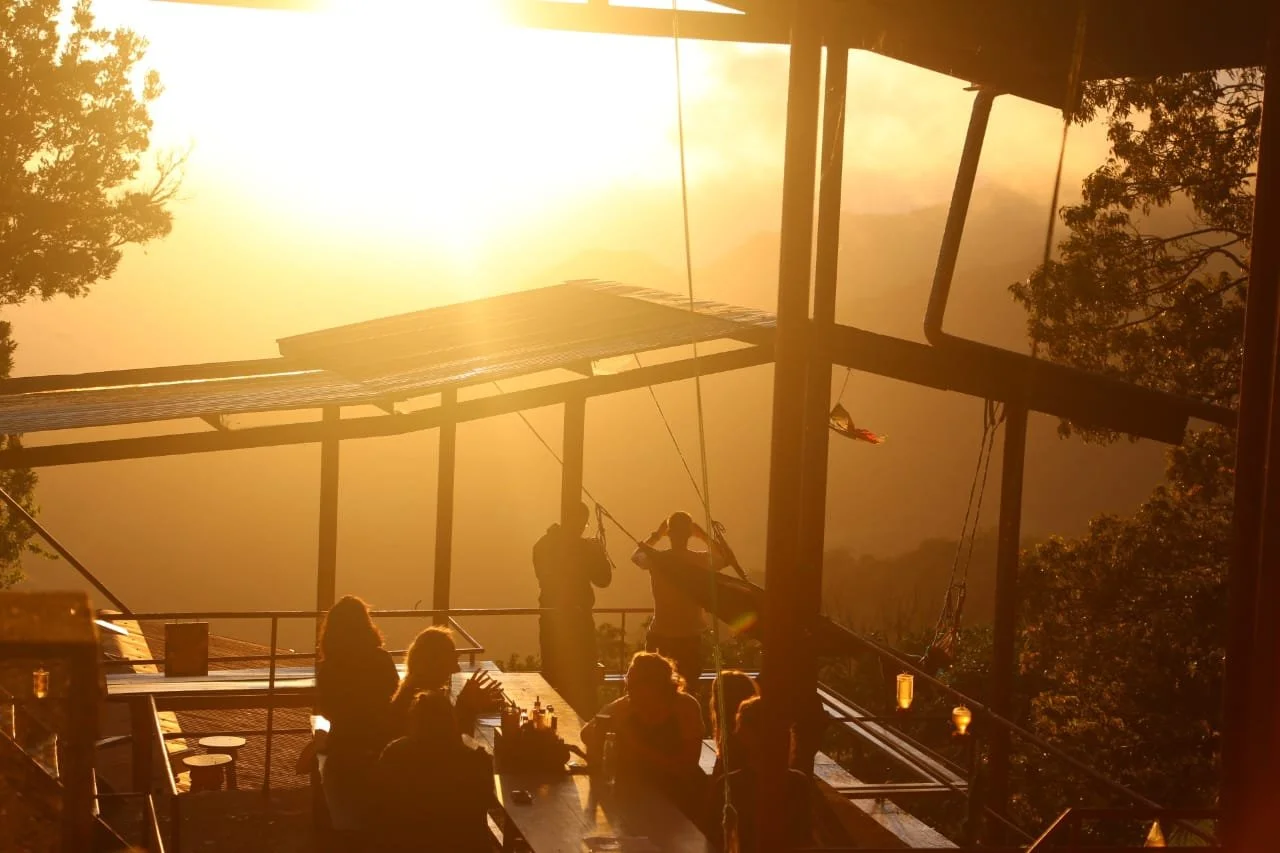
There are rainforests in Panama where the heat, humidity and sheer abundance of life can feel almost overwhelming. Then there are the cloud forests, where everything changes. The temperature drops, the sunlight becomes softer, mist moves through the trees and the forest seems to absorb the sky. Trees become covered in moss. Orchids grow from branches. Bromeliads collect water high above the ground. Ferns appear everywhere. Tiny streams suddenly emerge from what looks like solid vegetation. Birds disappear into the fog and occasionally something spectacular appears for just a few seconds before vanishing again.
Panama's cloud forests are among the country's most fascinating ecosystems because they aren't simply rainforests at a higher elevation. They are forests shaped by constant moisture, mountains, clouds, temperature and elevation, creating an environment that is extraordinarily different from the tropical lowlands.
And in western Panama, particularly around Chiriquí and the mountains bordering Costa Rica, you can experience some of the most spectacular examples.
What actually is a cloud forest?
A cloud forest is essentially a mountain forest that spends a significant amount of time interacting with clouds and mist. As warm, moisture laden air rises up the mountains, it cools. Eventually that moisture condenses, creating clouds and fog that can envelop the forest.
The result is a forest where water doesn't only arrive as conventional rainfall.
It arrives through mist, condensation and moisture captured by vegetation.
Walk through one and you can sometimes see droplets covering practically everything. Leaves sparkle. Moss feels permanently damp. Branches are covered with plants. Water slowly drips from vegetation even when it isn't actually raining.
The Smithsonian Tropical Research Institute describes cloud forests as high altitude environments that are continually saturated with moisture, with trees covered in mosses, orchids and air plants.
And this is one of the reasons cloud forests feel so completely different from ordinary tropical forests.
The clouds are actually part of the ecosystem.
Panama has some extraordinary cloud forests
When people think about Panama's mountains, they often immediately think about Boquete and Volcán Barú.
That's understandable.
The highlands of Chiriquí contain some of the country's most spectacular mountain environments, including cloud forests around Boquete, Cerro Punta, Volcán Barú, Fortuna and the enormous protected landscape of La Amistad.
The La Amistad International Park stretches across the Panama Costa Rica border and contains an extraordinary range of ecosystems because of its enormous changes in elevation. UNESCO describes everything from tropical lowland rainforest through montane and cloud forests to high elevation ecosystems.
That elevation gradient is one of the secrets to the region's biodiversity.
You can essentially climb a mountain and watch the entire forest change around you.
The trees aren't just covered in plants. They are ecosystems themselves.
This is one of the strangest things about walking through a mature cloud forest.
Look at a tree.
Then look closer.
Then look again.
The trunk may be covered in moss. Growing from the moss might be tiny ferns. Above them could be an orchid. A bromeliad might be attached to a branch. Lichens occupy another section. Vines wind around everything.
The tree isn't simply a tree anymore.
It has become a vertical garden.
Scientific research in Panama's Fortuna Forest Reserve provides a remarkable illustration of just how much life can exist above the ground. Researchers studying a tropical lower montane cloud forest found 155 species of vascular epiphytes, hemiepiphytes and nomadic vines in their study area. Orchids were the richest family, followed by aroids and bromeliads. The researchers also estimated enormous quantities of epiphytic material living on the trees.
And that is only one part of one forest.
Orchids are everywhere, even when you can't see them
Panama is famous for orchids, and cloud forests are one of the reasons.
Many orchids don't grow on the forest floor at all.
They grow on trees.
These plants are called epiphytes. An epiphyte uses another plant, usually a tree, as a place to live without necessarily taking nutrients directly from that tree in the way a parasite would.
Cloud forests are almost perfect environments for this lifestyle because moisture is abundant.
In the Fortuna Forest Reserve, researchers have documented an exceptionally diverse epiphyte community, including an estimated 250 orchid species in the broader forest according to the study's background information.
So when you walk through a cloud forest and think you're looking at one giant tree covered in moss, you're probably actually looking at a small botanical community occupying that tree.
And most of it may be several metres above your head.
Bromeliads are tiny water tanks
Bromeliads are another classic cloud forest plant.
Many species have leaves arranged in a way that creates a small reservoir in the centre of the plant. Water collects there, creating miniature aquatic environments high in the forest.
Rain falls into the plant.
Mist settles on it.
Leaves funnel moisture inward.
And suddenly there is a tiny pool sitting in a tree several metres above the ground.
These miniature pools can become habitats for small organisms and contribute to the incredible complexity of the cloud forest.
This is one of the things that makes the ecosystem so fascinating: water is stored at dozens of different levels.
In the soil.
Under moss.
On leaves.
Inside bromeliads.
On branches.
And in the clouds themselves.
Moss is practically the wallpaper of the cloud forest
If tropical rainforest is famous for enormous leaves and towering trees, cloud forest is famous for green everywhere.
Moss covers trunks.
Moss covers rocks.
Moss covers fallen branches.
Moss creeps across roots.
And in particularly wet areas, it can make the entire landscape appear almost unreal.
The reason is simple: moss loves moisture.
In a cloud forest, the atmosphere itself is providing the conditions it needs.
The result can be an almost prehistoric looking landscape.
Walk slowly through one and you'll start noticing that the forest isn't really one colour of green. There are dozens of shades.
Bright new growth.
Dark moss.
Pale lichens.
Glossy leaves.
Deep emerald ferns.
Yellow green bromeliads.
And occasionally an impossibly colourful flower appearing out of nowhere.
The forest is constantly making water
One of the most important things about cloud forests is something visitors don't necessarily notice.
They help capture and regulate water.
Mountain forests collect enormous quantities of moisture and protect the watersheds from which streams and rivers originate.
Panama's La Amistad landscape contains important headwaters and mountain watersheds, and the country's environmental authorities emphasize the role of these forests in protecting springs, rivers and streams.
The forest isn't simply sitting there looking beautiful.
It is effectively part of a giant natural water system.
Mist enters.
Water is captured by vegetation.
It reaches the ground.
It moves through soil.
Streams form.
Rivers descend the mountains.
And eventually that water supports ecosystems and people far below.
So when you're standing in a cloud forest watching water dripping from a moss covered branch, you're looking at a tiny piece of a much larger hydrological system.
The birds are another reason cloud forests are special
If you like birds, Panama's cloud forests can become almost addictive.
The highlands of Chiriquí are particularly famous for the resplendent quetzal, one of the most spectacular birds in Central America.
The famous Sendero Los Quetzales runs through cloud forest between Boquete and Cerro Punta, and Panama's tourism authority specifically highlights the trail as a place to search for quetzals.
But the quetzal is only the celebrity.
Cloud forests support hummingbirds, tanagers, toucanets, woodpeckers, flycatchers and many other species.
And because the forest is layered vertically, birdwatching isn't simply about looking at the ground or scanning the horizon.
You need to look everywhere.
Above you.
Across the canopy.
Inside bushes.
Along branches.
And sometimes directly through the mist.
The quetzal is perfectly suited to the mysterious atmosphere
There is something almost appropriate about the fact that one of Central America's most spectacular birds lives in environments that are so difficult to see through.
The resplendent quetzal has extraordinary plumage, but spotting one isn't guaranteed.
You might hear something.
You might see movement.
You might catch a flash of green.
Then nothing.
Five minutes later, a bird appears on a branch and suddenly the entire hike makes sense.
That's part of cloud forest wildlife watching.
You don't control the forest.
The forest decides when to reveal itself.
Cloud forests are incredibly important for amphibians
The combination of cool temperatures, moisture and abundant water makes cloud forests especially important for amphibians.
Frogs and other amphibians are intimately connected to moisture because their biology often depends heavily on humid environments.
This makes cloud forests particularly interesting places to search for tiny creatures that most visitors walk straight past.
A wet leaf might contain a frog.
A puddle might contain developing aquatic life.
A stream might be full of organisms you won't notice unless you stop and look closely.
Panama's La Amistad region is extraordinarily diverse in amphibians and other wildlife, with the broader protected landscape supporting numerous species across its elevation zones.
And then there are the insects
This is where cloud forests get really interesting.
You may come to Panama hoping to see a quetzal.
Instead, you discover that some of the most fascinating things are six centimetres long.
Or three millimetres long.
Or hiding underneath a leaf.
The humidity supports an enormous variety of insects, spiders and other invertebrates.
Scientific work in Fortuna and La Amistad has documented dozens of species of large moths alone. One study recorded 92 species of Sphingidae and Saturniidae combined, including new records for Panama.
And that's only two moth families.
Imagine how much life is actually moving around in a forest where practically every surface is alive.
Cloud forests have their own atmosphere
There is also something psychological about walking through one.
The temperature is cooler.
The light is different.
Sound behaves differently.
The mist reduces visibility.
Everything feels quieter.
Even the trees look different because they are often shorter, twisted or covered in epiphytes compared with trees in warmer lowland forests.
You can walk into a cloud forest under blue skies and, depending on elevation and weather, suddenly find yourself surrounded by fog.
Ten minutes later, the clouds may move.
The sun returns.
Then another cloud rolls through.
It can feel as though the forest is breathing.
They are forests built by elevation
Panama is a relatively narrow country, but its mountains create extraordinary ecological changes over surprisingly short distances.
As you climb, temperatures fall.
Moisture patterns change.
Different plants become dominant.
The architecture of the forest changes.
Wildlife communities change.
And eventually you enter ecosystems that look nothing like the tropical forests near sea level.
This is one reason the mountains of Chiriquí are so fascinating.
The La Amistad region ranges from roughly 200 metres above sea level to around 3,300 metres, encompassing multiple forest types and high elevation ecosystems.
That's an enormous environmental gradient packed into one mountain landscape.
The Panama Costa Rica border is a biodiversity powerhouse
La Amistad is particularly remarkable because the protected landscape doesn't stop at the international border.
The Talamanca mountain system continues between Panama and Costa Rica.
UNESCO describes the region as having remarkable biodiversity and endemism, with around 10,000 flowering plant species, approximately 600 bird species and hundreds of mammals, reptiles and amphibians recorded across the broader World Heritage property.
This matters because mountains can act like biological islands.
Species become isolated by valleys, elevation and geography.
Over very long periods, that isolation can contribute to the evolution of unique species and local populations.
So when you're standing in a cloud forest in western Panama, you're not simply standing in "a jungle."
You're standing inside a complicated evolutionary laboratory that has been developing for an extremely long time.
Why the trees look so strange
If you've only visited tropical forests at lower elevations, cloud forest trees can look almost miniature or twisted.
That's partly because the environment is harder.
Cooler temperatures.
Constant moisture.
Strong winds on exposed ridges.
Cloud cover.
Different soil conditions.
And less sunlight reaching the forest.
Trees have adapted to those conditions.
Some become heavily covered in moss and epiphytes. Others grow in unusual shapes.
The result is a forest that sometimes looks almost like something from a fantasy film.
Except it is completely real.
A cloud forest can be wet without actually raining
This is one of the best things to notice on a hike.
You can walk through mist without a traditional rainstorm.
The forest can still be dripping.
That's because moisture from the clouds is being intercepted by vegetation.
Leaves catch droplets.
Branches collect moisture.
Moss holds water.
Bromeliads trap water.
And eventually gravity takes over.
Drip.
Drip.
Drip.
The forest is effectively harvesting moisture from the atmosphere.
This is why cloud forests feel alive
Everywhere you look there is evidence of interaction.
Plants growing on plants.
Water moving through vegetation.
Birds eating fruit.
Insects pollinating flowers.
Fungi breaking down dead material.
Moss holding moisture.
Bromeliads collecting water.
Trees providing structure for entire communities of organisms.
Nothing exists completely by itself.
A giant tree isn't just a giant tree.
It's a building.
The moss is part of the building.
The orchids are tenants.
The bromeliads are water tanks.
The insects are pollinators and food.
The birds are seed dispersers and predators.
The fungi are recyclers.
And the rain and mist are the utilities.
Some of Panama's most beautiful hiking happens in cloud forest
This is why places such as Boquete and Cerro Punta have become so popular with hikers and nature lovers.
The trails aren't simply about reaching a viewpoint.
The forest itself is the attraction.
The famous Los Quetzales Trail is one example, crossing high elevation forest between Boquete and Cerro Punta. Panama's tourism authority specifically highlights the area's cloud forest, quetzals and remarkable birdlife.
Other mountain areas around Fortuna and La Amistad provide completely different versions of the same basic phenomenon.
And that's important.
There isn't one single "Panama cloud forest."
There are different cloud forest environments influenced by elevation, rainfall, exposure and geography.
Fortuna is a particularly fascinating example
The Fortuna Forest Reserve in western Panama is an excellent example of why cloud forests are scientifically important.
Research there has found extraordinary epiphyte diversity, including orchids, bromeliads, ferns, aroids, mosses and lichens.
This is also why places around the Fortuna area can feel so incredibly green.
The forest isn't merely wet.
It has evolved to use that wetness.
Everywhere there are organisms taking advantage of moisture.
The strangest thing is that you're probably missing most of it
This is something to remember when hiking in Panama's cloud forests.
You are walking at human height.
The forest is enormous vertically.
Some of the most interesting orchids are above you.
Birds may be 20 metres away.
Insects may be underneath leaves.
Tiny frogs may be beside a stream.
Epiphytes may cover branches in the canopy.
And the mist can hide everything beyond a few dozen metres.
So a cloud forest hike isn't necessarily about seeing the largest number of animals.
It's about learning to look differently.
Stop every few minutes.
Look at the tree trunks.
Look underneath leaves.
Look up.
Listen.
Watch for movement.
And give your eyes time to adjust.
Why Panama's cloud forests are worth protecting
Cloud forests are relatively limited ecosystems compared with the enormous tropical forests of the lowlands. The Smithsonian Tropical Research Institute notes that tropical cloud forests account for only a small fraction of tropical forest area while being disproportionately important for biodiversity and ecological functions.
They are also sensitive environments.
Their existence depends on a particular combination of elevation, temperature and moisture.
Change those conditions and the forest can change too.
That makes protecting large, connected mountain landscapes particularly important.
La Amistad's protected area is especially significant because it maintains a huge connected mountain ecosystem across Panama and Costa Rica. UNESCO recognizes its exceptional biodiversity, ecological variation and importance for conservation.
The magic of walking into the clouds
Perhaps the best way to explain Panama's cloud forests is simply to imagine walking into one.
You start somewhere warmer.
The road climbs.
The temperature drops.
The vegetation changes.
The air becomes wetter.
Eventually the forest begins to disappear into mist.
Moss appears on the trees.
Orchids hang from branches.
Bromeliads collect water overhead.
A hummingbird flashes past.
You hear water somewhere below.
The trail disappears around a bend.
Then the clouds move for a moment and the entire forest appears.
And you realize that you're not simply walking through a wet jungle.
You're walking through a forest that has learned how to live inside the clouds.
That is what makes Panama's cloud forests so special.
They are colder than the tropical lowlands, wetter than they look, more biologically complicated than they appear and filled with life at practically every height.
And perhaps the most beautiful thing about them is that the closer you look, the more you discover.
A cloud forest doesn't reveal itself all at once.
It reveals itself one leaf, one orchid, one bird, one drop of water and one strange little creature at a time.