
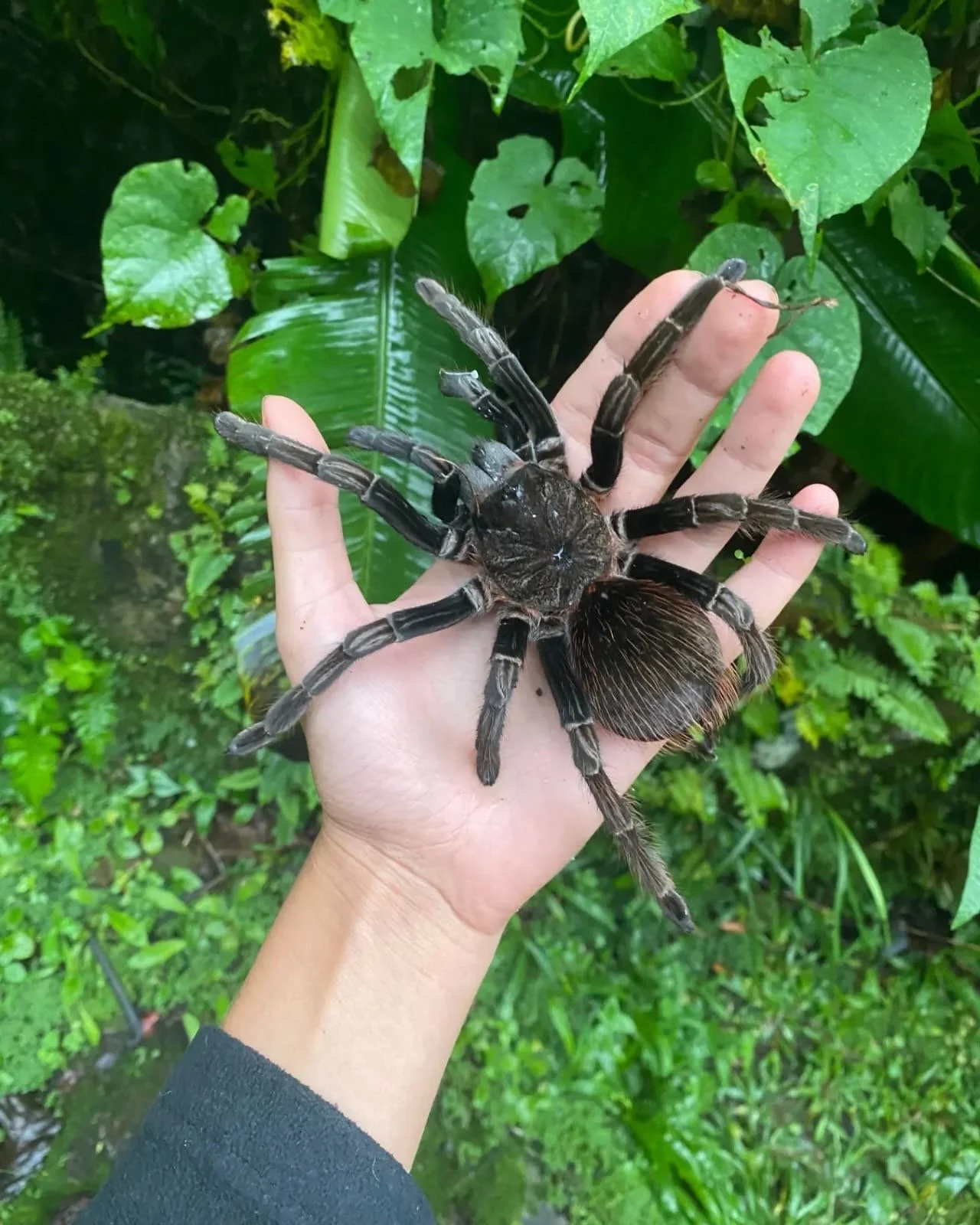
For many travelers, there is a particular moment on a Panama night walk when the flashlight catches something on the trail that makes the entire group stop.
It is big.
It is hairy.
It has eight legs.
And it appears to be looking directly at you.
A tarantula.
For someone who has never seen one outside a television documentary, the first reaction is often surprisingly dramatic. People freeze. Someone takes three steps backward. Someone else immediately wants a photograph. And there is usually at least one person who suddenly becomes very interested in whether the trail ahead is still necessary.
But here's the fascinating thing about seeing a tarantula in Panama:
It really shouldn't be that surprising.
Panama is a tropical country with enormous areas of rainforest, cloud forest, humid lowlands and undisturbed jungle habitat. Tarantulas are naturally part of these ecosystems. Scientists have documented a diverse collection of theraphosid spiders in Panama, including numerous species from genera such as Sericopelma, Psalmopoeus, Hapalopus, Holothele and others. Research in the Darién region alone has described several species new to science.
So if you're hiking through Panama and see one, you haven't discovered a monster.
You've discovered one of the rainforest's residents.
The First Thing to Understand: They're Supposed to Be Here
A tarantula on a jungle trail can seem strangely out of place to a visitor.
But imagine being a tarantula.
You live in a warm, humid environment with abundant insects and other small animals. There is plenty of leaf litter, soil, vegetation and natural shelter.
Panama is basically a gigantic tarantula neighborhood.
Some species live in burrows. Others use natural cavities, spaces beneath roots or debris. Some are arboreal and spend much of their lives in trees and vegetation. Research on Panamanian theraphosids has documented both ground dwelling and tree associated species.
So when one appears beside your hiking trail, it isn't necessarily wandering into civilization.
You have wandered into its civilization.
They're Big, But Big Doesn't Mean Dangerous
This is probably the biggest psychological problem with tarantulas.
Humans have an instinctive reaction to large spiders.
A tiny spider in the corner of a room might be ignored.
Make exactly the same spider several centimeters wide, cover it in hair and give it enormous fangs, and suddenly people start reconsidering their entire relationship with nature.
But size is not a reliable indicator of danger.
Tarantulas do possess venom, and they have substantial fangs, but their venom is primarily an adaptation for subduing prey. Smithsonian researchers emphasize that most spider venom is not dangerous to humans, although Panama does have some medically important spiders outside the tarantula group.
That distinction is important.
Tarantula does not mean medically dangerous spider.
Panama does have spiders that deserve considerably more caution, including Phoneutria, commonly called wandering spiders or banana spiders. Smithsonian Tropical Research Institute specifically notes that bites from Phoneutria can require medical attention.
So don't make the mistake of thinking every large spider in Panama is a tarantula.
But if you've positively identified a tarantula, the appropriate response is generally much calmer.
Their Fangs Look Terrifying for a Reason
Tarantulas are predators.
Their fangs aren't decorative.
They use them to capture prey and inject venom.
But this is where humans sometimes misunderstand animal behavior.
A tarantula doesn't look at a person and think:
"Excellent. Dinner."
You are far too large.
To a tarantula, a human is an enormous disturbance in its environment.
Its natural prey includes insects and other arthropods, and depending on the species, tarantulas can also take small vertebrates.
You are not on the menu.
You are the enormous, unpredictable thing stomping around near the burrow.
Most Tarantulas Would Prefer You Leave
This is probably the most useful thing to remember.
A tarantula doesn't generally want to fight you.
If you see one walking across a trail, it isn't necessarily coming toward you.
It may simply be trying to get somewhere.
It might be searching for prey.
It might be looking for a mate.
It could be moving between shelters.
Or, particularly with males, it could be wandering during a reproductive search.
It has somewhere to go.
And you're probably standing directly in its way.
The best response is therefore remarkably simple:
Step back.
Give it space.
Let it continue.
Why Do You See Them More at Night?
If you go on a jungle night walk in Panama, you have dramatically increased your chances of encountering animals that you would rarely notice during the day.
Tarantulas are predators adapted to nocturnal activity, and many species spend daylight hours concealed in burrows, cavities or other retreats.
At night, the forest becomes their hunting ground.
This is why a night walk can feel like entering a completely different ecosystem.
The same trail that seemed empty at noon can suddenly contain frogs, insects, snakes, sleeping birds, kinkajous, bats and spiders.
And somewhere among them is a tarantula doing exactly what it evolved to do.
The Hair Is More Interesting Than You Think
One of the most recognizable features of a tarantula is its hairy body.
Those hairs aren't simply there to make it look terrifying.
Many New World tarantulas possess specialized urticating hairs that can be used as a defensive weapon. Smithsonian describes these hairs as tiny irritating structures that tarantulas can release when threatened.
In other words, the tarantula doesn't necessarily have to bite you to defend itself.
It can use its hairs.
And those hairs can cause significant irritation, particularly if they get into sensitive areas such as the eyes.
This is one reason you should never handle a wild tarantula.
Even if you're convinced it looks calm.
Even if you've seen someone pick one up online.
Even if the guide says it is harmless.
Leave it alone.
The Tarantula Has a Surprisingly Effective Defense System
When threatened, a tarantula may display defensive behavior before resorting to a bite.
It may raise its front legs.
It may move quickly.
It may attempt to escape.
It may use its urticating hairs.
The exact response depends on the species and situation.
This is why the best way to interact with a wild tarantula is actually not to interact with it at all.
You don't need to touch it to appreciate it.
A flashlight, a camera and a few meters of respectful distance are enough.
They Are Not Out to Chase Tourists
One of the great myths surrounding big spiders is that they will chase people.
A tarantula moving quickly in your direction can certainly create this impression.
But there is an important difference between moving toward you and moving in the direction you happen to occupy.
If you suddenly illuminate a tarantula on a trail, it may become disoriented or simply try to reach cover.
If the only available route happens to pass near your feet, it can look like the spider has decided to launch an attack.
It hasn't.
It is trying to solve the problem of:
"How do I get away from this gigantic creature?"
Don't Be Surprised to Find One Around a Hostel
This is particularly important for travelers staying in jungle accommodations.
If your hostel, lodge or eco hotel is surrounded by forest, seeing a tarantula isn't necessarily a sign that something has gone wrong.
In fact, the opposite may be true.
A property surrounded by functioning forest is naturally going to have wildlife.
And wildlife doesn't understand property boundaries.
The tarantula doesn't know that one side of the trail belongs to a hotel and the other side belongs to the forest.
To the spider, it's all habitat.
Panama Has a Remarkable Tarantula Diversity
One of the most fascinating things about Panama's tarantulas is that "the Panama tarantula" isn't really a thing.
There are multiple species with different lifestyles and appearances.
Scientific work in the Darién region has even resulted in descriptions of several new species, demonstrating that researchers are still uncovering how much diversity exists within Panama's theraphosid fauna.
This makes the country particularly interesting for arachnologists.
A tarantula found in one region may not necessarily be the same species encountered somewhere else.
Cloud forest.
Lowland rainforest.
Caribbean slopes.
Pacific forests.
Darién.
Different environments can support very different tarantula communities.
Some Live Underground
The classic image of a tarantula is an enormous spider sitting inside a deep burrow.
There is some truth to this.
Many tarantulas are fossorial, meaning they live in or around underground retreats.
Some species construct their own burrows.
Others modify existing cavities.
Some simply use naturally occurring spaces beneath roots, logs, rocks or debris.
Research on Panamanian species has documented burrow associated lifestyles where spiders can remain hidden during the day and emerge around dusk and night to hunt.
The entrance may be surprisingly difficult to spot.
Which means you can walk past a tarantula's home dozens of times without ever realizing there's a large spider living underneath the trail.
And Some Live in Trees
This is where things get even more interesting.
Not all tarantulas are ground dwellers.
There are arboreal tarantulas that spend their lives in vegetation, tree cavities and other elevated shelters.
The genus Avicularia, for example, contains arboreal tarantulas associated with tropical forests and includes species with distinctive coloration on their feet.
So if you're walking through Panama's forest and looking only at the ground, you might miss half the story.
The rainforest has tarantulas below you.
And potentially above you.
They're Excellent Predators
Tarantulas aren't sitting around waiting for tourists to photograph them.
They are highly effective predators.
They use sensory structures to detect movement and vibrations in their environment and can ambush prey rather than relying on elaborate capture webs like many other spiders.
Their diet can include insects, other arthropods and, in some species, small vertebrates.
They therefore play a role in controlling populations of other animals.
That makes the enormous hairy spider beside your trail part of the ecological machinery of the forest.
It is not a pest.
It is a predator.
Tarantulas Are Basically Living Sensors
Their world is different from ours.
We rely heavily on vision.
A tarantula experiences its environment through a combination of touch, vibration, chemical cues and other sensory information.
The hairs and structures on its legs are extraordinarily important for detecting what is happening around it.
That means the spider can detect things you may not even notice.
A vibration through the ground.
A movement in vegetation.
An insect approaching.
A large animal walking nearby.
In 2026, field research even provided evidence that some New World tarantulas may possess more flexible, experience based spatial navigation abilities than previously appreciated.
So that seemingly simple spider wandering around at night may have a much more sophisticated relationship with its environment than people assume.
The Males Have a Dangerous Dating Life
Tarantula reproduction is one of nature's less romantic stories.
A mature male has to locate a female.
The problem?
The female can kill him.
In many tarantula species, the male must approach carefully and use specialized behaviors to reduce the chance of being mistaken for prey.
Smithsonian describes tarantula mating as a potentially deadly encounter for males, since females can attack and consume them.
So if you see a tarantula wandering around at night, there is a possibility you're looking at a male on a particularly important mission.
He isn't necessarily lost.
He might be looking for love.
Unfortunately, love may kill him.
Why You Shouldn't Kill One
This should go without saying, but it is worth emphasizing for travelers.
If you find a tarantula in your room, bathroom or cabin, don't automatically kill it.
Ask staff for help.
A cup, container or other safe relocation method can often solve the problem without killing the animal.
Remember, you are in Panama.
You are visiting a tropical ecosystem.
A few encounters with wildlife are part of the experience.
And a tarantula is far more interested in finding somewhere dark than in ruining your vacation.
Don't Put Your Hand Near It for a Photograph
This is perhaps the biggest mistake people make after getting over their initial fear.
They become fascinated.
Then brave.
Then too brave.
Suddenly someone is crouching beside a tarantula with their hand six centimeters away because they want a photograph that proves how fearless they are.
Don't.
You don't need to touch wildlife to prove that you're adventurous.
The best photograph is one that captures the animal behaving naturally.
Use a zoom lens.
Use your phone from a safe distance.
Let the tarantula walk away.
A Tarantula Sighting Is Actually a Great Wildlife Experience
If you're traveling through Panama and encounter one, don't think:
"Oh no, there's a giant spider."
Think:
"I just found one of Panama's rainforest predators."
You are looking at an animal that has evolved specialized armor, venom, sensory systems, defensive hairs and hunting behavior to survive in one of the world's most competitive environments.
And unlike a zoo animal, this one is living completely on its own terms.
It doesn't care about your camera.
It doesn't care about your itinerary.
It doesn't care that you have a bus leaving in forty minutes.
It has its own schedule.
The Bigger Picture
Panama's tarantulas are also a reminder of why the country's forests are so fascinating.
The obvious wildlife gets most of the attention.
Everyone wants to see the sloth.
Everyone wants a photograph of a toucan.
Everyone gets excited about monkeys.
But beneath the leaves, inside tree cavities and along the forest floor is an enormous world of animals that most visitors never notice.
Tarantulas are part of that hidden biodiversity.
Scientists continue to describe new species and investigate how these spiders live, particularly in biologically rich regions such as Darién.
So encountering one isn't an interruption to your Panama adventure.
It is part of the adventure.
Don't Fear the Hairy Giant
The next time you're walking through a Panamanian forest at night and your flashlight lands on a giant hairy spider, take a breath.
Don't scream.
Don't run blindly into the jungle.
And definitely don't try to pick it up.
Just stop and look.
You are seeing an animal that has probably spent most of its life hidden from humans.
It may be hunting.
It may be exploring.
It may be looking for a mate.
It may be heading back to its burrow.
Whatever it is doing, you are simply lucky enough to have caught it in the act.
Tarantulas are big enough to look frightening, but their appearance dramatically exaggerates the danger they pose to people. The sensible approach is respect rather than fear: give them space, don't handle them, and remember that Panama's forests are supposed to contain creatures that look completely alien to us.
And honestly, if you're backpacking through Panama and finish your trip without seeing a tarantula, you may have spent a lot of time looking at the trees.
Next time, look down.