
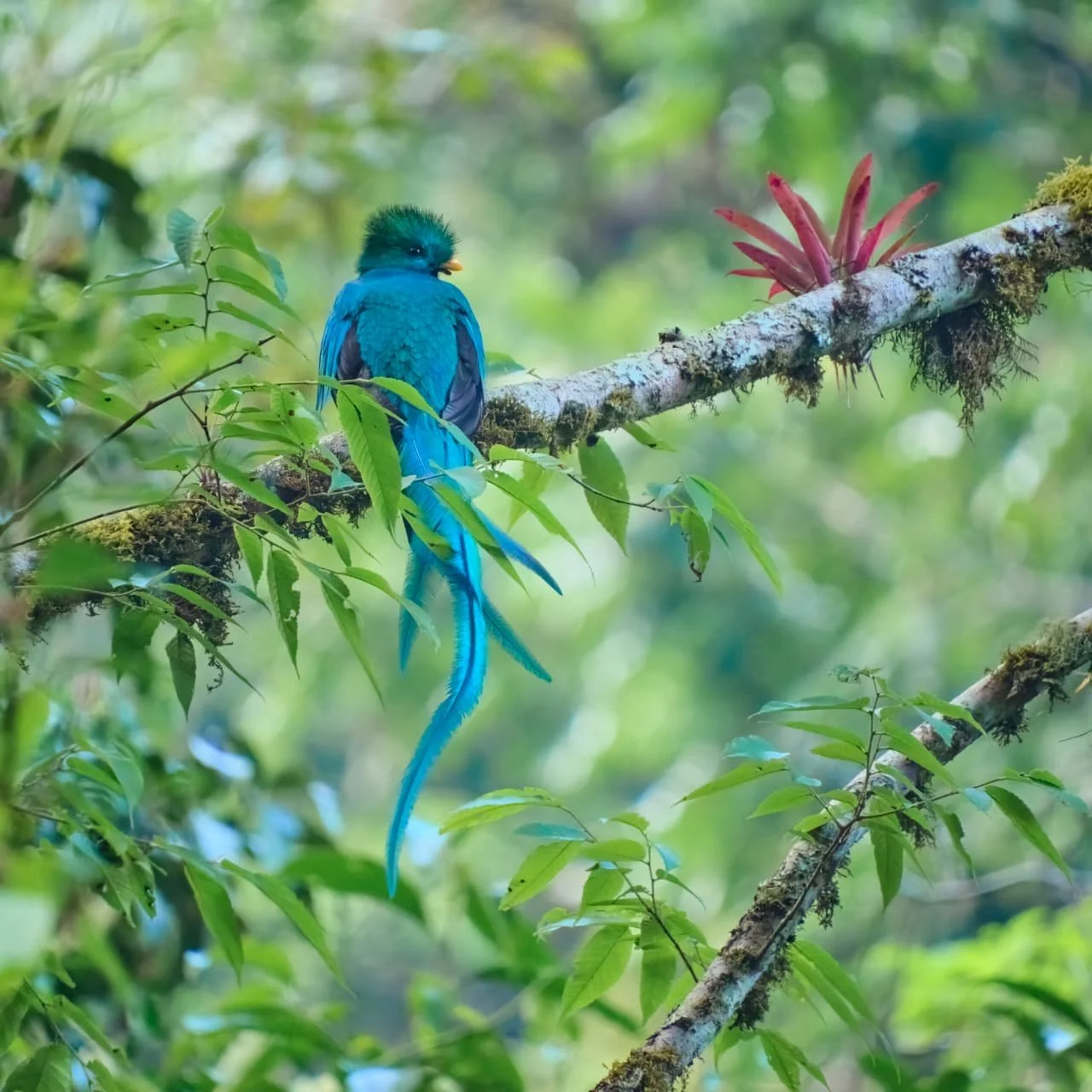
Few sights in Panama are more entertaining than looking up into the rainforest and suddenly realizing that the trees are full of tiny faces.
A branch shakes. A little black nose appears. Then another monkey races across the canopy, followed by five more. They leap between branches, disappear behind leaves and reappear somewhere completely different. Their enormous eyes seem to be permanently set to maximum curiosity, and their tiny bodies move through the forest with astonishing speed.
These are squirrel monkeys, among the most charismatic primates a traveler can encounter in Panama.
They are small, extremely social, highly intelligent and wonderfully adapted to life in the tropical forest. Watching a troop moving naturally through the trees can be one of the great wildlife experiences of a trip to Panama.
But there is an important rule that every visitor should know:
Do not feed them.
And this becomes especially important when taking organized wildlife tours, because some places visited by tourists have monkeys that have learned to expect food from people.
The fact that a monkey happily approaches a tourist does not necessarily mean that the monkey is enjoying a wonderful relationship with humans.
Sometimes it means something much more complicated has happened.
The Little Monkeys With the Giant Personalities
Squirrel monkeys are immediately recognizable.
They have relatively small bodies, long tails, delicate limbs and remarkably expressive faces. Their coloration creates the impression that someone has carefully painted their features: a pale face surrounding dark eyes and muzzle, contrasting with the darker fur around their head and body.
They are built for movement.
Rather than lumbering through the forest like a larger monkey, squirrel monkeys seem to fly through it.
They race along branches, climb vertically, leap between trees and move through dense vegetation with incredible coordination.
Watching them from the ground can feel like watching a miniature circus taking place several stories above your head.
And then there is the sheer number of them.
Squirrel monkeys are highly social and can travel in groups. When a troop moves through the forest, the experience can be completely different from spotting a solitary sloth or a single monkey sitting quietly in a tree.
You may suddenly find yourself surrounded by movement.
One monkey is eating.
Another is grooming.
Another is watching you.
A youngster is chasing another youngster.
Then the entire group disappears.
Five minutes later, you realize they have been following the trail above you the entire time.
Panama's Squirrel Monkeys Are Special
The squirrel monkey found in parts of Panama and Costa Rica is the Central American squirrel monkey, Saimiri oerstedii.
Its distribution is relatively restricted compared with many of the more widespread monkeys found elsewhere in Central and South America. The species has also faced significant pressure from habitat destruction, making the protection of its remaining forest particularly important.
That makes seeing one in Panama more than simply checking another animal off a wildlife list.
You're seeing a specialized rainforest primate that depends on functioning tropical ecosystems.
And Panama happens to be an extraordinary place for studying how animals live in those ecosystems.
The Smithsonian Tropical Research Institute has conducted decades of research in Panamanian forests, including long-term studies of primates and the way rainforest animals find and use food.
They Are Not Little Forest Pets
This is perhaps the most important thing for tourists to understand.
Squirrel monkeys can look remarkably approachable.
They are small.
They have huge eyes.
They are curious.
And if they have become accustomed to humans, they may come surprisingly close.
That can create the impression that they are almost domesticated.
They are not.
They are wild animals.
Their entire existence is built around finding natural food, avoiding predators, communicating with members of their troop, raising young and navigating a complicated three dimensional rainforest environment.
A monkey sitting three feet away from a tourist is still a wild monkey.
And the fact that it has learned that tourists sometimes carry bananas doesn't change that.
The Problem With Feeding Them
Feeding wildlife feels harmless.
A traveler might think:
"It's only one banana."
Or:
"The tour guide gave us some peanuts."
Or:
"They clearly love it."
But wildlife feeding can create a chain of consequences that is much bigger than that one interaction.
The monkey learns that humans can provide food.
Then it starts associating people with food.
Eventually, the animal may begin approaching tourists rather than avoiding them.
And that can fundamentally change its behavior.
Instead of spending its time searching through the forest for natural foods, it may start watching humans.
Instead of remaining high in the canopy, it may descend toward people.
Instead of moving away when tourists approach, it may move closer.
The behavior that looks adorable in a photograph can actually be a sign that the animal has been conditioned.
Suddenly, You Have a Monkey Looking for Snacks
This is where the situation can become funny for about thirty seconds and problematic afterward.
A squirrel monkey that believes tourists have food may become remarkably persistent.
It might approach your backpack.
It might inspect your pockets.
It might climb onto a railing.
It might grab something.
And if it doesn't get what it expects, its behavior may become more assertive.
Wild animals don't understand the concept of "I'm sorry, but I've already given away my last banana."
They understand rewards.
If approaching humans produces food, approaching humans becomes worthwhile.
Human Food Is Not Monkey Food
There is another obvious problem.
Tourists don't generally carry a perfectly balanced squirrel monkey diet.
They carry cookies.
Bread.
Chips.
Candy.
Fruit.
Crackers.
Sandwiches.
And sometimes completely inappropriate processed foods.
Even foods that seem relatively harmless can be unsuitable when given regularly or in large quantities.
Wild animals evolved around the foods available in their ecosystems. Their natural diet and nutritional requirements are part of an enormously complicated ecological system.
Panamanian rainforest researchers have demonstrated just how important natural food availability is to primates and other mammals. In one study on Barro Colorado Island, researchers examined how several species navigated the rainforest to find naturally occurring fruit resources.
That natural foraging behavior is not just something animals do because they have nothing better to do.
It is part of being a wild animal.
Feeding Can Make Wildlife Tourism Worse
This is where tourists need to look beyond their own experience.
A tour company may say:
"Don't worry, these monkeys are used to people."
That might be true.
But it doesn't necessarily mean that the situation is good for the monkeys.
In fact, the question a responsible traveler should ask is:
Why are they used to people?
There is a huge difference between a monkey naturally tolerating humans at a distance and a monkey actively approaching tourists because it expects food.
The first is wildlife.
The second can be conditioning.
Panama has already experienced similar problems with other forms of wildlife tourism. Smithsonian researchers studying dolphins in Bocas del Toro have documented how tourism can concentrate large numbers of boats around wildlife and have emphasized the importance of educating tourists and operators about responsible wildlife viewing.
The lesson applies far beyond dolphins.
Just because tourists want an interaction doesn't mean the animal benefits from it.
Be Careful With Wildlife Tours
This doesn't mean that you should avoid wildlife tours.
Quite the opposite.
A good wildlife guide can completely transform your experience.
A knowledgeable guide can tell you what the animals are doing, identify species, explain their behavior and help you observe without interfering.
The problem is when wildlife tourism becomes more about guaranteeing an interaction than observing natural behavior.
If a tour company promises:
"You will definitely get the monkeys to come right up to you!"
that should make you stop and think.
If the secret to making the monkeys appear is a bag of food, you're not necessarily seeing natural wildlife behavior.
You're seeing the result of conditioning.
The Best Monkey Encounter Is the One You Didn't Control
Imagine walking through a Panamanian forest.
You hear movement above you.
You stop.
A squirrel monkey appears.
It looks at you.
You don't move.
Another appears.
Then another.
Suddenly the whole troop is moving through the canopy.
They aren't coming because you have food.
They aren't performing for tourists.
They aren't waiting for a handout.
They're simply going about their lives.
And you happen to be lucky enough to witness it.
That is the wildlife experience worth having.
You are a visitor in their world rather than the center of it.
Don't Try to Touch Them Either
Feeding often leads to another temptation:
touching.
If an animal comes close enough, people naturally want to reach out.
Don't.
Even if the monkey seems relaxed.
Even if another tourist is doing it.
Even if the guide says the monkey is friendly.
Wild animals can react unpredictably, and physical contact creates risks for both humans and animals.
You don't know what the animal is carrying, and it doesn't understand human intentions.
A monkey doesn't know that you're trying to take a cute selfie.
It only knows that something has entered its personal space.
Your Backpack Is Suddenly Very Interesting
Backpackers should be particularly careful.
Squirrel monkeys are exceptionally curious, and a backpack full of interesting smells can be extremely tempting.
If you're carrying fruit, snacks or other food, don't leave your bag open beside a group of monkeys.
And don't deliberately hold food out to attract them.
Once an animal has learned that backpacks equal snacks, your peaceful wildlife experience can turn into a surprisingly energetic game of "give me your bag."
You probably won't win.
Why Feeding Can Affect the Entire Troop
The consequences aren't necessarily limited to one individual monkey.
Squirrel monkeys live in social groups, meaning that behaviors can occur within a larger social environment.
If certain individuals repeatedly receive food from tourists, other monkeys may learn from those interactions.
Eventually, a particular tourist location can become associated with food.
The monkeys begin appearing there regularly.
The animals and the humans become part of a predictable cycle.
Tourists arrive.
Monkeys approach.
Food appears.
Tourists take photographs.
More tourists arrive.
The monkeys approach even more aggressively.
And suddenly the attraction isn't really a wild forest anymore.
It has become an unofficial feeding station.
But What If the Tour Guide Gives Them Food?
This is a much harder situation for tourists.
You may find yourself on a tour where the guide produces food and encourages the monkeys to approach.
You might think:
"The guide is local. They must know what they're doing."
Not necessarily.
Tour operators vary enormously in their understanding of wildlife ethics.
Some are extremely knowledgeable and conservation minded.
Others may simply have discovered that tourists love getting close to animals and are responding to customer demand.
If you're uncomfortable with feeding, you can simply say:
"I'd rather watch them naturally."
You don't have to participate.
And if the guide insists that feeding is necessary to attract the monkeys, that tells you something important about the experience you're being offered.
A Great Wildlife Guide Doesn't Need Food
One of the best signs of a good wildlife guide is patience.
They know that wildlife doesn't operate on a schedule.
A monkey may appear.
Or it may not.
A sloth might be hidden.
A toucan might fly away.
A snake might be three meters off the trail instead of directly beside it.
That's nature.
The best guides don't need to manufacture the experience.
They know the forest.
They know where animals are likely to be.
They understand tracks, calls, feeding trees, weather patterns and animal behavior.
They can give you a fantastic experience without turning the wildlife into a vending machine.
Squirrel Monkeys Are Part of a Much Bigger Story
One of the fascinating things about watching monkeys in Panama is realizing that you're not simply watching individual animals.
You're watching an entire ecosystem working.
Fruit is produced by trees.
Monkeys find the fruit.
Seeds are transported.
Predators hunt mammals.
Birds interact with plants.
Insects pollinate flowers.
Animals compete and cooperate.
Everything is connected.
Panama's tropical forests are among the most intensively studied ecosystems in the world, and research conducted by organizations such as the Smithsonian Tropical Research Institute has revealed extraordinary details about how animals move, forage and interact.
A squirrel monkey doesn't need a tourist to give it a banana.
It has evolved for millions of years to solve the problem of finding food in the forest.
Let it do its job.
The Backpacker's Wildlife Rule
There is a very simple rule that works almost everywhere in Panama:
Look, photograph, admire and move on.
Don't feed.
Don't chase.
Don't touch.
Don't call the animal toward you.
Don't block its path.
Don't surround it for photographs.
And don't encourage tour operators to turn wildlife into an attraction that depends on food.
If a squirrel monkey comes close naturally, consider yourself incredibly lucky.
Take your photograph.
Watch what it does.
Then let it continue with its day.
And There Is Something Wonderful About Not Feeding Them
There is a certain satisfaction in knowing that the animal you're watching doesn't need you.
You're not responsible for making the encounter happen.
You haven't bribed it.
You haven't changed its behavior.
You haven't interrupted its search for food.
You simply happened to be there.
Maybe it looks at you for three seconds.
Maybe it completely ignores you.
Maybe the troop races overhead so quickly that you barely get a photograph.
That is perfectly fine.
Because the goal of wildlife travel shouldn't be:
"How close can I get?"
It should be:
"How naturally can I experience this animal?"
Panama's Tiny Jungle Acrobats Deserve Better
Squirrel monkeys are one of those animals that can make a trip through Panama unforgettable.
Their speed, intelligence, social behavior and extraordinary appearance make them irresistible to watch.
But their greatest value isn't that they provide tourists with photographs.
Their value is that they belong in Panama's forests.
They belong in the canopy, moving through the trees, searching for natural food, raising their young and interacting with the rest of the ecosystem.
So if a tour company takes you somewhere where squirrel monkeys are waiting for food, don't automatically assume that what you're seeing is a good thing.
Ask yourself why the monkeys are waiting.
And remember that sometimes the most responsible wildlife experience is the one where you give the animal absolutely nothing except space.
The perfect photograph isn't necessarily the one where a squirrel monkey is sitting on your shoulder.
Sometimes it is a tiny face looking down from a rainforest branch, surrounded by green leaves, completely wild, completely independent and completely uninterested in what you brought for lunch.
That is the monkey you really came to Panama to see.