
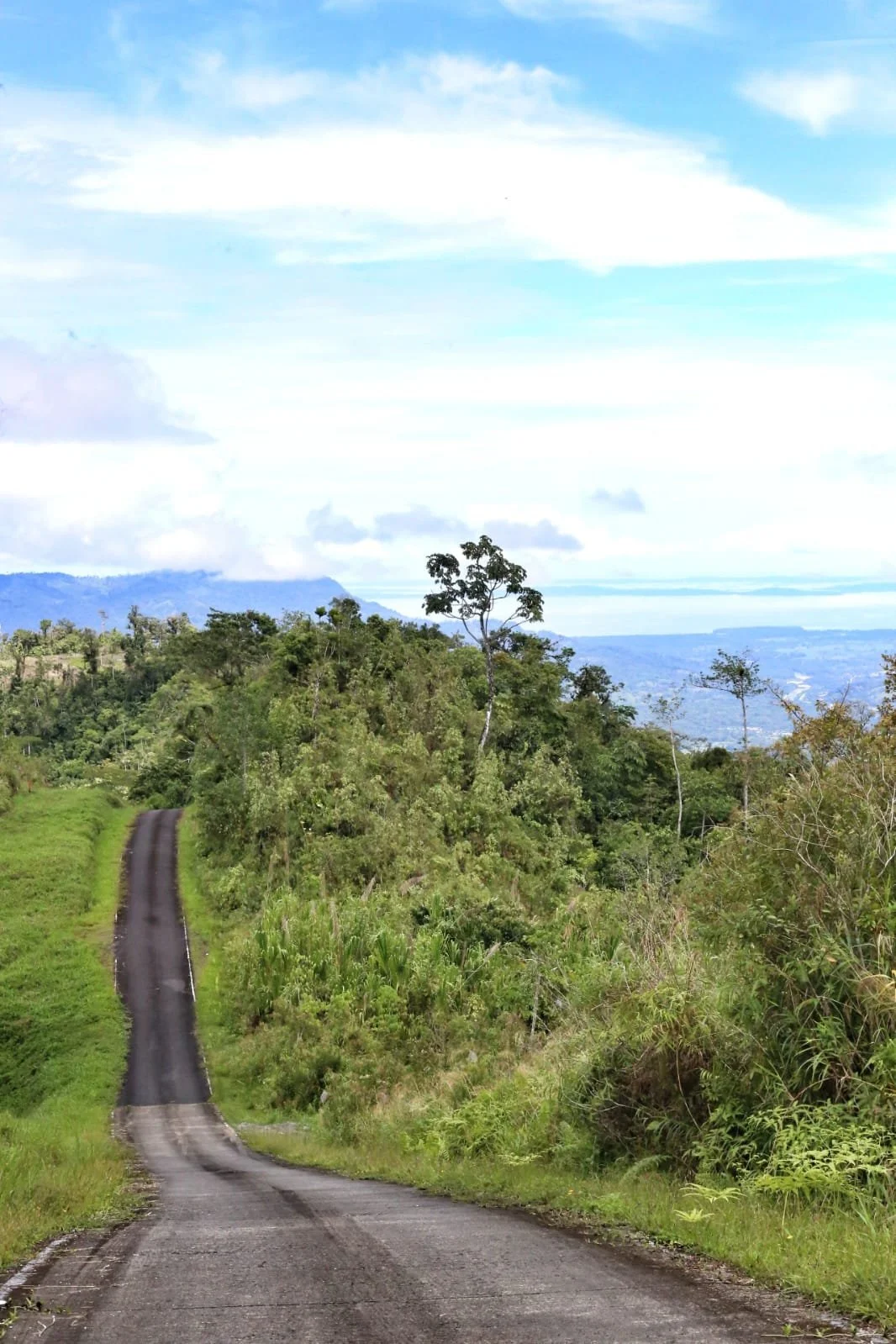
Just outside the small town of Gamboa, where the Panama Canal cuts through one of the richest tropical landscapes on Earth, there is a place where the rainforest becomes almost impossible to ignore: the Panama Rainforest Discovery Center.
The name sounds rather innocent. “Discovery Center” might conjure up images of a museum with glass cases and educational displays. But this is something much more exciting. The Discovery Center is essentially a gateway into the jungle, sitting beside the legendary Pipeline Road on the edge of Soberanía National Park. Instead of putting the rainforest behind glass, it puts visitors right in the middle of it.
And Gamboa is an extraordinary place for this. The Smithsonian Tropical Research Institute describes the surrounding Soberanía National Park as roughly 20,000 hectares of intact lowland tropical forest and an important biological corridor connecting two continents.
The famous Pipeline Road
One of the biggest reasons people come here is Pipeline Road.
Originally constructed during the Second World War to allow access to an oil pipeline, the road has become one of Panama's most famous wildlife-watching routes. Today, it passes through dense rainforest where researchers, birdwatchers, photographers and adventurous travelers go looking for the astonishing creatures that live in the canopy, undergrowth and forest floor.
The Discovery Center provides a much more structured way of experiencing this environment. Rather than simply walking down a muddy jungle road hoping something appears, visitors can follow trails through the forest and then climb above the canopy for a completely different perspective.
And that is where things get spectacular.
Climb above the rainforest
The center's observation tower is one of its defining features. After walking through the forest, visitors can climb upward and suddenly find themselves looking across the enormous green ocean of the Panamanian rainforest.
From the ground, tropical forests can feel almost claustrophobic. Trees tower overhead, vines cross the trails and foliage blocks the horizon. From above, everything changes. The forest reveals its structure: layers of vegetation, enormous trees rising above the canopy and birds moving between treetops.
It is also one of those places where patience pays off. The rainforest isn't a zoo, and there is no guarantee that a toucan will conveniently fly past at exactly the right moment. But that uncertainty is part of the magic.
The hummingbird spectacle
Perhaps the easiest wildlife encounter at the Discovery Center is also one of the most entertaining.
Around the visitor center are hummingbird viewing areas where these tiny birds dart around at extraordinary speed. They can appear almost comically aggressive for creatures weighing only a few grams, chasing one another away from feeding spots before disappearing into the vegetation.
For photographers, this can become addictive. One moment the feeder appears empty; the next, several hummingbirds are hovering inches away, wings moving so rapidly that they seem almost supernatural.
And unlike trying to spot a bird somewhere deep inside the jungle, the viewing area gives visitors the chance to sit down and actually watch.
But the birds are only the beginning
Gamboa is particularly famous among birdwatchers, and the Discovery Center is an excellent introduction to the extraordinary birdlife of the Canal Zone.
The surrounding forest supports an incredible variety of species, from toucans and motmots to trogons, tanagers, parrots, woodpeckers and hummingbirds. Some are brightly colored and surprisingly easy to spot. Others seem to have been specifically designed by evolution to make birdwatchers suffer.
A green bird in a green tree is one thing. A tiny bird moving somewhere behind six layers of leaves is another.
This is one reason experienced birdwatchers often arrive early. The forest is generally cooler and more active in the morning, and the combination of early light and bird activity can make the first few hours especially rewarding.
A rainforest with a scientific reputation
There is another reason Gamboa feels different from many tropical tourist destinations.
This isn't simply rainforest that happens to have wildlife. It is rainforest that has been studied intensively for generations.
The nearby Smithsonian Tropical Research Institute facilities have made Gamboa an important center for tropical science. Researchers work on subjects including forest ecology, animal behavior, evolution, climate change and biodiversity. The Gamboa research complex includes insectaries, experimental greenhouses, amphibian conservation facilities and specialized installations for studying bats.
In fact, the Smithsonian's relationship with Panama goes back more than a century. Scientists have been studying the country's tropical ecosystems since Panama invited the institution to conduct biological surveys in 1910.
That means that when you are standing in the forest around Gamboa, you aren't simply looking at an attractive jungle. You are standing inside one of the world's great living laboratories.
The frogs hiding in the forest
One of the most fascinating stories connected with Gamboa is the struggle to save Panama's amphibians.
Panama has more than 200 species of frogs, salamanders and caecilians, but many amphibian populations have suffered catastrophic declines because of chytrid fungus, a disease that has devastated amphibians across Central America. The Smithsonian and its partners established amphibian rescue facilities in Gamboa to maintain breeding populations of threatened species.
So while visitors at the Discovery Center might be watching a hummingbird weighing only a few grams, scientists elsewhere in Gamboa may be working with an equally tiny animal whose survival could depend on their research.
That contrast is what makes the area so fascinating.
Gamboa is much bigger than one attraction
The Discovery Center works particularly well as part of a larger Gamboa adventure.
Nearby are Pipeline Road, Soberanía National Park, the Panama Canal, Gatún Lake and the Chagres River. The area is also the mainland launching point for scientific expeditions to Barro Colorado Island, the legendary Smithsonian research site in the middle of the Canal watershed.
There are therefore several completely different ways to experience Gamboa. You can walk quietly through the forest looking for birds, climb into the canopy, take a boat through the Canal watershed, search for monkeys and sloths, or simply sit beside the rainforest and listen to the extraordinary soundtrack of tropical life.
And that is the real appeal of the Discovery Center.
It doesn't try to compete with the jungle. It lets the jungle be the attraction.
Why it is worth visiting
For travelers staying in Panama City, the Discovery Center is one of the easiest ways to experience genuine rainforest without committing to a multi-day expedition. Gamboa is only about 30 kilometers from Panama City, yet the landscape can feel dramatically more remote once the city disappears behind the trees.
For serious birdwatchers, it is particularly compelling. For photographers, the hummingbirds and elevated viewpoints are obvious draws. For backpackers, it offers something completely different from the beaches, skyscrapers and historic streets of Panama City.
But perhaps the best reason to visit is simply to understand how alive Panama really is.
Stand quietly on one of the trails and listen. Something is almost certainly moving. A bird calls from somewhere above. Leaves shake in the undergrowth. Insects buzz around the vegetation. A monkey may be watching from a branch that you haven't noticed.
Then look upward.
The rainforest stretches away in every direction.
And suddenly, the name Discovery Center makes perfect sense.