
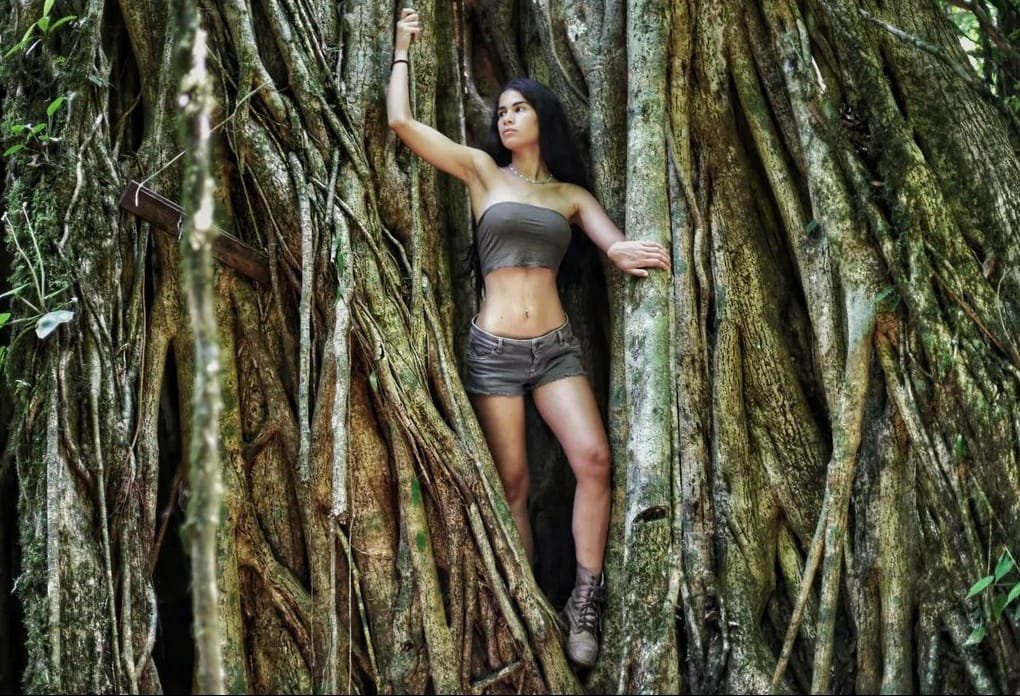
When people think of Panama, they often picture beaches, the canal, tropical islands, or the skyline of Panama City. Yet some of the country's most impressive wonders are not found along the coast or inside cities. They are found deep within forests where living organisms tower above the jungle floor like natural skyscrapers. These giants were already growing when many of the world's modern nations did not yet exist. They survived storms, droughts, floods, and centuries of change. Some have witnessed the arrival of explorers, the rise and fall of empires, the construction of the canal, and the transformation of Panama into a modern nation. They are the great trees of Panama, silent giants that form one of the most remarkable living landscapes in the Americas.
A person walking through a mature tropical forest for the first time often struggles to understand the true scale of what surrounds them. Photographs rarely capture it. Looking upward from the forest floor can feel like standing at the base of a cathedral built by nature. Massive trunks rise into the air before disappearing into a canopy that may be more than forty or fifty meters above the ground. Branches spread outward like enormous arms. Vines twist toward sunlight. Epiphytes cling to bark. Birds, insects, monkeys, and countless other creatures occupy levels of the forest invisible from below.
These forests are not merely collections of trees. They are entire vertical worlds.
One of the most impressive species found in Panama is the majestic kapok tree, known locally as the ceiba. The Ceiba pentandra is among the largest and most recognizable tropical trees in the Americas. Some specimens reach extraordinary heights and develop immense buttress roots that extend outward from the trunk like the walls of an ancient fortress. These roots are not simply decorative. They provide stability in the often shallow soils of tropical forests. Standing beside a giant ceiba can feel like standing next to a living monument. The trunk may be so large that several adults joining hands would struggle to encircle it completely.
What makes tropical trees particularly fascinating is that height alone does not tell the whole story. Tropical forests are environments of intense competition. Every plant seeks sunlight. Reaching the canopy provides access to one of the most valuable resources in the ecosystem. As a result, trees grow upward in a constant race toward the sky. Over decades and centuries, the winners become towering giants that dominate the forest landscape. Their crowns receive direct sunlight while smaller plants survive beneath them in perpetual shade.
The forests of Panama contain numerous species capable of reaching impressive dimensions. Some hardwoods grow slowly but achieve exceptional size and durability. Others grow more rapidly, taking advantage of favorable conditions. Certain trees become ecological centers supporting entire communities of life. Birds nest in their branches. Mammals feed on their fruits. Insects inhabit their bark. Fungi interact with their roots. A single large tree may support hundreds of different species throughout its lifetime.
Perhaps the most remarkable thing about these giants is their age. Tropical forests often give the impression of constant change. Leaves fall. Branches break. New plants emerge. Yet hidden among this apparent dynamism are individuals that have persisted for centuries. While determining the exact age of tropical trees can be more difficult than aging temperate species, some of Panama's largest forest giants likely began life long before the modern era. Imagine a tree that started as a seedling while sailing ships crossed the oceans, before railroads existed, before airplanes flew, and before electricity illuminated cities. Such timescales are difficult for humans to comprehend.
The forests themselves are even older. Not individual trees, but the ecosystems they belong to. Panama's rainforests represent the latest chapter in ecological histories stretching back millions of years. The species composition may have shifted. Climatic conditions may have changed. Yet forests have occupied parts of the isthmus for immense spans of geological time. They witnessed the emergence of the land bridge connecting North and South America. They experienced climatic fluctuations and evolutionary transformations that shaped the modern natural world.
One reason Panama's forests are so rich is its unique geographical position. The country serves as a biological crossroads between continents. Species from North and South America meet here. Plants evolved in different regions coexist within the same ecosystems. The result is extraordinary biodiversity. A walk through a Panamanian forest reveals an astonishing variety of tree forms, leaf shapes, flowers, fruits, and ecological strategies. Few places on Earth contain such diversity within such a relatively small area.
The giant trees play critical roles in maintaining this biodiversity. Their canopies create habitats for birds, monkeys, sloths, and countless other animals. Cavities within old trunks provide nesting opportunities. Fallen branches create microhabitats on the forest floor. Even after death, large trees continue contributing to the ecosystem. Decaying wood becomes food and shelter for fungi, insects, amphibians, and numerous other organisms. In a tropical forest, the life of a giant tree influences generations of other living things.
Rainfall is another key factor behind the growth of these giants. Panama's wet climate provides the moisture necessary for sustained growth. In some regions, annual rainfall reaches extraordinary levels. Water supports photosynthesis, nutrient cycling, and countless biological processes. Combined with warm temperatures throughout the year, these conditions allow forests to remain productive and vibrant. The result is a landscape capable of supporting some of the most impressive vegetation in the tropics.
The forests surrounding Soberanía National Park provide an excellent example. Located relatively close to Panama City, these forests contain towering trees and extraordinary wildlife diversity. Visitors walking the trails often focus on birds, monkeys, or butterflies, but the trees themselves are equally impressive. Some dominate the canopy, creating the structural framework upon which much of the ecosystem depends.
Farther east, the forests of Darién National Park contain some of the most extensive and least disturbed tropical forests in Central America. Here, giant trees continue to shape landscapes much as they have for centuries. In remote valleys and ridges, immense trunks rise above dense vegetation, forming part of one of the last great wilderness regions of the Americas.
One of the lesser appreciated aspects of giant trees is their influence on climate. Large trees store enormous quantities of carbon. They regulate local temperatures through shade and transpiration. Their roots stabilize soils and reduce erosion. Their canopies intercept rainfall. Forests function as complex environmental systems, and the largest trees are among their most important components. Remove the giants and the entire character of the ecosystem changes.
The experience of standing beneath one of these living towers is difficult to forget. Looking upward, a person gains a sense of scale rarely encountered in everyday life. Human concerns suddenly seem smaller. The tree has survived storms that would have flattened buildings. It has endured dry seasons, floods, and the passage of generations. It continues growing, slowly adding wood, leaves, and branches year after year.
Perhaps that is what makes Panama's giant trees so compelling. They represent continuity in a rapidly changing world. Cities expand. Roads are built. Technologies evolve. Generations come and go. Yet deep within Panama's forests, ancient giants continue reaching toward the sky just as they have for centuries.
These trees are not simply plants. They are living monuments, architects of ecosystems, guardians of biodiversity, and witnesses to history. Their roots anchor them to the earth, but their stories extend across centuries. To walk among them is to enter one of the oldest and grandest worlds still thriving in Panama today, a kingdom of giants whose true scale can only be appreciated by standing in their shadow and looking up.