
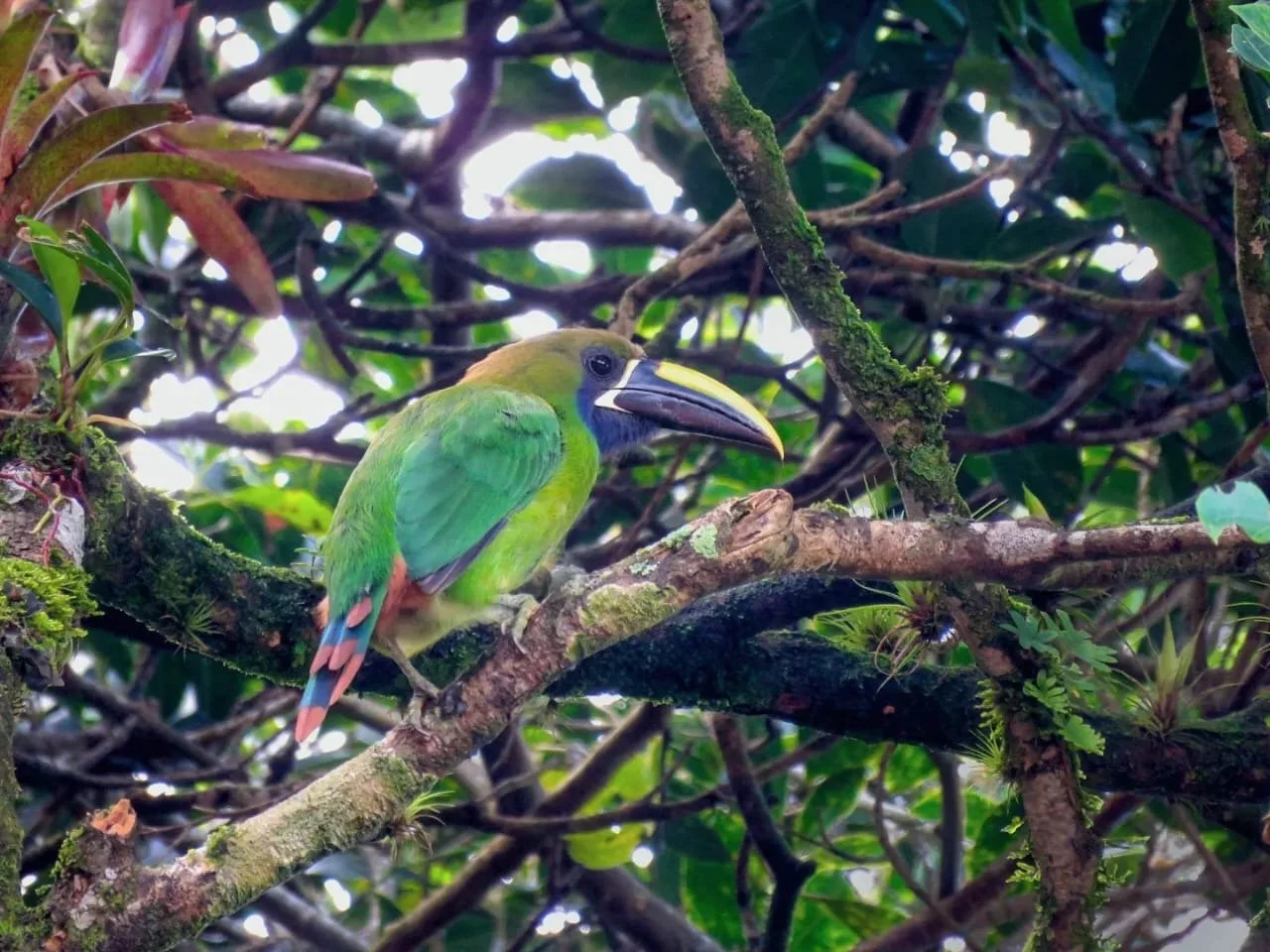
Every birdwatcher has a list.
Sometimes it exists on paper. Sometimes it lives only in the imagination. It is the collection of birds that keep people returning to forests before dawn, hiking through rain, climbing mountains, and staring into dense vegetation for hours at a time. These are not merely birds. They are obsessions. They are the species that appear in guidebooks and eBird checklists, the birds that show up in photographs taken by someone else, the birds whose calls echo from deep within the forest but never seem to reveal their source.
Panama is one of the world's great birdwatching destinations, with more than a thousand recorded species packed into a country smaller than South Carolina. For many birders, it is a paradise where toucans, trogons, hummingbirds, parrots, tanagers, and motmots seem almost easy to find. Yet even in this bird-rich nation there exists another level of challenge. These are the birds that humble experts. The birds that can elude experienced guides for weeks. The birds that generate excitement whenever their names appear on local WhatsApp groups. The birds that inspire international birders to travel thousands of miles for a chance at a few seconds of observation.
These are Panama's avian ghosts.
The Harpy Eagle: The Bird Everyone Dreams About
Perhaps no bird captures the imagination quite like the Harpy Eagle.
As Panama's national bird and one of the most powerful eagles on Earth, the Harpy Eagle is legendary. With talons larger than a grizzly bear's claws and the ability to hunt monkeys and sloths, it dominates the rainforest canopy. Yet despite its enormous size, it remains remarkably difficult to find.
The challenge is not that Harpy Eagles are secretive. The challenge is that they inhabit vast areas of rainforest at very low densities. A pair may control a territory covering dozens of square kilometers. You can spend weeks in suitable habitat and never see one.
Your best chances are in the remote forests of Darién National Park, where some of the largest remaining populations survive. Occasionally active nests are monitored, creating rare opportunities for visiting birders. Even then, success is never guaranteed.
Many birdwatchers visit Panama specifically for this species. Some leave successful. Others leave with only stories of distant calls and secondhand sightings.
The Bare-necked Umbrellabird: Panama's Most Bizarre Bird
If evolution occasionally enjoys a sense of humor, the Bare-necked Umbrellabird may be proof.
Large, black, and crowned with an umbrella-like crest, the species appears almost prehistoric. Males possess an inflatable red throat wattle that hangs dramatically from the chest during display.
The bird is so unusual that first-time observers often struggle to believe it is real.
Unfortunately, finding one can be extraordinarily difficult.
Populations have declined significantly across much of their range, and they often move seasonally between elevations. A location that hosted umbrellabirds last month may seem completely empty today.
The cloud forests of the Fortuna Forest Reserve provide some of the best opportunities in Panama. The forests around the Continental Divide occasionally produce sightings, particularly when fruiting trees attract feeding birds.
Many experienced birders rank the umbrellabird among their most difficult Central American targets.
The Three-wattled Bellbird: Heard More Than Seen
The first encounter with a Three-wattled Bellbird often happens through sound.
A metallic explosion echoes across a mountain valley.
The noise sounds impossible.
Some compare it to a hammer striking steel. Others describe it as a giant bell ringing in the forest.
Then begins the challenge.
Finding the source.
The bird may be perched hundreds of feet away in the canopy, remaining surprisingly difficult to locate despite producing one of the loudest calls in the bird world.
Bellbirds migrate seasonally through western Panama's cloud forests, making timing critical. Birders visiting at the wrong season may miss them entirely.
The Fortuna region remains one of the most reliable places to search, particularly around higher-elevation forests near the Continental Divide.
The Black-crowned Antpitta: The Master of Disappearing
Among birdwatchers, antpittas occupy legendary status.
These secretive forest-floor birds seem determined to remain unseen.
The Black-crowned Antpitta is among Panama's most frustrating examples.
Birders frequently hear it.
The haunting whistles emerge from dense vegetation.
The bird sounds close.
You move toward the call.
The call moves.
You follow.
The bird disappears.
Hours can be spent attempting to glimpse what often amounts to a brown shape crossing a trail for two seconds.
High-elevation cloud forests around Fortuna and the Chiriquí Highlands offer some of the best chances.
Yet even experienced birders sometimes wait years before achieving a satisfying view.
The Beautiful Treerunner: A Tiny Bird With a Huge Reputation
The name alone creates expectations.
The Beautiful Treerunner is genuinely beautiful, with intricate plumage and energetic behavior.
The problem is that it rarely stops moving.
Treerunners dart through moss-covered branches, often as part of mixed feeding flocks. By the time binoculars focus, the bird has already moved.
Cloud forests in Fortuna and around Volcán Barú National Park provide some of the best opportunities.
Success often depends on luck, patience, and being present when a feeding flock suddenly materializes.
The Rufous-vented Ground-Cuckoo: The Holy Grail
Ask veteran birdwatchers about the most difficult bird in Panama and many will mention the Rufous-vented Ground-Cuckoo.
This bird has achieved almost mythical status.
Large, striking, and incredibly elusive, it spends much of its life following army ant swarms through dense rainforest. Unlike many birds that forage independently, ground-cuckoos often depend on these moving insect armies to flush prey.
The problem is that ant swarms are unpredictable.
The bird is unpredictable.
And the rainforest is enormous.
Even guides who spend years in the field may only encounter a handful.
The forests of Darién and remote Caribbean-slope rainforests offer the best possibilities, but this remains one of Panama's ultimate birding prizes.
The Sapayoa: A Living Mystery
The Sapayoa fascinates scientists as much as birdwatchers.
For decades, researchers struggled to understand where it belonged evolutionarily. It turned out to be more closely related to birds from Australia and New Guinea than to most American species.
Finding one is no simple matter.
Sapayoas inhabit humid lowland rainforest and often remain high in the canopy.
Darién remains one of the strongest locations for those hoping to add this remarkable species to their life list.
Many birders see dozens of species during a day in the rainforest but return without finding a Sapayoa.
The Resplendent Quetzal: Surprisingly Difficult Despite Its Fame
People often assume that the Resplendent Quetzal is easy to find because it is so famous.
Not necessarily.
While more visible than many rare birds, quetzals still require suitable habitat, seasonal food sources, and a bit of luck.
Cloud forests surrounding Fortuna, Volcán Barú, and the Chiriquí Highlands offer some of the best opportunities.
The challenge is that quetzals often move in response to fruiting trees. A location that was productive yesterday may seem empty today.
For many birdwatchers, seeing a male quetzal illuminated by morning sunlight ranks among the greatest wildlife experiences in the Americas.
Why Fortuna Has Become So Important
If there is one location that repeatedly appears in conversations about Panama's rare birds, it is the vast cloud forest ecosystem of the Fortuna region.
The Fortuna Forest Reserve sits near the Continental Divide and protects an enormous expanse of cloud forest habitat. The combination of elevation, moisture, and relatively intact wilderness supports species that are difficult to find elsewhere.
Many visiting birders base themselves in the reserve because it allows access to habitats favored by quetzals, bellbirds, umbrellabirds, chlorophonias, silky-flycatchers, antpittas, and dozens of specialized cloud forest species.
Hidden within the reserve, Lost and Found Hostel has become particularly attractive to birdwatchers because the birding starts immediately. Rather than driving to a trailhead every morning, guests wake up inside the habitat itself. Hummingbirds visit feeders throughout the day, mixed feeding flocks regularly move through surrounding forests, and some of Panama's most sought-after species can be encountered on nearby trails.
For serious birders, that proximity matters. Every minute spent in the forest increases the chances of finding one of those elusive dream birds.
The Reality of Rare Birding
One of the great lessons Panama teaches birdwatchers is that rarity creates value.
Anyone can appreciate a toucan.
Anyone can admire a hummingbird.
But the birds that stay with people for decades are often the ones that required effort.
The antpitta that finally stepped onto a trail after three hours of waiting.
The umbrellabird that appeared briefly through a gap in the fog.
The bellbird that revealed itself after an hour of searching.
The Harpy Eagle perched silently above the rainforest.
The ground-cuckoo that emerged from an army ant swarm for thirty unforgettable seconds.
These moments become stories. They become memories that are told and retold long after the trip ends.
And that is why birdwatchers continue returning to Panama. Not because the common birds are easy to find, but because somewhere in its forests, mountains, and remote wilderness areas, there is always another elusive species waiting to test their patience, skill, and determination. In a country with more than a thousand recorded bird species, the next great sighting may be around the next bend in the trail, hidden in the mist of a cloud forest, or perched silently in a rainforest giant that nobody has looked at quite closely enough yet.